I firmly believe that humanity is no better or worse that it used to be….I think humans like to believe the myths of “human progress” or “the world ending” because its hard to find purpose if we aren’t running towards or away from something. Of course, what we should be running towards is God and what we should be running away from is evil. Also, we tend to look a “the world” from our own individual perceptive and judge it accordingly (when we’re up the world is better, when we’re down the world is ending) However, I think that we are human, we have ups, and downs. We have flaws and we have gifts. It may be easier to believe in a change, but I think that that truth is humanity will always remain human, and part of humanity is that need for relationship, the need for love in our lives.
Author: katyandtheword
Huffington Post article disappoints (takes fairy tales at face value)
http://www.huffingtonpost.com/andrew-carl/once-upon-a-time_1_b_2214370.html?utm_hp_ref=books
and
and my comment for said article…
I agree fairy tales are important and told early. However, I feel it is flawed to say “who wants to hear the tale again.” The whole point of fairy tales is their oral nature (short, not many details so we are able to fill in). That’s why we tell the story over and over again. When we retell these stories we are doing what the genre begs us to do…so please don’t discount the power of the fairy tale
Sigh…seriously they are SO missing the point
…what I read..in high school
Have you ever listened to, read or watched something so much that you have internalized it, and its become a part of your very being?
That is another way to describe what “Reading out” a book is
in highschool I discovered fantasy as a genre
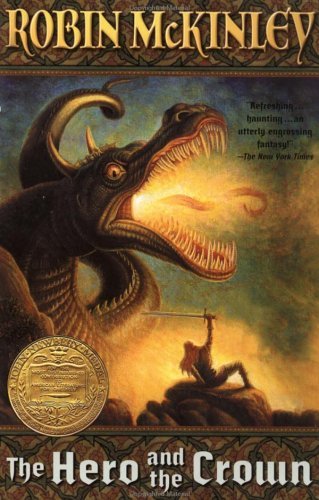
The first “fantasy” book I read was Robin McKinley “A Hero and the Crown” very quickly it and all the McKinley books I could find Beauty, Deerskin and the Blue Sword) became my go to books.
As well as the Tamora Pierce quartets (High School involved reading Alanna and then awaiting as Daine slowly came out)
And there was Patricia C. Wrede’s Enchanted Forest series which I discovered in the school library in 6th grade. This series maybe, perhaps, if I had to say, my favorite books ever (although I hate t o pic k because I love so many)
I never did read fantasy to escape. I always read it theologically. I read it to affirm the goodness of humanity and the human irrepressible & irrational endurance. I read it to see the abundance and presence of hope no matter how hard things get. I read it because I wanted to see people suffer challenges & loss and to know that it is all worth it, to see good triumph over evil. To me the happy-ever-after is guaranteed, but the work that is done to get there is what is truly important.
What I read…
Growing up I didn’t know fantasy existed–ok I knew, but not as a “genre” I just knew I liked that magic stuff….
One of the things I used to do was “read out” a book. That is reading a book so often that I had it practically memorized, and I was beyond reading it anymore–it was in my head forever.
The books that I read out and therefore molded me were…
Wrinkle in Time Quintent by Madeline L’Engle
Narnia series (read in the original publishing order Lewis was wrong to reorder)
Wizard of Oz (the 1st 7 I didn’t own the others)
The Hobbit
Laura Ingalls Wilder
Anne of Green Gables
Note how none of these were singular instead of the Hobbit….amazing how these books will forever be in my head….
We agree about pecans, but not about pastors
Here it is because Landon says it so well…:)
Prophecy
“I’m sorry, I’m a pastor, I tell the truth, its my job”
My defense for my prophetic, contextual and therefore offensive sermon about the Golden Rule telling everyone to love eachother (even if they are right and the other is wrong)
Think One Person Can Change the World?????
We do too

That’s where they got me. I mean I was pretty sure that Oberlin was the undergraduate program for me. I had talked to the dweeby guy, stood up to my counselor “You sure you want to move that far away” (um…DUH I hate high school), and all, but when I got the packet with Oberlin’s old motto, it got me.
I also probably should have realized that I was going to be a minister then, because I was kind of like one person has changed the world (ie Jesus) and he has totally empowered me to do the same
…ah the confidence of youth….
But if you know me, I am the eternal optimist, so I hopefully haven’t become too cynical since then, even though the world keeps on giving me worst and worst news….bad economy, little jobs, sucky compensation for work done, the evaporation of pension funds, the need to put off life (marriage, house, children etc) due to the aforementioned problems, wars, fiscal cliffs, national debts and taxes.
However I believe there has been a cultural shift in the last election–it hasn’t really to do with the president but more the fact that racism and bigotry has been limited due to the backlash for some representatives comments Re; gays, women, abortion, etc.
Part of that change was examined in my last post Open Source Culture (Go Millenials!)
Thanks to a recent conversation with my philosophical compadre Charlie, I have crystalized some of what I have been writing towards in the last couple of posts. (PS he totally pointed out that at least in a democracy we all have a vote that is value–talk about power)
Churches need to do the following to Change the World
Build a Community that
1. Forgives Debts: That’s right, be proactive, do a kickstart, open donations, find some way to address indidividual’s debts in your community–I suggest starting with student debt since that is the least questionable kind of debt. What if we as the church worked to communally Forgive as many debts as possible?
2. Be multigenerational: Church is one of the few places where different generations interact who are not related. Embrace this. Keep young people in church, give them a special space to be look at one example. If we make those connections that otherwise can’t be made, then we are providing a service. (and of course this means making worship accessible to those spiritual but not religious people).

3. Finally Educate, educate, educate. Why are people in debt? In pursuit of education. What if church’s provided free community education: relieving debt and bringing generations together in one fell swoop (HA, wouldn’t that be wonderful?) I would love to spearhead a million different educational opportunities for my community, because that is a concrete way of helping people.
THink one church can change the world????

Open Sourcing and Laziness
Ok, so what if this open source movement which started with the music companies and the digital downloading (actually it started with the record button on VCRs but I’m too young
to remember that). Was a cultural shift today? If you look at communities sharing businesses, etc. this generation is into open source
Examples include Relayrides, carsharing, CSA, community gardens, couchsurfing, firefox, anything Wiki and of course probably the most famous and one of the first Linux
Opensource means sharing information freely so that the community benefits. Granted making money by sharing your car isn’t a direct example of open source, but the free sharing of when you use and don’t use your car helps to free it up so others can use it (see what I mean). It also can hint at laziness because your are using someone else’s work/resources to get information. You didn’t do the work yet you get to benefit from it!
When it comes to Spirituality, my generation also tends to take a more open source perspective, enjoying all of the knowledge that comes from religion and then choosing what they want to practice (hence spiritual not religious can mean anything from a vague idea of God, to a number of spiritual practices that just to happen to exist via the church). I think this is a piece of culture of millennials that older people are missing. In fact there is a slight movement towards Open Source Theology/Christianity Read Landon Whitsitt’s book or blog(http://landonwhitsitt.com/2012/11/27/pecans-and-pastors-continued/) or checkout http://www.opensourcetheology.net/ and the Bible without Religion Project http://jimpalmerblog.com/rfv-bible-religion-free-version-by-jim-palmer/.
Which brings me to the “lazy” idea. There is this idea that unemployed people are lazy, and since roughly %40 of those who are unemployed are under the age of 30 I take great offense of this. Every single person I know is looking for a job, those who are employed are either underemployed or unable to make enough to support themselves/their families (this is esp. true for families where one spouse has found employment and the other is more limited in their geographical choices). It isn’t that we are lazy, its that we can’t find work, and we have to make do in the in-between. (And if you think people don’t want to be working, do me a favor and offer someone a job and see what they say)
In the meantime we are making do by sharing, by returning to trading times, goods and services for things instead of money. Something that started as an internet phenomenon (free information: its everywhere) became a necessity as we couldn’t get to work, and the reality that working harder has not meant that we do better/make more money or are more successful. Since we’ve seen through the promise of “work hard and you’ll succeed” (because that’s what we were told growing up).
If you mean we won’t work harder for little to no rewards, if you mean that we don’t have our eye on the prize, if you mean we are less possessive and are becoming instead an open source generation: then yes, I guess your right we are lazy Instead we are doing what we need to make ends meet and then using our extra time creatively.
But I, instead, see it as a cultural shift away from materials and valuing information, a place where timeand space are seen as more definitional than profession or monetary status. 
Yes, boredom helps creativity, and yes we as a generation are bored, there is little to no meaning in our lives, and all the things we were taught to strive for (no student debt, professional fulfillment, financial security) are inattainable–but that boredom is giving us creativity. And if that is a side effect to our so called laziness, I’ll take it.
I see this as a moment for change…
Go Laziness, Go Openness, Go Millenials, I wonder what we will do next
God Can’t work thru…
The next time you think that God doesn’t work through a president, an annoying person or a bad situation, remember all that God has worked through.
Noah drank
Rahab was not virtous
Saul persecuted
Christ was born in a manger
If you can’t see God in the picture, it is because you are too caught up in your human bubble–rest assured, God is there, and God will do amazing things you never even thought of