But Thomas

“But Thomas,” this phrase sticks with me. Poor Thomas was the exception, the one who missed it.

Maybe that makes sense though. It was Thomas who was the first one willing to risk going back to Judea, even tho they tried to stone him the last time he was there John 11: 7-16. No one wanted to return there, even tho Martha & Mary were begging Jesus to return and tend to their sick brother Lazarus. All the disciples wanted to avoid Judea from now on but Thomas, who was willing to die with Jesus, cannot believe he is alive.

And maybe its because Thomas was willing to die with him. Maybe Thomas was one of the clearest-sighted disciples about the danger they were in. Peter liked to talk big, Judas was mired in his own guilt, Mark was unaware of the big secret, but Thomas seemed to understand that death was real.

So all the disciples are gathered, why? To hide but Thomas was not locked in fear in the room, he was somewhere else. Clearly is not one of Thomas’ defining qualities. Perhaps we should refer to him as “Brave Thomas” instead of “Doubting Thomas.”

Then the disciples tell of what they say, they testify to the presence of Jesus. No doubt saying that his words were “Peace be with you” but Thomas cannot be at peace. Thomas needs to touch Jesus’ scars to believe its actually him.

All of the disciples have been breathed on the pneuma of the Holy Spirit, but Thomas. 

Thomas is one of the most constant texts of the church year. Without fail, every year, we are reminded of the story of Doubting Thomas. RCL and Narrative Lectionary collide giving the same story over and over again. Reminding us of our doubt.

But Thomas is the person who isn’t in the church today, for whatever reason. Its the person who stands outside the group. Its the forgotten one, its the person who is homebound, or too busy, or too overwhelmed to come to the group. This person is the wandering sheep (I hesitate to say lost, because I’m not always convinced that Thomas was truly lost or just waiting in his own way).

But Thomas could be argued to be the beginning of church. All the disciples had gathered, but Thomas wasn’t there, but Thomas wasn’t forgotten or left out. The disciples tried to tell him, but Thomas hadn’t had access to the Holy Spirit yet.

Recall, Jesus learns from this encounter, that all humans need access to the Holy Spirit. It isn’t until after this encounter that Pentecost happens. There is not church yet, just the understanding that there should be.

“How very good and pleasant it is when we live in unity” proclaims Psalm 133, but right here, in this moment, the church does not yet exist. Its good to live together, but we need the Holy Spirit to be able to do it.

Even then, we have trouble sharing and living in common with one another as is described in Acts 4. But we can, when we do church well, everything is shared, and there is not one person left out. When we do it well, we include the person who was gone.

In John 20, we see the church in action. Thomas is not left behind. Its not a “too late you lose” game. First the disciples try to include him, and when that doesn’t work, God acts. Jesus comes and personally works on Thomas’s heart. Jesus comes so that Thomas can truly taste and see the gospel truth that Jesus is the Risen Christ.

I would argue, in fact, that the gathering with Thomas is actually the first “church” gathering in the Bible. Full of the Holy Spirit, and witnessing, and the direct presence of Jesus Christ, this fellowship shows in full what the work of the church is going to be. And Thomas shows us how important that welcome and work is going to be. 1 John 1 puts it in formal languague, about gathering together and working on faith and sin as a fellowship of people, but John 20 is the story on which this is all based.

Also I always like to note that Thomas did not actually had to touch Jesus to believe that he was real. Once Jesus is there, once Thomas feels the Holy Spirit, all questioning is over. My guess is John is too busy hugging Jesus to worry about such things. Jesus says “Hey remember you wanted to touch these” but Thomas is too busy rejoicing. That’s how I picture Thomas, not touching the scars, but hugging the Jesus who he loves. Sadly its not depicted this way (look for pictures of them hugging, I have yet to find one). But in my head, this image of Jesus and Thomas hugging is the church illustrated in human flesh.

Brave Thomas

Here we are, back to one of the most preached texts, ever. And Thomas is here again, poking at our assumptions and asking all of the questions. In my mind Thomas is not “Doubting Thomas” but “Brave Thomas.”

The first time Thomas speaks is in John 11, when Jesus’s close friend Lazarus has died. The disciples do not want to return to Judea, because the disciples knew the town wanted to stone Jesus there. Thomas says bravely not only should Jesus go but also, “Let us also go, that we may die with him. “

This is doubly brave of Thomas, if indeed Thomas’s title “Twin” comes from the fact that he looks like Jesus’s Twin. (We don’t know, if Thomas is actually a sibling of Jesus, or any other disciple or if he looks like Jesus, but it is interesting that he is called Twin throughout the narrative) If Thomas looks like Jesus, this means he is putting himself doubly in danger by promising to go to Judea with him.

And this carries even further implications, because Thomas was not locked in the room with the scared disciples, when Jesus appears. It is very clear that Thomas does not like to stand around and wait for things. But again, if he looks like Jesus and is walking around after Jesus is crucified, he should be the most frightened disciple of all. Even if he just looks like another of the disciples, it’s pretty dangerous for him to be out and about during this tenuous time. This clearly does not bother Brave Thomas who eschews hiding in a room–and misses Jesus’s first appearance. 

Then Thomas asks for the same thing his friends, the other disciples got, a chance to see Jesus. And it is little wonder, that he says he wants to not only see Jesus and see him eat (to prove he is not a ghost), but really he wants to touch Jesus’s wounds. He wants to witness to the pain of his friend and teacher Jesus. 

Brave Thomas, wanting to fully know how his teacher was wounded, before he believes he is alive. Jesus appears and says “Peace be with you” and invites Thomas to do what he wants “Put your finger here and see my hands. Reach out your hand and put it in my side. Do not doubt but believe.” John 20:26-27 Thomas is not recorded having done any of that. He said he wanted to touch to believe, but apparently seeing was enough to believe. He goes into full confession mode and says “My Lord and my God!” John 20:28

Thomas is brave enough to face the consequences of following Jesus, more than once. And brave enough to admit he was mistaken about Jesus being dead and gone. And brave enough to declare his faith. So rests my case for calling Thomas, the twin, Brave Thomas.

Finally, an addendum. Jesus blesses those who believe without seeing, but note, John goes on to say Jesus performed many more wonders to get his disciples to believe. This line about believing without seeings seems to be a blessing to US the readers. For Jesus goes all out to convince his disciples so they might apostle and witness appropriately. The onus of believing without seeing lies on us, for “these are written so you might believe” John 20:31, which we can take as invitation to celebrate Easter all over again, as the disciples were able to.

Disability Glorified, A Prayer

Ableism kills,

Jesus you were not ableist.

What kind of diagnoses did your twelve disciples have?

Who limped, who was “ugly”

Who had voices, who had ADD or Autism or OCD?

….

As you healed and were asked,

What sin was committed that this person is blind?

The people asked, and, then our Savior said

None. Neither he nor his parents!

And then Jesus, you touched lepers,

those who were lame or blind or bled,

the poor, the oddly shaped and the dirty,

the ones who humans avoided even looking at–

because in our hearts of hearts,

we are so scared of disabilities that we avoid eye contact

afraid of catching it,

embarassed that we still

even today,

do not know how to interact

with people who exist differently than us.

—-

In some ways Jesus’s resurrection

might be the scariest thing of all.

Jesus you were young and healthy,

and died anyway, and the disciples

(of course) fled death.

Except for the women,

who probably had the most intimate

relationship with death and dead bodies.

…..

Jesus the Good News is not just that you returned

but you returned with holes in your arms and legs–

who were still wholly you, but unchanged.

You were still perfect, but your body was still yours!

What hope for those with disabilities.

It leads us to ask, are there wheelchairs and mobility aides in heaven?

Is it a place where your body is not weighty and there is no more pain,

but you are still you?

Are those with Dyslexia, ADD, OCD, Bipolar, Down Syndrome, Autism and more are–

Beloved and understood!

….

Jesus, I am so thankful that you got it,

that you get it,

that ableism kills

That you do not promise wealth and health!

That you do not need our bodies to be perfect for us to enter heaven–

You know Jesus I am not yet 40 and relatively healthy,

and I would definitely fail that test.

….

Jesus, I am thankful that as humans

make decisions that are more and more ableist

and fall more and more in the vein of a death cult–

(ignoring all those who aren’t fit or rich or whatever)

that I am hanging on

with every breath I take

that Jesus is not ableist.

….

And, maybe Thomas wasn’t either.

And as sure as the holes remained

in Jesus sacred body–

Holes that I am invited to touch

whenever I doubt or feel alone or scared of my own imperfections

I can breathe in

Jesus wasn’t ableist

and breathe out

And Jesus affirms all people.

..

Thank God for the Risen

holy, hole-y body!

Amen.

Feel free to use/adapt/share with credit to Pastor Katy Stenta

If you want to support my work, Please Contribute to my Doctorate in Ministry in Creative Writing at Pittsburgh Seminary. It is a degree as a Public Theologian!

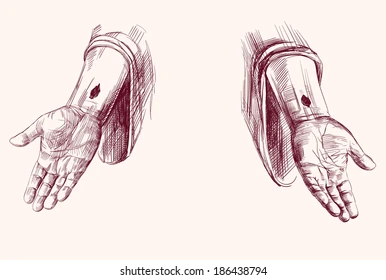
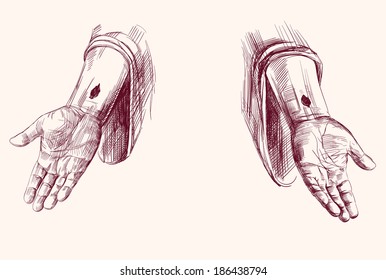
Image: https://image.shutterstock.com/image-vector/hands-jesus-christ-isolated-hand-260nw-186438794.jpg

April 24th Thomas: Disability Glorified

Sermon Ideas:

But Thomas

Brave Thomas

John 20:19-31

Psalm 145:13-21

Topical Prayer: Disability Glorified

Call to Worship

God we are ready to see you

So we think

God we want to see you

Be present with us here today

Call to Confession: God we are so glad Jesus is ready to hear our full selves. Come let us sit with Jesus and confess.

Confession: Jesus we confess that it is sometimes hard to believe that you will glorify all things. Sometimes the questions Thomas has about the holes in Jesus’s body, the questions about disabilities or differences or even the vast varieties that we see around us are just too much for our human brains to process. We confess that we are a lot like Thomas–we are often just not brave enough to voice our doubts and misgivings out loud. Forgive us, and remind us that you glorify all things, and somehow do not take away one iota of who we truly are. Remind us with the Holy Spirit we pray. Amen.

Assurance of Pardon: If Christ is for us, who can be against us? Know and feel and taste the truth on your tongue: In Jesus Christ we are forgiven.

Prayer of the Day/Dedication: Walk with us Christ, remind us when we falter or feel alone that you are with us we pray. Amen.

Children: Talk about what you think Thomas’s reaction was when he saw Jesus, it is not actually described. Did they hug? Did he actually put his hand through the holes? Did they cry?

Hymns: We Walk By Faith and Not By Sight, Invisible Immortal God Only Wise, Lift High the Cross, Christ is Made the Sure Foundation, God of Grace and God of Glory, Lord Whose Love through Humble Service

Please support my writing: Katy’s Doctorate in Ministry in Creative Writing at Pittsburgh Seminary. 

For Word versions of the Liturgy email me at Katyandtheword at gmail

From Lament to Hope Full Resources

I want Answers: a prayer

Lord, I confess that it would be a heck of a lot easier to throw up my hands and say God will provide.

It’s easy to look to heaven for answers, instead of grace. I’m a practically minded person, somedays solutions are all I want. Not hints or insights or learning journeys, a neon sign pointing to what I should do and how I should fix it seems easier.

Though I know this is easier, I also know you are a God who loves me and teaches me exactly the way I am. You do not force my hand, nor my choices. And the truth is, sometimes even when the solution is made obvious, I have trouble recognizing it until afterwards.

You have foresight, I am only blessed with hindsight.

Like Thomas, we think the solution is seeing to believe, and instead he ignore’s the wounds and give Jesus a hug.

This is why Acts is so important, because it’s only after the fact of Jesus’s Resurrection that they start to understand what it’s all about.

This is why Easter is not one day, because we need time and hindsight to truly act upon the commandments that Christ has given us.

Remind me Lord that this Unfolding Easter, this grace in action, this time to practice the kingdom over and over is a gift. And that solutions wouldn’t have helped me understand anyway.

For God is about love and grace and forgiveness, not solutions.

Because we are not a problem, we are the part of the relationship.

Remind me of this I pray.

Amen.

When in Doubt: Thomas Narrative Lectionary Prayer

John 20: 19-31 and Psalm 145: 13-21

Call to Worship: Lord we come to know you, So Lord we come to taste and see the kingdom through communion, Lord we are full of doubts, So Lord, we come to touch and believe that you are the crucified God, Lord we are full of worry, So Lord, let us confess together, here, that you are “My Lord and My God” today. 

Prayer of Confession: Lord we confess that we are much more likely to remember people’s moments of doubt, then their acts of belief. We call Thomas the doubting one, when he was the one cheered Jesus’s return to Lazurus, willing to risk stoning and death. Too often we worry about our doubts, instead of embracing our triumphs. Remind us, here and now, that you are our Lord and God in times of both doubt and certainty. Let us confess you as our Lord and God, even when we aren’t sure, we pray.

Assurance of Pardon: God is faithful in all God’s words,and gracious in all deeds.
The Lord upholds all who are falling, and raises up all who are bowed down. Therefore, we can be confident in the truth In Jesus Christ we are forgiven, Amen.

Prayer of Dedication/Offering Prayer Lord, let us go into the world, ready to find and hug Jesus. Do not allow doubt to be a stumbling block, but instead teach us how to share the love of Jesus Christ in such a way that all might hear it, so that we might be better dedicated to you we pray. Amen.

Prayers and Liturgy by Pastor Katy Stenta who is the solo pastor at a bigger on the inside church in Albany, NY and enjoys reading fantasy, soaking up sunshine, playing with her three sons and visiting her husband at his work, the library.