Bulletin 2: Passover by Pastor Katy Stenta

The Promise of Passover: Sermon & Bulletin 1 by Rev. Dr Barbara Hedges-Goettl, Bulletin 2 by Pastor Katy Stenta, Passover Prayer
Exodus 12:1-13; 13:1-8
Luke 22: 14-20 Opt Psalm 105: 31-36

Announcements 

Call to Worship

God called Abraham out of his homeland, and the Hebrews out of Egypt

Come Let us worship the Lord

God continues to call us out of where we are to who we should be

Come let us worship the Lord

All Creatures of Our God and Kings 455

All creatures of our God and King, Lift up your vote and with us sing; Alleluia! Alleluia!Thou burning sun with golden beam, Thou silver moon with softer gleam

Alleluia, Alleluia, Alleluia, Alleluia, Alleluia

Thou rushing wind that art so strong, Ye clouds that sail in heaven along; O sing ye Alleluia Thou rising morn, in praise rejoice, Ye lights of evening find a voice!

Thou flowing water, pure and clearMake music for thy Lord to hear; Alleluia! Alleluia! Thou fire so masterful and bright, That gives us both warms and light

Thou fertile earth, that day by day, Unfoldest blessings on your way; O sing ye! Alleluia! The flowers and fruits that in thee grow, Let them God’s glory also show! 

Exodus 12:11b-13:8

(1 finger) It is the passover of the Lord. For I will pass through the land of Egypt that night, and I will strike down every firstborn in the land of Egypt, both human beings and animals; on all the gods of Egypt I will execute judgements:

(2 fingers)  I am the Lord. The blood shall be a sign for you on the houses where you live: when I see the blood, I will pass over you, and no plague shall destroy you when I strike the land of Egypt. 

(3 fingers) The Lord said to Moses: Consecrate to me all the firstborn; whatever is the first to open the womb among the Israelites, of human beings and animals, is mine. 

(4 fingers) Moses said to the people, ‘Remember this day on which you came out of Egypt, out of the house of slavery, because the Lord brought you out from there by strength of hand; no leavened bread shall be eaten.

(Pastor Katy) Today, in the month of Abib, you are going out. When the Lord brings you into the land of the Canaanites, the Hittites, the Amorites, the Hivites, and the Jebusites, which he swore to your ancestors to give you, a land flowing with milk and honey, you shall keep this observance in this month. 

(5 fingers) For seven days you shall eat unleavened bread, and on the seventh day there shall be a festival to the Lord. 

(6 fingers) Unleavened bread shall be eaten for seven days; no leavened bread shall be seen in your possession, and no leaven shall be seen among you in all your territory. 

(7 fingers) You shall tell your child on that day, “It is because of what the Lord did for me when I came out of Egypt.” 

Children’s Sermon

Sermon                         God with the enslaved Pastor Katy Stenta

Live into Hope 332

Live into hope of captives freed, Of sight regained, the end of greed

The oppressed shall be the first to see, the year of God’s own jubilee

Live into hope the blind shall see, With insight and with clarity, 

Removing shades of pride and fear—A vision of our God brought near.

Live into hope of liberty, The right to speak, the right to be

The right to have one’s daily bread, To hear God’s word and thus be fed.

Live into hope of captives freed, From chains of fear or want or greed.

God now proclaims our full release, To faith and hope and joy and peace. 

Prayer of Confession: Lord God we confess that we are not where we should be right now. We get distracted by idols, we forget that God promises to free all of God’s children. We proclaim our liberty, and forget that you also commanded us to love one another, and gave us instructions how to save one another.  Help us to love and work to save one another, we pray.  Our Father who art in heaven, hallowed by Thy name. Thy kingdom come, Thy will be done on earth as it is in heaven. Give us this day our daily bread and forgive us our debts as we forgive our debtors and lead us not into temptation but deliver us from evil. For Thine is the Kingdom and Power and the Glory Forever. Amen.

Passing of the Peace

More Narrative Lectionary Resources

Passover Prayer

I see what you did there, God. All those years ago.

You put forth all the plagues: the bloods and the bugs and the frogs (or a giant frog depending how you translate it).

And when all of that was said and done. When Moses’ leadership alone wasn’t enough to set the Hebrews free–you required some participation.

You said, with arms outstretched, that if you want salvation, I’m going to need a little work and sacrifice from you people.

I imagine there might be some Godfearers in Egypt–some friends–who also put the sign of God upon the door. I imagine there was grace there that is as of yet unknown.

And I wonder, God, if the method to this was the foretaste of the work to come. The understanding that Moses could lead all he wanted but without the people, nothing would happen.

What a great precursor to Jesus who stands with an open hand for our salvation–and at the same time forces no one and waits for our participation.

God is always with us, but are we able to see it?

Lord, how can I participate in my own salvation? How can I help others paint their doors with the sign of God?

Image from Prince of Egypt from here

In an era where we continue to think it’s every person for themselves, I’m praying that you show us how to be more like the people in Exodus–who although they complained every step of the way, and fumbled and made mistakes. In the end they understood that my freedom is wrapped up in yours.

Lord teach us to be safe and free, teach us how to love and serve one another. Help us to participate in our own Passover today. Not because we are better than anyone else, but because we want every single person who can be saved, to be saved.

I pray this is your most holy name. Amen.

More Narrative Lectionary Resources

Bulletin: The Promise of Passover

The Promise of Passover: Sermon & Prayer
Exodus 12:1-13; 13:1-8
Luke 22: 14-20 Opt Psalm 105: 31-36

Sermon by Rev Dr. Barb Hedges-Goettl

More Narrative Lectionary Resources

Prelude Song of Freedom             Bing Crosby from Holiday Inn https://youtu.be/HldLDqMQcQw

Opening Prayer                        Rev. Dr. Barb Hedges-Goettl 


God, just as You rescued the people of Israel from slavery in Egypt, setting them free to worship and serve You, so You have also rescued us, setting us free from slavery to sin and selfishness, and inviting us into relationship with You and one another,and so we praise and thank you. Amen. (1)

Call to Worship

When you set us free, O God, we are free indeed.

O God, we rejoice in your freedom.

A freedom which transforms us and the world around us.

O God, we rejoice in your freedom.

A freedom that invites us to intimacy with you.

O God, we rejoice in your freedom.

A freedom that demands action.

O God, we rejoice in your freedom.

A freedom that makes us different—like in Christ instead of the world.

O God, we rejoice in your freedom.

A freedom that invites us out of the norm and into the extraordinary.

O God, we rejoice in your freedom. (2)

Hymn: The Day of Resurrection 

Call to Confession                                Rev. Dr. Barb Hedges-Goettl

We recognize our responsibility not only for our immediate family and our own people, but for all humankind. As long as nation lines up against nation and class lines up against class, as long as oppression and injustice weigh down the lives of our fellow human beings, as long as there is poverty, disease, ignorance, crime and war, our conscience cannot be at ease. (3)

Gloria Patri: (Blue #579) Glory Be to the Father https://www.youtube.com/watch?v=QUBxpypSblw

Hymn of Dedication  Love Divine, All Loves Excelling https://youtu.be/6oM1NZ9YSnw

* Doxology (Blue, #592)   Praise God, from Whom All Blessings Flow https://www.youtube.com/watch?v=ivaDXu27_IY

* Prayer of Dedication  

O God, by this offering we remember the lamb without blemish offered at the first Passover–and on the cross. Join our offerings and our selves to the gifts of your people and the self-offering of Jesus himself. (4)

Charge & Benediction

(1) Adapted from a prayer by Christine Longhurst from https://re-worship.blogspot.com/2011/08/prayers-of-people-september-4-2011.html

(2) Adapted from Reformation Worship, copyright Lisa Frenz. Posted on Lisa’s Liturgies. https://sites.google.com/site/lisasliturgies/home 

(3) Adapted from an English version of a Hebrew prayer of confession found at https://www.oztorah.com/2009/09/confession-of-sins-a-liturgical-commentary/#.X2fHN2hKjIUf

(4) Adapted from a prayer by https://www.umcdiscipleship.org/worship-planning/through-the-wilderness/fourteenth-sunday-after-pentecost-year-a-lectionary-planning-notes/fourteenth-sunday-after-pentecost-year-a-offertory-prayers

More Narrative Lectionary Resources

Sermon: Passover

Rev. Dr Barb Hedges-Goettl

The book of Exodus, telling the story of the freeing of God’s people from slavery, begins about four hundred years after the story of Joseph, saying: “Now a new king arose over Egypt who did not know Joseph.” This new king, as you may recall, feels threatened by the Hebrew people who have grown great in numbers, and he seeks to subdue them. He enslaves them and then embarks on a campaign to break them by increasing their workload and punishments. When this doesn’t work, he orders that all newborn Hebrew male babies be drowned in the river.

This is when Moses’ mother puts him in a basket and floats him down that same river, where the pharaoh’s daughter rescues him. She even hires Moses’ mother to be his wet nurse! After he is raised by the daughter of the pharaoh, Moses kills an Egyptian who was beating an Israelite-a death penalty crime. He flees to Midian, where he marries Zipporah. Through the miracle of the burning bush, God calls Moses to return to Israel to free the Hebrew people from slavery. But Pharaoh does not listen to Moses, and Egypt is subjected to nine plagues: the water was turned to blood; then there were frogs, lice, flies, diseased livestock, boils, a thunderstorm of hail, locusts and darkness for three days. And now, as described in today’s passages about the Passover, the tenth plagues: the death of the firstborn of all living things. 

This particular plague echoes the killing of all of the male children of the Hebrews ordered by the pharaoh. By the deaths of the firstborn among the people and the animals, God upends the power of pharaoh. By passing over the houses of the Hebrew people marked by the blood of the Lamb, God indicates who his people are. And the pharaoh finally (momentarily) relents and lets God’s people go only to try to chase them down to bring them back, resulting in the drowning of the Egyptian army in the Red Sea.

Jesus’ actions at the Last Supper, depicted in the gospels of Matthew, Mark and Luke as taking place at the time of the Passover, resound loudly here. Jesus takes the role of the Passover Lamb, providing the blood that makes God pass over our sins. 

The upshot of both the story of the Exodus, and of Jesus at the Last Supper, is that God is the God of freedom. God is about the business of freeing God’s people. That freedom is not limited to people’s spirits, but includes freeing people from all kinds of oppression.

God stopped the genocide of the Hebrew people and then freed them from their oppression. God demands justice for those who do not have power: for the widows, the orphans, the strangers, the poor. God takes action on the side of the oppressed against the powerful, confronting those who sit in power.

While the phrase “speaking truth to power” was part of the Quaker call to non-violence in the 1950s, you could say this is something the prophets have done all along—and it is what Moses did when he said, “Let my people go.” 

Belonging to God means serving as God’s voice,                                                                   joining Moses in saying, “Let my people go,”                                               raising up issues of oppression and injustice wherever they arise.                   Serving God means serving, as Jesus said, “the least of these.”

How do we serve God by serving the least of these? 

    Serving starts by listening

(When Len was in his first pastorate, we got a phone call from a lady who said “Is this the pastor who listens?”—a feat so rare that it brought a stranger to us via the telephone. 

    Listening means that I do not tell you what your experience is

    I let you tell me what your experience is

    The fact that it’s different from mine reinforces that it’s your       experience    

Listening means I don’t necessarily try to solve your problem, esp. if that is not what you are asking me to do. Listening may just mean—listening. 

That’s a hard one for me—our kids know if they want a list of suggestions, call Mom. If you want someone to just listen, call Dad.                                                 

Can I say, “Do you want to know what I think?” and accept if the person says no?

A Korean-born friend of mine recently (once again) went through a set of circumstances in which she was ignored

The professional accomplishments she reported were not included in the newsletter

The gift from the company for those working at home was not sent to her house

The donations list put down her donation as 1/5 of what she’d given

And while she has been asked to serve on her company’s committee to address racism, she feels, especially in light of her experiences, that this means she is being asked to solve something over which she has no power.

But when she raises this list of occurrences, she is told that these are just details and that nothing was meant by it. She is, essentially, told that her experience is not valid; that no one wants to hear it and she should get over it. 

But the devil is in those details

    The very act of dismissing her experience is itself oppressive

The inability to hear her pain is itself an indication of how far astray the system has gone

We didn’t mean it, so you shouldn’t be hurt

But if they didn’t mean it, why don’t they fix it? Why don’t they change things?

When we are little, we are taught, 

what do you say when you hurt someone? 

And, even more so,                                                                                       what do you say when you hurt someone accidentally?

But we can’t, we don’t, do it

Instead we tell the one who is hurt                                                

that they are wrong, they aren’t hurt, 

that it doesn’t count, 

that it doesn’t or shouldn’t matter, 

that they are making a stink over nothing, 

that they should get over it, 

that they should say it better, differently, at another time, to another person because right now we just want them keep quiet, to shut up, about it.

When we do these things, how can we argue that we are on God’s side? 

How do we (better) serve 

the God who hears the people’s cry, 

the God who frees his people? 

For all God’s people to be free, we should listen to all God’s people

Instead of pre-judging your experience to make it fit what I already think, 

I can listen–

I can listen—we can listen even when we don’t want to hear

Actually, that is the most important time to listen

    Because it means we are being told something 

we won’t discover on our own, 

because we don’t/can’t/won’t see it.

God calls the Israelites to remember

                      to celebrate Passover

                to teach the children

                to be compassionate to the strangers among them

Being compassionate to those who are hurting means listening   

When someone talks about sexual abuse or sexual harassment

we can listen

When someone talks about the challenges and problems of police work

we can listen

When someone talks about police brutality and oppression, 

we can listen

When someone talks about being white in America, 

we can listen

When someone talks about being a minority in America, 

we can listen

When someone talks about being sick, we can listen.

When someone talks about being old, we can listen.

When someone talks about being poor, we can listen

When someone talks about what they need, we can listen.

No, really, we can!

In addition to listening, I am doing some little thin. 

One of the things I am doing is wearing my new justice T-shirts

In support of black people who are experiencing racism

When I’m deciding whether or not I want to wear those T-shirts,

I realize, isn’t it nice to be able to decide?

Aren’t I privileged that I can decide that today I don’t want to deal

with injustice, with equal rights, with standing up for others

People of color don’t get to choose not to deal today

Every day, everywhere they go, racism may greet them

    But I can decide I just don’t want to go there today

When I say I am doing “little things,” in part what I mean is 

that I have found some things I can do and I am doing them. 

I am doing these little things to try to make the world better.

And if lots and lots of people do little things, they add up…

After you have listened, find one little thing to do in solidarity with others

And do it.

Because, like my Asian friend noted, 

    Racism has to be solved by everyone

    And especially by those for whom race isn’t usually an issue

In solidarity with those who don’t get to choose if today                                                                                 they want to go there/be there/address this or not 

And the God of freeing the slaves in Israel be with you and empower you. 

Let us pray…

Bible full of Nobodies

God, in your might and power you gave us a book that tells us truth through a bunch of nobodies.

When you tell the story of Hagar, Shiphrah & Puah, the Sultan’s daughter, Miriam and Zipporah you tell us about the “little people” in the world. We don’t even know the name of the Pharaoh’s daughter!

When you reveal the energy, intelligence, imagination and love of Ruth & Naomi and also Esther you report the profound sacredness of the lives of women of color.

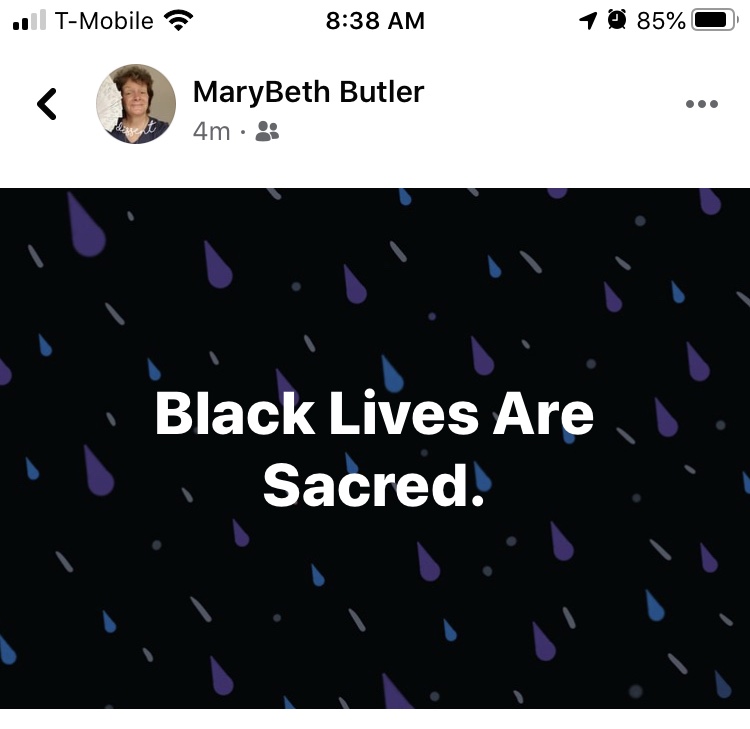
“Black Lives are Sacred” attributed to Dr Wil Gafney

Because of these women we stand in prayer every single time we tell the story of persecuted black women, women of color and trans women who are black or brown.

And because women throughout the Bible are unnamed we know, we know the importance of #sayhername.

Breonna Taylor we say your name Oluwatoyin Sakai, Atatiana Jefferson, Latasha Harlins and Sandra Bland we say your name and pray.

And because we know there are even more women who are unnamed victims of police violence, healthcare violence, sexual violence and state violence perpetrated through powerfully neglectful pandemic policy.

The true nobodies in the Bible are those in power kings, pharaohs and religious leaders serve as footnotes to the real everyday lives of the “ordinary” somebodies in the Bible.

As these stories and names echo in my head in between distance learning and working and running errands, help me to take these echoes seriously.

Help me to take each and every echo, and to find the ways to tell these stories to my children, just like the stories in the Bible.

Help me to tell the story meaningfully, fleshing out my black and brown sisters and humans who are fully of life and value. Help me to tell the stories in such a way that they matter.

And empower me to see and stop racism and violence in all of its physical, emotional and political forms, I pray. Make me an interrupter of violence.

I pray this in the presence of the brown, persecuted, imprisoned and murdered man who I am honored to be an adopted sister of, Jesus Christ. Amen.

Feel free to use/adapt with credit to Pastor Katy Stenta

Bulletin 2 by Pastor Katy Stenta

Drive in Worship September 20th 2020
Announcements
Call to Worship
Give thanks to the Lord and Call on the name of God
Let the hearts of those who seek the Lord Rejoice

Spirit 319
Spirit, Spirit of gentleness,
Blow through the wilderness, calling and free
Spirit, Spirit of restlessness, Stir me from placidness,
Wind, Wind on the sea

  1. You move the waters,You called to the deep
    Then You coaxed up the mountains
    From the valleys of sleep And over the eons
    You called to each thing, Awake from your slumbers
    And rise on your wings
  2. You swept through the desert, You stung with the sand
    And You gifted your people, With a law and a land
    And when they were blinded with their idols and lies,
    Then You spoke through Your prophets
    To open their eyes
  3. You call from tomorrow, You break ancient schemes,
    From the bondage of sorrow. The captives dream dreams
    Our women see visions, Our men clear their eyes.
    With bold new decisions, Your people arise.

Genesis 37:20-28, 50:15-21
(1 finger)’Here comes this dreamer. 20Come now, let us kill him and throw him into one of the pits; then we shall say that a wild animal has devoured him, and we shall see what will become of his dreams.’
(2 fingers)’but when Reuben heard it, he delivered him out of their hands, saying, ‘Let us not take his life.’
(3 fingers) Reuben said to them, ‘Shed no blood; throw him into this pit here in the wilderness, but lay no hand on him’—that he might rescue him out of their hand and restore him to his father.
(4 fingers) Then Judah said to his brothers, ‘What profit is there if we kill our brother and conceal his blood? 27Come, let us sell him to the Ishmaelites, and not lay our hands on him, for he is our brother, our own flesh. And his brothers agreed.
(5 fingers) When some Midianite traders passed by, they drew Joseph up, lifting him out of the pit, and sold him to the Ishmaelites for twenty pieces of silver. And they took Joseph to Egypt.
(Pastor Katy) Joseph was enslaved, abused by his owner’s wife and eventually imprisoned. There he told the prisoners who would be punished and set free according to their dreams. Eventually the Pharaoh heard and freed him, listening to the dreams of Pharaoh Joseph foretold a drought, so that only Egypt was ready for it. For this reason, Joseph’s brothers journeyed to Egypt for food.
(6 fingers) Realizing that their father was dead, Joseph’s brothers said, ‘What if Joseph still bears a grudge against us and pays us back in full for all the wrong that we did to him?’
(7 fingers) So they approached* Joseph, saying, ‘Your father gave this instruction before he died, 17“Say to Joseph: I beg you, forgive the crime of your brothers and the wrong they did in harming you.” Now therefore please forgive the crime of the servants of the God of your father.’
(8 fingers) Joseph wept when they spoke to him.
(9 fingers) Then his brothers also wept,* fell down before him, and said, ‘We are here as your slaves.’
(10 fingers) But Joseph said to them, ‘Do not be afraid! Am I in the place of God? 20Even though you intended to do harm to me, God intended it for good, in order to preserve a numerous people, as he is doing today. 21So have no fear; I myself will provide for you and your little ones.’ In this way he reassured them, speaking kindly to them.

Children’s Sermon

Sermon “God with All of Us” Pastor Katy Stenta

God, only you would bring a feuding family together and find a way to bless and reunite them. As we live with suspicion and in a divided nation, we pray that you teach us how to be gracious and forgiving. We pray that we don’t refuse to help one another out of prejudices or hate, and we pray that you order all things for good. We pray this using the prayer your son taught us. Our Father who art in heaven, hallowed by Thy name. Thy kingdom come, Thy will be done on earth as it is in heaven. Give us this day our daily bread and forgive us our debts as we forgive our debtors and lead us not into temptation but deliver us from evil. For Thine is the Kingdom and Power and the Glory Forever. Amen.

O God of Every Nation 289

  1. O God of every nation, of every race and land
    Redeem the whole the creation with Your almighty hand
    Where hate and fear divide us And bitter threats are hurled
    In love and mercy guide us And heal our strife torn world
  2. From search for wealth and power and scorn of truth and right
    From trust in bombs that shower destruction through the night
    From pride of race and station and blindness to Your way
    Deliver every nation, Eternal God we pray.
  3. Keep bright in us the the vision of days when war shall cease
    When hatred and division, Give way to love and peace
    Till dawns the morning glorious When peace on earth shall reign
    And Christ shall rule victorious O’er all the world’s domain

Bulletin 1 by Rev. Dr Barb Hedges-Goettl, God of the Rainbow Coat Prayer, More Narrative Lectionary Resources

Bulletin 1 with Sermon

More Narrative Lectionary Resources

Prelude Arise, Your Light is Come
https://youtu.be/pDLOLH6LhaI?list=TLPQMTMwOTIwMjDl93yM-R7ESA

Opening Prayer (1)
Light-giving God, We lumber together in hope as Your church to lift Your Light. Let us lift not the light of our congratulation of ourselves, not the light of belief in our own superiority, not the light of our belief in our own narrow presuppositions, not even the light of our own church.
 
Let us lift the light from You, the light of the power You make known to us
in the truth of our powerlessness, learning to be at ease with You.
 
Let this be the light we lift as a beacon in the darkness we know best.
As we lift that light, may we too be lifted to know
the true power that lies among us
waiting to rise as a beacon of our true hope. Amen.

Call to Worship (from 1 John 1) (2)
5 This is the message we have heard from him and proclaim to you:
God is light and in him there is no darkness at all. 
6 If we say that we have fellowship with him while we are walking in darkness, we lie and do not do what is true.
God is light and in him there is no darkness at all. 
7 but if we walk in the light as he himself is in the light, we have fellowship with one another, and the blood of Jesus his Son cleanses us from all sin. 
God is light and in him there is no darkness at all. 
Let us worship and live together in the light.

Hymn: Joyful, Joyful, We Adore Thee
https://www.youtube.com/watch?v=otm_o8ZQpXA

Joyful, joyful, we adore Thee, God of glory, Lord of love;Hearts unfold like flow’rs before Thee, Op’ning to the sun above.Melt the clouds of sin and sadness; Drive the dark of doubt away;Giver of immortal gladness, Fill us with the light of day!
All Thy works with joy surround Thee, Earth and heav’n reflect Thy rays,Stars and angels sing around Thee, Center of unbroken praise.Field and forest, vale and mountain, Flow’ry meadow, flashing sea,Singing bird and flowing fountain Call us to rejoice in Thee.
Thou art giving and forgiving, Ever blessing, ever blest, Wellspring of the joy of living, Ocean depth of happy rest!Thou our Father, Christ our Brother, All who live in love are Thine;Teach us how to love each other, Lift us to the joy divine.

Call to Confession 1 John 3:9
9 If we confess our sins, he who is faithful and just will forgive us our sins and cleanse us from all unrighteousness. 

Prayer of Confession
O God, at times our actions contradict the fact that we are your people, revealing that we are more interested in ourselves than in others. Forgive us, Lord.
Our words themselves can increase the distance between “us” and “them,” forgetting we are all made in your image.
Forgive us, Lord.
In our church, we can care too much for getting our own way and not enough for hearing and supporting one another.
Forgive us, Lord.
At home, we can show our worst selves, especially in these times of stress and too much togetherness.
Forgive us, Lord.
In private, we can forget that you love us and that we can trust you with our darkest thoughts and deepest hurts.
Forgive us, Lord.

(Silent Confession)

Assurance of Forgiveness 1 John 2:1-24
If anyone sins, we have an advocate with the Father, Jesus Christ the righteous; 2 and he is the atoning sacrifice for our sins, and not only for ours, but also for the sins of the whole world. Thanks be to God for the Good News: In Jesus Christ, we are forgiven
(Silent Confession)
Gloria Patri: (Blue #579) Glory Be to the Father https://www.youtube.com/watch?v=QUBxpypSblw Sharing of the Peace: The peace of Christ be with you. And also with you.
Prayers of the People/Lord’s Prayer (traditional)
Celebration of Birthdays and Anniversaries 9/27 Jane

Hymn of Dedication Jesus, Thy Boundless Love to Me
https://www.youtube.com/watch?v=DVc5TrnEwhQ
1 Jesus, Thy boundless love to me, no thought can reach, no tongue declare;
O knit my thankful heart to Thee, and reign without a rival there.
Thine wholly, Thine alone, I’d live Myself to thee entirely give
2 O grant that nothing in my soul
may dwell, but Thy pure love alone!
O may Thy love possess me whole, my Joy, my Treasure, and my Crown.
All coldness from my heart remove; may ev’ry act, word, thought, be love.
3 O love, how gracious is thy way!
All fear before thy presence flies;
care, anguish, sorrow, melt away, where’er thy healing beams arise.
O Jesus, nothing may I see, nothing desire or seek, but Thee.

In a world of give and take, in a culture of mend and break,
give us minds, hearts, hands, and wallets for sacrificial care,
to satisfy hunger and thirst everywhere. These gifts, our prayers
and our very selves we offer in the name of Love himself, Jesus the Christ and by the power of the Holy Spirit, Amen.

Prayer for Illumination Be Thou My Vision
https://www.youtube.com/watch?v=yLr1XrX3a1E
Be Thou my vision, O Lord of my heart;
Nought be all else to me, save that Thou art
Thou my best thought, by day or by night,
Waking or sleeping, Thy presence my light.

First Reading: Genesis 37 selected verses4
Second Reading Genesis 50:15-214

Message About That Forgiveness Thing

Confession of Faith Adapted from the Second Helvetic Confession
True repentance is conversion to God. True repentance is a sincere turning to God and to all good. True repentance is an earnest turning away from the devil and all evil. True repentance is a sheer gift of God. True repentance is not a work of our strength. Now that sinful woman who washed the feet of the Lord with her tears showed true repentance. And Peter who wept bitterly and bewailed his denial of the Lord showed true repentance. The mind of the penitent who seriously who laments the sins committed shows true repentance. Moreover, the prodigal son showed true repentance when he said “ ‘Father, I have sinned against heaven and before you; I am no longer worthy to be called your son; treat me as one of your hired servants” The tax collector in the Gospel, and not the Pharisee, showed true repentance when compared with the Pharisee, showed true repentance when he said, “God be merciful to me a sinner” And the truly repentant are accepted by God into grace. For the apostle John says: “If we confess our sins, he is faithful and just, and will forgive our sins and cleanse us from all unrighteousness. If we say we have not sinned, we make him a liar, and his word is not in us” Thanks be to God.
*Closing Hymn Jesus, Thou Joy of Loving Hearts
https://youtu.be/jsqHOt29_48?t=36
Jesus, Thou Joy of loving hearts, Thou Fount of life, Thou Light of all,From the best bliss that earth imparts, We turn unfilled to heed thy call.
Thy truth unchanged hath ever stood;Thou savest those that on Thee call;To them that seek Thee Thou art good,To them that find Thee all in all.
Our restless spirits yearn for Thee,Wherever our changeful lot is cast;Glad when Thy gracious smile we see,Blessed when our faith can hold Thee fast.
O Jesus, ever with us stay,Make all our moments calm and bright;Chase the dark night of sin away,Shed over the world Thy holy light.
*Charge and Benediction

Postlude Be Thou My Vision Glad
https://youtu.be/nPLcOlg0PWo

Old Testament Reading Genesis 37iii selected verses Dan Smaczny
3 Now Jacob loved Joseph more than any other of his children, because he was the son of his old age; and he had made him a coat of many colors. 4 But when his brothers saw that their father loved him more than all his brothers, they hated him, and could not speak peaceably to him.
5 Once Joseph had a dream, and when he told it to his brothers, they hated him even more. 6 He said to them, “Listen to this dream that I dreamed. 7 There we were, binding sheaves in the field. Suddenly my sheaf rose and stood upright; then your sheaves gathered around it, and bowed down to my sheaf.” 8 His brothers said to him, “Are you indeed to reign over us? Are you indeed to have dominion over us?” So they hated him even more because of his dreams and his words.
17 Joseph went after his brothers, and found them at Dothan. 18 They saw him from a distance, and before he came near to them, they conspired to kill him. 19 They said to one another, “Here comes this dreamer. 20 Come now, let us kill him and throw him into one of the pits; then we shall say that a wild animal has devoured him, and we shall see what will become of his dreams.” 21 But when Reuben heard it, he delivered him out of their hands, saying, “Let us not take his life.” 22 Reuben said to them, “Shed no blood; throw him into this pit here in the wilderness, but lay no hand on him”—that he might rescue him out of their hand and restore him to his father.
26 Then Judah said to his brothers, “What profit is it if we kill our brother and conceal his blood? 27 Come, let us sell him to the Ishmaelites, and not lay our hands on him, for he is our brother, our own flesh.” And his brothers agreed. 28 When some Midianite traders passed by, they drew Joseph up, lifting him out of the pit, and sold him to the Ishmaelites for twenty pieces of silver. And they took Joseph to Egypt.
29 When Reuben returned to the pit and saw that Joseph was not in the pit, he tore his clothes. 30 He returned to his brothers, and said, “The boy is gone; and I, where can I turn?” 31 Then they took Joseph’s robe, slaughtered a goat, and dipped the robe in the blood. 32 They had the coat of many colors taken to their father, and they said, “This we have found; see now whether it is your son’s robe or not.” 33 He recognized it, and said, “It is my son’s robe! A wild animal has devoured him; Joseph is without doubt torn to pieces.” 34 Then Jacob tore his garments, and put sackcloth on his loins, and mourned.
Second Reading Genesis 50:15-21 Rev. Dr. Len Hedges-Goettl

(3) And the brothers seeing that Joseph’s father was dead, are saying “Suppose Joseph is holding a grudge against all of us and will reverse all the evil we visited upon him against all of us.” So they demanded a messenger to go to Joseph to say “Your father commanded before he died saying ‘Please forgive your brothers and their sins for they did evil to you and now I pray, please forgive the transgressions of the servants of the God of your father’”

And Joseph was weeping when they spoke to him.
And his brothers falling on their faces before him said, “Behold, we are servants to you.”

And Joseph replied, “Don’t fear me, am I in the place of God? But as for you, you meant it for evil but God devised it for good. God brings to pass this day the good to keep many people alive. Now, therefore, fear you not;
I will nourish you and your little ones.” And Joseph comforted them and spoke kindly to them.

Sermon: Dr. Len Hedges-Goettl

As we have noted in the past, we are following the series of scriptures suggested by the narrative lectionary instead of what is called the Common Lectionary. In my years of preaching, I often wondered why the Joseph story, that we typically get taught in Sunday school, is not included for preaching in the Common Lectionary… especially since I use the Joseph story often when I doing therapy, especially when am treating abuse survivors.
Joseph is kind of the ultimate abuse story. Joseph is not only abused physically and emotionally, but that abuse is all the more horrible because it is at the hands of the family that is supposed to love and protect him. It is the breaking of trust by those who are supposed to be the most trustworthy, the folks who are supposed to “have is back.” Joseph goes on to be sexually abused by Potiphar’s wife and then gets blamed even though he was the victim and he gets imprisoned by the Pharaoh, but none of these terrible experiences destroy is trust as much as the betrayal by the ones who were suppose to love him. Did you notice the parallel when the brothers got 20 pieces of silver for betraying Joseph and when Judas got 30 pieces of silver for betraying Jesus? So one expects Joseph to never trust anyone again, especially his brothers.
So chapter 50 comes as something of a surprise, at least to me, when Joseph’s father has died and is buried and the brothers must face Joseph after all the dust has settled. You probably remember that Joseph more than put his life back together and was in charge of all the food that Egypt needed and that his brothers and their families needed in a time of famine. Joseph was being asked to be compassionate to the ones who abuse and betrayed him.
If we carefully read the Hebrew when the brothers return following the funeral of their father, we notice some very telling details. The inevitable confrontation between Joseph and his brothers is the climax to the story and the brothers just know they are really in for it now. Joseph has the power. Joseph has the food they desperately need. And Joseph knows full well how terribly they treated him. Their only concern is the revenge Joseph could now take on them without their father around to protect them.
Many commentators for this scripture jump to the conclusion that this is an excellent example of forgiveness and reconciliation. Thankfully, at least one commentator agreed with my reading of the text. The brothers were cowards afraid because the one they harmed so grievously now had power to harm them. The did NOT say they were sorry for their behavior. They did not even take responsibility for their behavior. They did not identify themselves as sons of Joseph’s father but kept leaning on the wishes of “Joseph’s father,” as if they weren’t even part of the family. Joseph was supposed to forgive them, not because they confessed their sin and repented of their behavior but because of some command that they say “Joseph’s father” made when “Joseph’s father died.”
Barb said I should tell the story about her mother whose words seldom took responsibility for her actions when things went wrong. She might say “someone” forgot to do a thing, vaguely noting the offense but not the offender. She also typically refused to acknowledge what is called agency, that is when a person causes something to happen and takes responsibility. She would say “the glass broke” or “the milk spilled” as if it happened without any person involved. I really don’t remember her saying “I broke this” or “I did that.” Since things apparently “just happened” without anyone being responsible, she never had to apologize!
Joseph’s brothers act as if things “just happened” to Joseph, they don’t accept responsibility even though they fear Joseph’s revenge.
So the brothers press Joseph to forgive them not because they are sorry, not because they apologized, not because they repented of their actions, but because “Joseph’s father” not their father but “Joseph’s father” said Joseph should forgive them. Repenting from our behavior means we
acknowledge that we are responsible for what we have done
apologize and ask for forgiveness (not just say you ought to forgive without me being sorry)
repent from our bad behavior. Repent is a Hebrew word meaning to turn away from one thing and turn toward another… to turn away from bad behavior and turn toward good behavior from then on.
And Joseph’s response is startling! Well, it is not so startling that he begins by weeping. The hurt caused by his brothers was so deep and they stirred up the memory of all that hurt without taking responsibility and without repenting and without even asking for forgiveness themselves. Who wouldn’t weep if we demanded an abused person to just go ahead and forgive someone who doesn’t even try to apologize?
But then Joseph responds: Don’t be afraid. You meant it for evil but God used it for good. He then asks: Do you think I am taking God’s place? Joseph likely could not forgive his brothers. Why not? Let’s think about the call to confession today used from 1 John.
If we confess our sins, he who is faithful and just will forgive us our sins and cleanse us from all unrighteousness
God is perfectly willing, in fact God is aching to forgive our sins…IF… we confess our sins. Full confession of sin means acknowledging and taking responsibility for what we have done, being sorry for what we have done, and turning from bad behavior toward good behavior. I wonder sometimes if God gets impatient with us or if God is just sad and yearning as God waits for us to fully confess so that at last God’s forgiveness can occur.
The brothers did NOT confess their sins against Joseph. If God does not forgive without full confession, why would we expect Joseph to forgive? He probably ached for his brothers to accept responsibility, ask forgiveness and repent of their behavior. Perhaps even like God, Joseph longed to forgive and be reconciled with his brothers.
But before we get too shocked by this lack of forgiveness, lets also look at Joseph’s behavior toward his brothers in the absence of forgiveness. Despite the deep hurt, Joseph nourished his brothers and their little ones. Joseph comforted them and spoke kindly to them.
When someone hurts us, even if the hurt is not at the level of abuse, we want them to change, to apologize, to make things right with us. And it can be so unnerving if they won’t even take responsibility for their actions. But like Joseph, our response should not be a response of revenge. And our response should not be some fake effort to forgive when they have not done their part to make forgiveness possible. But like Joseph, perhaps our response could be to show the love and compassion… the grace… the thing they don’t deserve even if they don’t do a full confession. Like Joseph we could feed their needs and the needs of their family anyway. Like Joseph we could comfort them and speak kindly to them. Because the grace Joseph shared, the grace we might share, is tiny compared to the grace God shares with us in our own sinfulness…every single day.
God is faithful and just and so full of grace… may we be likewise. Amen.

And the brothers seeing that Joseph’s father was dead, are saying “Suppose Joseph is holding a grudge against all of us and will reverse all the evil we visited upon him against all of us.” So they demanded a messenger to go to Joseph to say “Your father commanded before he died saying ‘Please forgive your brothers and their sins for they did evil to you and now I pray, please forgive the transgressions of the servants of the God of your father’”

And Joseph was weeping when they spoke to him.
And his brothers falling on their faces before him said, “Behold, we are servants to you.”

And Joseph replied, “Don’t fear me, am I in the place of God? But as for you, you meant it for evil but God devised it for good. God brings to pass this day the good to keep many people alive. Now, therefore, fear you not;
I will nourish you and your little ones.” And Joseph comforted them and spoke kindly to them.

As we have noted in the past, we are following the series of scriptures suggested by the narrative lectionary instead of what is called the Common Lectionary. In my years of preaching, I often wondered why the Joseph story, that we typically get taught in Sunday school, is not included for preaching in the Common Lectionary… especially since I use the Joseph story often when I doing therapy, especially when am treating abuse survivors.
Joseph is kind of the ultimate abuse story. Joseph is not only abused physically and emotionally, but that abuse is all the more horrible because it is at the hands of the family that is supposed to love and protect him. It is the breaking of trust by those who are supposed to be the most trustworthy, the folks who are supposed to “have is back.” Joseph goes on to be sexually abused by Potiphar’s wife and then gets blamed even though he was the victim and he gets imprisoned by the Pharaoh, but none of these terrible experiences destroy is trust as much as the betrayal by the ones who were suppose to love him. Did you notice the parallel when the brothers got 20 pieces of silver for betraying Joseph and when Judas got 30 pieces of silver for betraying Jesus? So one expects Joseph to never trust anyone again, especially his brothers.
So chapter 50 comes as something of a surprise, at least to me, when Joseph’s father has died and is buried and the brothers must face Joseph after all the dust has settled. You probably remember that Joseph more than put his life back together and was in charge of all the food that Egypt needed and that his brothers and their families needed in a time of famine. Joseph was being asked to be compassionate to the ones who abuse and betrayed him.
If we carefully read the Hebrew when the brothers return following the funeral of their father, we notice some very telling details. The inevitable confrontation between Joseph and his brothers is the climax to the story and the brothers just know they are really in for it now. Joseph has the power. Joseph has the food they desperately need. And Joseph knows full well how terribly they treated him. Their only concern is the revenge Joseph could now take on them without their father around to protect them.
Many commentators for this scripture jump to the conclusion that this is an excellent example of forgiveness and reconciliation. Thankfully, at least one commentator agreed with my reading of the text. The brothers were cowards afraid because the one they harmed so grievously now had power to harm them. The did NOT say they were sorry for their behavior. They did not even take responsibility for their behavior. They did not identify themselves as sons of Joseph’s father but kept leaning on the wishes of “Joseph’s father,” as if they weren’t even part of the family. Joseph was supposed to forgive them, not because they confessed their sin and repented of their behavior but because of some command that they say “Joseph’s father” made when “Joseph’s father died.”
Barb said I should tell the story about her mother whose words seldom took responsibility for her actions when things went wrong. She might say “someone” forgot to do a thing, vaguely noting the offense but not the offender. She also typically refused to acknowledge what is called agency, that is when a person causes something to happen and takes responsibility. She would say “the glass broke” or “the milk spilled” as if it happened without any person involved. I really don’t remember her saying “I broke this” or “I did that.” Since things apparently “just happened” without anyone being responsible, she never had to apologize!
Joseph’s brothers act as if things “just happened” to Joseph, they don’t accept responsibility even though they fear Joseph’s revenge.
So the brothers press Joseph to forgive them not because they are sorry, not because they apologized, not because they repented of their actions, but because “Joseph’s father” not their father but “Joseph’s father” said Joseph should forgive them. Repenting from our behavior means we
acknowledge that we are responsible for what we have done
apologize and ask for forgiveness (not just say you ought to forgive without me being sorry)
repent from our bad behavior. Repent is a Hebrew word meaning to turn away from one thing and turn toward another… to turn away from bad behavior and turn toward good behavior from then on.
And Joseph’s response is startling! Well, it is not so startling that he begins by weeping. The hurt caused by his brothers was so deep and they stirred up the memory of all that hurt without taking responsibility and without repenting and without even asking for forgiveness themselves. Who wouldn’t weep if we demanded an abused person to just go ahead and forgive someone who doesn’t even try to apologize?
But then Joseph responds: Don’t be afraid. You meant it for evil but God used it for good. He then asks: Do you think I am taking God’s place? Joseph likely could not forgive his brothers. Why not? Let’s think about the call to confession today used from 1 John.
If we confess our sins, he who is faithful and just will forgive us our sins and cleanse us from all unrighteousness
God is perfectly willing, in fact God is aching to forgive our sins…IF… we confess our sins. Full confession of sin means acknowledging and taking responsibility for what we have done, being sorry for what we have done, and turning from bad behavior toward good behavior. I wonder sometimes if God gets impatient with us or if God is just sad and yearning as God waits for us to fully confess so that at last God’s forgiveness can occur.
The brothers did NOT confess their sins against Joseph. If God does not forgive without full confession, why would we expect Joseph to forgive? He probably ached for his brothers to accept responsibility, ask forgiveness and repent of their behavior. Perhaps even like God, Joseph longed to forgive and be reconciled with his brothers.
But before we get too shocked by this lack of forgiveness, lets also look at Joseph’s behavior toward his brothers in the absence of forgiveness. Despite the deep hurt, Joseph nourished his brothers and their little ones. Joseph comforted them and spoke kindly to them.
When someone hurts us, even if the hurt is not at the level of abuse, we want them to change, to apologize, to make things right with us. And it can be so unnerving if they won’t even take responsibility for their actions. But like Joseph, our response should not be a response of revenge. And our response should not be some fake effort to forgive when they have not done their part to make forgiveness possible. But like Joseph, perhaps our response could be to show the love and compassion… the grace… the thing they don’t deserve even if they don’t do a full confession. Like Joseph we could feed their needs and the needs of their family anyway. Like Joseph we could comfort them and speak kindly to them. Because the grace Joseph shared, the grace we might share, is tiny compared to the grace God shares with us in our own sinfulness…every single day.
God is faithful and just and so full of grace… may we be likewise. Amen.

(1) Excerpted from a prayer by Dr. Susan M. (Elli) Elliott. Source: http://ellielliott.webs.com/sermonsprayers.htm

(2) New Revised Standard Version Bible, copyright © 1989 the Division of Christian Education of the National Council of the Churches of Christ in the United States of America. Used by permission. All rights reserved

(3) Translation by Dr. Len Hedges-Goettl using the Hebrew Interlinear Bible

Bulletin 2 by Pastor Katy Stenta, God of the Rainbow Coat Prayer, More Narrative Lectionary Resources


Mourning

God, how is it that I can have a relationship with someone I’ve never met?

Sometimes, I don’t even know the fullness of someone’s personality till after they die, and yet I feel their loss.

I’ve lost a piece of myself today. So I’m crying out to you God.

A woman who worked hard, a woman who wouldn’t take no for an answer, a woman who had the imagination to see the world as better and healthier place.

And because those things are what I want to, I lost a piece of myself today.

You know what I mean God!

Her notoriety was paved with refusals: refusals to back down to the dean of Harvard law, her refusals to let cancer have it’s way first with her husband, then with her career, and finally with her life.

Her dissent was for justice for all and sparkled whenever it was brought into the light.

She said no, when life told her to quit, over and over again. She was steadfast.

She was a fighter, small in stature and long in memory.

Lord, It is said a person who dies on Rosh Hashannah is tzaddik- a person of great righteousness.

That they die at the last possible moment of the year because they are so needed.

Lord you know we all needed a notorious and righteous RBG in our lives.

Lighting the way for all those who are striving to be notorious.

May that righteousness, that piece I feel like I’ve lost, actually remain like a lit fire in my belly.

Well done Ruth Bader Ginsberg, Good and faithful servant.

We here on earth are praying that you are hatching a plot with the company of saints, I know you are sitting with God and John Lewis and Chadwick Boseman.

And while you are plotting we pray that you are hanging your collar in the stars, so we might see, and remember how justice shines in the dark.

Help us in our grief to cry and rage, and then find ourselves in your work we pray.

Lord hear our prayer.

Amen.

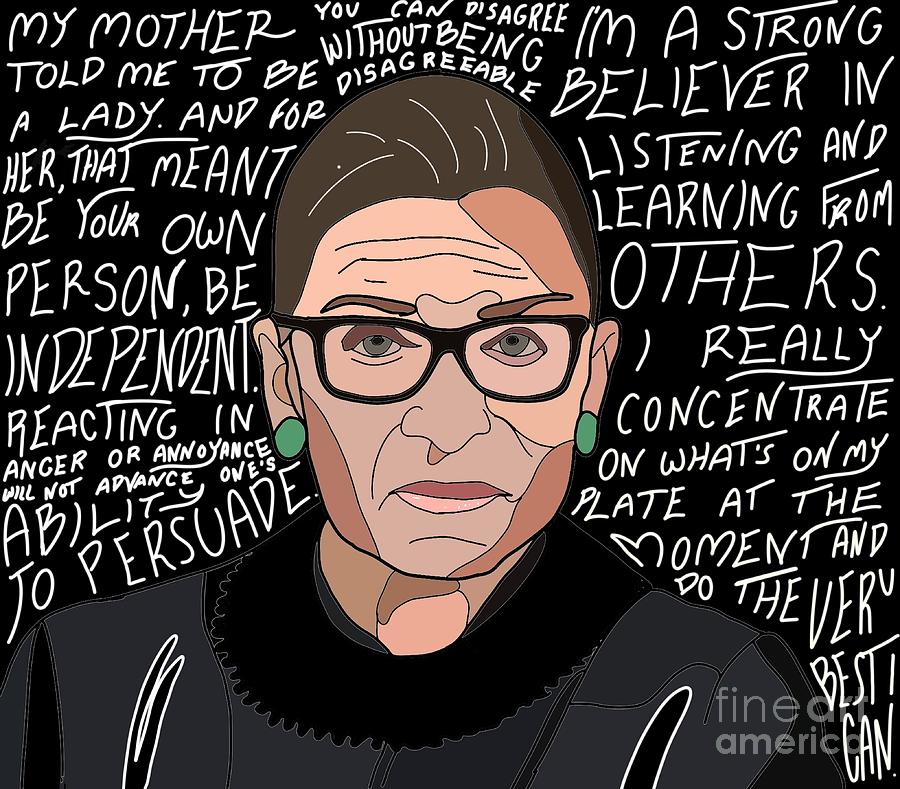
Notorious RBG with Quotes Digital Art by Madison Ann

Image

Feel free to use/adapt with credit to Pastor Katy Stenta

On the motivational side: Part of Her Work

Here is the Link for Pandemic Prayers and Resources: Top Posts are “In an Abundance of Caution” “The Lord is My Shepherd: What kind of Sheep are You” and “Masks: A Prayer”

Communion Tastes Different Now

God, I have had many times when I realized I didn’t really know anything.

All the things I knew how to do have changed.

From going for a walk to grocery shopping.

And, so, Communion tastes different.

Do we even know how the economy works? I doubt anyone knows anymore.

Money and power become nonsensical, time itself has changed.

When I see two or three year olds wear a mask, without blinking, for three hours of nursery school.

I realize that they are the only ones who will know how the world works right now. Because they are growing into it.

Meanwhile ancient schemes are being broken

And the Holy Spirit is here, whispering new words on the wind.

And because I have changed, and I’m a part of communion, communion tastes differently now. The kingdom tastes different.

Because everything is being made new.

The whole world is indeed laboring in birth, and I am praying that somehow, all things are working together for good.

The thing about labor is, you don’t know what you’re doing

Parts of you die and parts of your body make room for the new thing, and parts of your body are never the same again.

It’s messy and bloody and it hurts like hell.

And when you are handed the child, whew.

You really realize that you really don’t know anything.

Mothering, swaddling God, tell us it’s ok if communion tastes different, it’s still communion.

Lord, teach us how to handle this new reality that is being birthed, I pray.

Amen.

Feel free to use/adapt credit Pastor Katy Stenta

Here is the Link for Pandemic Prayers and Resources: Top Posts are “In an Abundance of Caution” “The Lord is My Shepherd: What kind of Sheep are You” and “Masks: A Prayer”

God of the Rainbow Coat

God,

when you looked into Joseph’s face, laced with drama;

when you saw their heart–full of queer notions…

And their coat/cloak/princess dress that was rainbow to its core.

When you truly got to know who Joseph was.

Then, and only then did you call them by name.

I know this, because you are God, and you are with us.

You don’t call us as strangers who might be able to help.

You call us as beloved children who you know can be more fulfilled serving others.

You didn’t ask Joseph to take off their rainbow dress, or to change, or to be better–you just asked them to come.

And it is beautiful that you can take a dreaming child, who was too flamboyant, and dramatic, and talked to much, and turned their dreams into hope.

First for all of Egypt, and then for the very siblings that betrayed them.

May we all have the grace to remember that God calls us exactly as we are. Remind us, that just as God knows each and every star, God knows and calls us all by name.

We pray in the Holy Names of Christ

Amen.

Feel free to use/adapt with credit to Pastor Katy Stenta

More Narrative Lectionary Resources