
Lord Jesus, God, brother, healer, hope of the world. I pray for all those who are seeking asylum. No matter what the reason, no matter who they are. Those who are political, religious or emotional refugees from their home, how can I not cry out on their behalf. There are so many kinds of homelessness in the world Lord, and my heart breaks for all those who cannot find sanctuary, sabbath and peace. How can we do better? How can we find space for the sanctuary, sabbath and peace? How can we open our doors to those who have nowhere else to go? How? Lend us your Holy Spirit so we may build places of safety for all of your children to go home to…every single one.
Amen
#hopewins #notafraid #diwali Practicing Humanity & Defeating #Terrorism
Because those are hope building practices, and this is how to defeat evil. This is how #hopewins, this is how we defeat #terrorism, not with weapons or policies, but with the refusal to live a life of fear.

Today is diwali the celebration of light winning over darkness, how fitting a reminder, for me a Christian when mercy and justice are hard to find today.
Fear Not!
Every time an angle appeared, every time God speaks, fear is cast out. God doesn’t want us to live in fear, God wants us to live into hope.
But that’s hard, its hard when attacks occur all over the world on one day–Beruit, Paris, Baghdad. Its difficult when gun violence continues to cause school shooter drills and institutional racism is unveiled again and again and again.
So what I do is, I cry. I pray. I look at the stars. I light candles.
(until we find the right words, we’ll light candles–Martha Spong)

I live in hope.
This expression is one I use when things are uncertain. I toss it off in casual conversation as though it is easy, but it is so, so difficult.
Worrying is a human past time. Its a way to cope with the reality that evil is in the world. It is a tool that can be overused to the point where we worry too much and forget to live.
Fear also, is interesting. As Christians a tenant of our faith is the fear God. We are not supposed to base our decisions on what could happen, we are not supposed to live our life based in fears, we aren’t supposed to live into the worry and the guilt, because the truth is, we humans do not function well in those state.
When we are anxious and afraid, when we are guilty or judgmental, we make bad decisions.
No doubt, this is why over and over again we are urged only to fear God. “Those who fear God” is an expression in the Old Testament to describe all those who are trying to follow God instead of giving in to other things. But then God tells us over and over again to fear not. And counsels us to hope and trust in what is going on….
Its hard not to fear, not to worry that I’m not secure enough in money or friendships. Its hard when my body does not function the way I want it to, or when my children get hurt from the bad things that go on in the world. Its hard when the news talks a lot about the problems of the world and little about the solutions. Its hard when refugees and children are dying from violence and rejection. Its hard when people proclaim “its not like it used to be” with authority as if evil is new and spreading instead of being old and already defeated by Jesus.
But I live into hope.
I practice not being afraid.
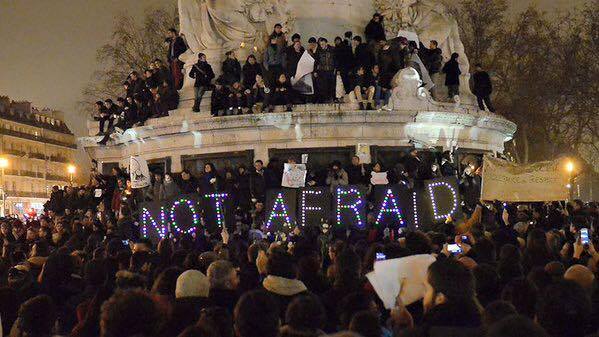
Building trust, assuming people are trustworthy, treating everyone with respect and kindness.
Because those are hope building practices, and this is how to defeat evil. This is how #hopewins, this is how we defeat #terrorism, not with weapons or policies, but with the refusal to live a life of fear.

Practicing Being #human #paris
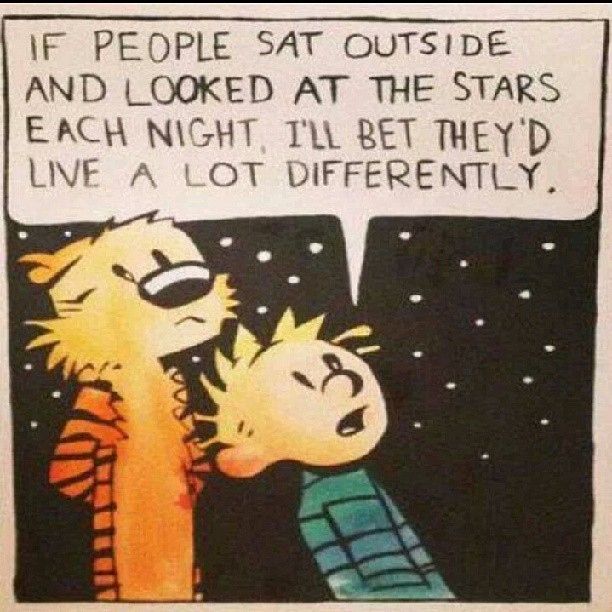
Tonight, I’m going to look at the stars. I’ll look and wonder and remember how big the world is, how small I am, I’ll remember beauty and joy and hope, I will count the countless, remember small things and think wispy thoughts.
I will look at the stars and think of Paris and Japan, of Syria and the Middle East.
I will look at the stars to practice my humanity, I will do it, because I need to pray, and I don’t know what to do, except to respond by remembering what it means to be human.

Tonight I’ll be one small human being looking at the stars, and I invite you to do the same.
The Anglo-American, Caucasian #Christmas, War on #Christmas & #Starbucks Coffee


Apparently Starbucks selling coffee in plain red cups is seen by some as another sign of the so-called “War on Christmas.” And rightly so. How dare they crowd out Advent and Christmas with the color reserved for Pentecost? I only drink liturgically correct coffee.
(Above is a light-hearted post from a colleague of mine)
Did you know the liturgical color for Advent is actually purple or blue? And that the color for Christmas is just plain white (no doubt for holiness?)
The war on Christmas is really a harkening for days when Christianity all looked the same….Christianity and Christians…and America, back when “true” Americans all looked the same and part of being American was being a certain brand of Christianity.
The War on Christmas is not really a war and its not really about Christmas, its a culture trying to come to grips with how the world is changing
Look the outrage at the cups, the outrage at the outrage of the cups, and those who are tired of the whole debate and feel that the Christians who are talking about how ridiculous the other Christians are being make for a good cultural discussion about meaning.
I worked in a Korean American church for a while. It was the melding between a 1.5 generation Korean congregation (those who are truly of both Korean and American heritage) +their young truly American, but ethnically Korean, children.
This congregation joined a regular small, had their heyday in the 1950s Caucasian Congregation.
I was on staff as the Christian Ed Coordinator, but realistically a lot of my job was translating.
Translating between the older Anglo-Christians, the Gen Y Koreans and the up and Coming Millenial-American-ethnically Korean Children.
Advent candles
Aren’t Advent Candles Taught in Seminary?
Ruth, a saint and mother to us all at church asked me this when their Korean-American Pastor didn’t do them.
No, I said, thats an American Tradition, not a Christian one.
Then I explained that Advent differs from place to place (I’ve lived all over America) and that even the words are different and in different order, depending where you came from.
Oh.
We did do Advent Candles, I was put in charge (as cultural translator) extradinare.
So the question is this?
What is at the root of this question about Starbucks (whose CEO is Jewish) and red cups?
As Christianity and Religion changes, as being American changes, perhaps we are asking the wrong questions.
And if people do things differently than you traditionally do…ask about it, learn about what people do and why.
And if you want to learn more, go to church, we have highly educated people, I spent 4 years at Princeton, who know about how things are done and why they are done that way, and how things are changing and why that’s exciting too…
Other thoughts on Red Cups
http://emilycheath.com/2015/11/07/christians-red-cups-and-priorities/
Useful #Bible Verses

Its called Proverbs because its a life truth, right?

#onesentencesermon #theologyblurb
Jesus Said
Blessed are the Geekmakers
For they shall imagine the earth
#Ruth #rejected SermonTitles Let’s talk about #hell (practical applications)

My very savvy 7 year old asked me today what Hell was.
Can I just say that a. I’m glad he asked me b. I’m glad he didn’t have a concept yet
Because, I’m a Pastor and I’m always a little afraid of what is seeping into my child’s brain theologically
I have no doubt this query was prompted by The Corpse Bride.
Halloween is great, and I mean it. Its a way to conceptionalize and deal with fears of death and Hell.
Deep Theology going on.
I have a working concept of Hell.
Its like a hypothesis–in theory this concept has withstood my theological understanding and it works for me to understand life, the universe and everything
Its like a practical application concept. (By the way that’s what theology is…its a working concept of how you apply your faith/beliefs)
The Bible is mostly unclear about what Hell is. When mentioned in the Bible it often carries with it whatever the local culture thinks is the underworld.
My working concept of Hell is that it is that deepest darkest place in existence that has no love.
Not a shred.
Because to me, that is the most horrific concept ever….
And though God promises to be with us, no matter where we are–When we descend to Sheol, God promises to be with us, this does not mean we are able to feel God’s presence/love while we are there. (Romans 8)
When Jesus Christ goes to Hell, when he cries out “My God, My God, Why have you forsaken Me” I believe that Jesus Christ experiences the lonely heart-wrenching existence of no love.
No God.
The hows and the whys of Jesus Christ not being with God and Love when His very self is God and Love escape me, but the definition works for me. Because we all have times in our lives when we feel unloved.
When we feel alone, unloved, unlovely and unable to love.
““Is this Naomi?” She said to them, “Call me no longer Naomi, call me Mara, for the Almighty has dealt bitterly with me. I went away full, but the Lord has brought me back empty; why call me Naomi when the Lord has dealt harshly with me, and the Almighty has brought calamity upon me?” ” Ruth 1:19-21
Naomi feels this, she says, call me Mara, bitter. I exist in a place with no love.
Even if we aren’t actually alone or unloved.
These places and times are Hell for us. A visit into what happens when God is completely ignored and unaccepted in our lives.
On the other hand, it means that those who love, have seen the face of God.
Those who love experience joy and pleasure and beauty and understanding.
In this way, I believe that whether Hell is a physical place or not, it exists.
(For me it was Jr. High, when I hadn’t really any friends was horribly socially awkward, and for a while a group of bullies told me to shut up every time I spoke or laughed)
Have you experienced Hell?
It makes sense then the contrast of Hell is Heaven, a place of love, a place of family, a place of hope.
How many times have poets compared love to Heaven?
Love exists too, and if we are bringing the Kingdom of God to Earth, then we will be like Ruth. Following Naomi, loving her even when she can’t accept that love.
There are times in our lives when we are loved, and we can’t feel it. The entire stage of teenage-hood comes to mind. Where we are loved, but we feel like no one cares.
The important thing about love, though, is that its different from “fixing someone.” Because fixing someone isn’t permanent, but love can go on and on.
Those of us who are married know that no one is perfect, and we can’t fix them forever, that doesn’t actually happen, but we can still love them. I would argue that loving someone is the opposite of fixing them. Its going where they go, experiencing what they experience, and keeping with them.
Too often at church we forget and try to fix people. Often we can’t fix someone, or the fix is temporary or we don’t know how to fix them. We can however, love them. We can experience life with them and build the family of God. We can make sure no one gets left behind, or forgotten, and call one another brother and sister.
That’s why we do this church thing, so we can be together in Christ.
Mark 3:33-35
And he replied, ‘Who are my mother and my brothers?’ And looking at those who sat around him, he said, ‘Here are my mother and my brothers! Whoever does the will of God is my brother and sister and mother.’

Thanks to Chuck Goodman for the Ohana Lilo and Stitch reference
#rejectedsermontitles #wrongquestionMoses
Moses Asks: Who am I to do all this
God says: I am with you, You are on Holy Ground.
Because God makes Holy Ground to be where God and humanity meet. That is what makes things Holy.
Moses: Who are you then?
God: I am who I am<–God the one and only, often imitated, never duplicated……the living God
Moses: You don’t have a name?
God: I am the God of all things, I don’t need one name, you can name me
Mark 12:26-27a
26And as for the dead being raised, have you not read in the book of Moses, in the story about the bush, how God said to him, “I am the God of Abraham, the God of Isaac, and the God of Jacob”? 27He is God not of the dead, but of the living; you are quite wrong.’
Exodus 1:8-14, 3:1-15
8 Now a new king arose over Egypt, who did not know Joseph. 9He said to his people, ‘Look, the Israelite people are more numerous and more powerful than we. 10Come, let us deal shrewdly with them, or they will increase and, in the event of war, join our enemies and fight against us and escape from the land.’ 11Therefore they set taskmasters over them to oppress them with forced labour. They built supply cities, Pithom and Rameses, for Pharaoh. 12But the more they were oppressed, the more they multiplied and spread, so that the Egyptians came to dread the Israelites. 13The Egyptians became ruthless in imposing tasks on the Israelites, 14and made their lives bitter with hard service in mortar and brick and in every kind of field labour. They were ruthless in all the tasks that they imposed on them.
3Moses was keeping the flock of his father-in-law Jethro, the priest of Midian; he led his flock beyond the wilderness, and came to Horeb, the mountain of God. 2There the angel of the Lord appeared to him in a flame of fire out of a bush; he looked, and the bush was blazing, yet it was not consumed. 3Then Moses said, ‘I must turn aside and look at this great sight, and see why the bush is not burned up.’ 4When the Lord saw that he had turned aside to see, God called to him out of the bush, ‘Moses, Moses!’ And he said, ‘Here I am.’ 5Then he said, ‘Come no closer! Remove the sandals from your feet, for the place on which you are standing is holy ground.’ 6He said further, ‘I am the God of your father, the God of Abraham, the God of Isaac, and the God of Jacob.’ And Moses hid his face, for he was afraid to look at God.
7 Then the Lord said, ‘I have observed the misery of my people who are in Egypt; I have heard their cry on account of their taskmasters. Indeed, I know their sufferings, 8and I have come down to deliver them from the Egyptians, and to bring them up out of that land to a good and broad land, a land flowing with milk and honey, to the country of the Canaanites, the Hittites, the Amorites, the Perizzites, the Hivites, and the Jebusites. 9The cry of the Israelites has now come to me; I have also seen how the Egyptians oppress them. 10So come, I will send you to Pharaoh to bring my people, the Israelites, out of Egypt.’ 11But Moses said to God, ‘Who am I that I should go to Pharaoh, and bring the Israelites out of Egypt?’ 12He said, ‘I will be with you; and this shall be the sign for you that it is I who sent you: when you have brought the people out of Egypt, you shall worship God on this mountain.’
13 But Moses said to God, ‘If I come to the Israelites and say to them, “The God of your ancestors has sent me to you”, and they ask me, “What is his name?” what shall I say to them?’ 14God said to Moses, ‘I am who I am.’* He said further, ‘Thus you shall say to the Israelites, “I am has sent me to you.” ’ 15God also said to Moses, ‘Thus you shall say to the Israelites, “The Lord,* the God of your ancestors, the God of Abraham, the God of Isaac, and the God of Jacob, has sent me to you”:
#rejectedsermontitles #Jacob admits he’s a jerk
Mark 14:32-36
32 They went to a place called Gethsemane; and he said to his disciples, ‘Sit here while I pray.’ 33He took with him Peter and James and John, and began to be distressed and agitated. 34And he said to them, ‘I am deeply grieved, even to death; remain here, and keep awake.’ 35And going a little farther, he threw himself on the ground and prayed that, if it were possible, the hour might pass from him. 36He said, ‘Abba,* Father, for you all things are possible; remove this cup from me; yet, not what I want, but what you want.’
Genesis 32:22-30
22 The same night he got up and took his two wives, his two maids, and his eleven children, and crossed the ford of the Jabbok. 23He took them and sent them across the stream, and likewise everything that he had. 24Jacob was left alone; and a man wrestled with him until daybreak. 25When the man saw that he did not prevail against Jacob, he struck him on the hip socket; and Jacob’s hip was put out of joint as he wrestled with him. 26Then he said, ‘Let me go, for the day is breaking.’ But Jacob said, ‘I will not let you go, unless you bless me.’ 27So he said to him, ‘What is your name?’ And he said, ‘Jacob.’ 28Then the man* said, ‘You shall no longer be called Jacob, but Israel,* for you have striven with God and with humans,* and have prevailed.’ 29Then Jacob asked him, ‘Please tell me your name.’ But he said, ‘Why is it that you ask my name?’ And there he blessed him. 30So Jacob called the place Peniel,* saying, ‘For I have seen God face to face, and yet my life is preserved.’ 31The sun rose upon him as he passed Penuel, limping because of his hip. 32Therefore to this day the Israelites do not eat the thigh muscle that is on the hip socket, because he struck Jacob on the hip socket at the thigh muscle.
Jacob is the ankle grabber, the loveable thief. The one who pulls himself up…by another’s bootstrap. Its Jacob, the man who got his inheritance by cheating his father and stealing his brother’s. This is Jacob, who despite that cheating, finds God. The man who, when he sees Jacob’s ladder says “I didn’t expect to see God here.”
Jacob sees God, and knows God, and wrestles with God. How this happens we don’t really know. One minute Jacob is traveling, the next he’s wrestling God.
And, Jacob is winning, when God asks Jacob’s name, and Jacob confesses. Confession is presenting your whole self, your good and bad to God. Its admitting who you are, naming yourself to God.
But the interesting thing about confession, is that you can’t confess yourself to God, without being changed by God. Its a Murphy’s Law kind of thing. God asks, Jacob’s name, and Jacob admits its cheater, not a name to be proud of. Jacob confesses himself, his name and then literally and figuratively breaks under the strain of it.
Then, it changes, God says “No, now your name is Israel: God prevails.” God prevails and Jacob is changed by his struggle with God.
What’s amazing is that this struggle happens many times in the Bible. In the time Jesus prays in the Garden it going on both with the disciples and Jesus himself.
Jesus struggles with God, asking if he could not do it. (Don’t ask me how, but Jesus is struggling with God).
The disciples too are struggling, struggling to stay awake while Jesus prays. They are struggling to be the friends and disciples that Jesus is calling them to be. Up all night, full of wine, the disciples struggle with God.
In the end, though, Jesus gives himself to full confession. Saying “your will be done.”
The gift of faith is just the beginning. Struggle and confession are a part of the practice of faith.
That is what we are doing when we confess ourselves to God. Claiming ourselves as children and belonging to God. We struggle with claiming who we are, confessing ourselves so that God’s will can be done, so we can be the people God envisions us to be.
In that way, God calls us into being, by our very names
The #Myth of Katy: #fairytale and #theology in action
…..Mary Poppins says that until your baby curls are cut, babies can understand the languages of nature–birds and bees and breezes and other babies all sing together to tell the story of creation.
When I was little I listened hard to the story, attending to the spirits alit on the wind, looking for the chatter that filled up the clouds, attending to the adults as they told more and more stories of how the world worked.
You know how every single relationship is a story in action? How every time you relate to someone in your life sister, love, fairy godmother, you are storytelling. I want to know the big story, I want to participate in writing the world, co-creating reality, understanding the endings. I want to know who plotted this world, and how, and where all the people fitted together in the cloth of time.
You know why names are magical? Because they are first gift we are given, because to name something is to claim it through perception. Stories grow with us, they change as we change. The more complex we are, the more complex the story becomes. To name something is to grow it into creation. Which is why we are able to become old enough to read Fairy Tales again (as C. S. Lewis says). I’m working on being mature enough to hear the bird, breeze, bee, and baby breathe their true names into my ear once again.
 katyandtheword