Everyday Faith

Everyday Faith

“Faith, as Jesus describes it, is just doing your job, just doing your duty, not because of any sense of reward but simply because it needs doing. Faith, in other words, is doing what needs to be done right in front of you and this, Jesus says, the disciples can already do. Folks who feel daunted by discipleship need to hear that sometimes faith can be pretty ordinary. That’s what Jesus means, I think, by saying that if they had the faith even of a mustard seed, they could uproot and move a mulberry tree — that it really doesn’t take all that much faith to be, well, faithful.”

“Faith, Working Preacher, isn’t an idea, it’s a muscle. And the more we use that muscle, the stronger it gets.”

The new Young Adult Dystopia An AWESOME PERSPECTIVE

The new Young Adult Dystopia An AWESOME PERSPECTIVE

If you think kids are too young to worry about unemployment numbers, consider this: Some of our most popular young adult novels fairly shiver with economic anxiety.

Queer Creation: A synchroblog!!!

Queer Theology Synchroblog 2013: Queer Creation

May thanks to my AMAZING sister who wrote this essay in response to my questions!!!!

What is your favorite series to read? How does it relate to your real life experience? Does it help to inform who you are/want to be?

TORTALL_d_original

Well any week that you ask me this I’m likely to have a different answer, but right now I’d say I’m really fond of the quartets that Tamora Pierce has written. There’s a lot in there about strength in yourself and through friends, and showing strength in different ways. Alanna is fiery and forward, Keladry is more reserved and protective. Daine is compassionate and driven, Aly is resourceful and wily. But in the end, they each have some strength that pushes them forward and towards great heights. I identify with each of these women, in part for their strength and in part for how hard they fight. I’ve faced my own challenges, and I have learned to never stop and don’t accept defeat.

What can I say, my sister has great taste in books..what is interesting about all of Pierce is that all of her characters “Come Out” Alanna as a girl (can’t imagine how my sister relates), Daine as a wild Mage and Aly as a spy…Their coming out is natural, it is a growing into themselves and their strength, and what I appreciate about my sister’s answer’s is that its these gifts and strengths that are highlighted, the fact that they are women to look up to….that and HOPE and PERSEVERANCE which are traits that I find to be essential and what should be what we love about the Bible as much as fantasy and PS is why I read fantasy….

As Joss Whedon notes, this shouldn’t be noteworthy (Query: why do you write strong heroines? Whedon: because you keep asking me that), but it is! (PS Favorite book is a totally cheating question, one I can never answer, can I pick a favorite star in the sky?)

The story God gives us is that we are both female and male in God’s image. Do you experience yourself as being in God’s image? (I like to think that transsexual’s have a more (w)holistic sense of what God’s image is)

So there’s this weird conflict here where, on the one hand, God must be both genders- and some representations of the Holy Ghost/Spirit interpret that as female. But I can’t view God that way- because there’s distinctly more than two genders. If the purpose of the question is to establish that God shares their gender with everyone, I think of it like this. Jesus was pretty clearly male- to the best of our knowledge, he’s the son and had no issues with his body in that way. (Which is an entirely different conversation one could have, but that’s not the point here.) So if the physical manifestation was male, then to me the logical next step is that the part we cannot grasp or understand is, as the physical manifestation’s natural opposite, female and comfortable with that. Well then, what is God, both? No. God can’t be both. God must be all. Male, Female, Trans* Genderqueer, Genderfluid, Bi-Gender, Agender, Third Gender (I can’t possibly list all of them…) They must be all of them and thensome. Part of what makes me uncomfortable in most churches is the interpretation of God as Father, Christ as Son and ignore the Holy Spirit completely. What, you mean it should all be male? God and Christ don’t understand women, and have nothing to share with them? Because sometimes that’s what it feels like. And the more a church focuses on Christ as son and redeemer, the less attached I feel to the words they’re speaking, because they’re only speaking from one viewpoint and ignoring the rest.

I will try not to rant here, but there are all kinds of mistranslations of the Bible that slant God towards masculine, when God isn’t. The word for Holy Spirit (Ruach) in Hebrew is a feminine word. The word Almighty in Hebrew means the God of many mounds (i.e. BREASTS to feed all of her children) etc. etc. This is a problem most females have with Christianity, that my sister has a VERY perceptive and unique focus on. God MUST BE ALL (which I bolded above), God is all, and its too much for us to understand so we compartmentalize so our little brains can handle it, but really, God must be all! PS I have always been a Kinsey 1-6 scale advocate, where completely straight is 0, completely bi is 6 and most people are 1-5…not a gendering issue, but still brings in the issues of God, Sexuality, Gender and Sex. Hey if we can’t talk about our embodied experience, why the heck are we even worrying about religion, am i right?

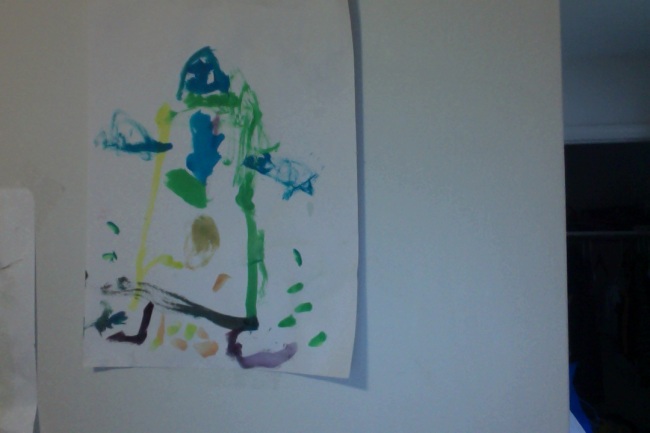
Image

My son drew God, because he wanted to know what God looked like, he said that God is both a boy and a girl and not a boy in a girl and….”I think God is very big, because God takes care of everybody, and I think God is a rainbow, because God likes all colors. See these dots? These are all the people, they are all different kinds too…” ..and a child shall lead them, anyone, anyone?

How important was naming yourself as female? How did the naming effect the embodiment? Or how did the embodiment effect the naming? Was there an order to it, or did all come together?

Okay, there’s a lot of questions to this question and I just have to address them one at a time.

Hehehehe, I told my sister I wrote only 4 questions, but of course I cheated, layering question upon question, luckily my sister is brilliant (really brilliant she is the smartest one by far in my family) and she was able to pull apart my meaning…good thing she has practice, being related to me and all.

Naming myself as female changed my whole world. It was about comfort and knowledge as much as anything else. I collect stories, including those I experience, and there was always something wrong with the story of me as a male. It would be like reading Harry Potter but instead of the proper ending Voldemort kills all the muggles and takes over the world. It’s still a pretty good story, but it’s not right. It’s not the way that the story should go, and we know that somewhere in us. In a similar way, being male wasn’t ruining my life. It just wasn’t right, and somewhere within me knew that. So the naming and identifying put me back to the right story, and changed…well, everything to some extent. As for the naming/embodiment dynamic, I’d say it was (and still is) a pretty consistent back and forth. I’d look at my past- realize that I’d been skipping around in skirts at age 8 and pinning down my arm movements since age 10- and see how I’d been living it my whole life. Then I’d start doing something and the driving feeling would be “screw it, I feel like doing x-y-z because that’s what my gender says is comfortable, so I will.” In the past, I was still learning what made me comfortable and my physical actions in the past helped guide that. As I look more toward the future, and being a woman is an unshakeable part of my identity, I’d say the balance is more towards the naming- I chose this title and this gender and this life (well, I chose to act on it, anyway) So I might as well embrace the parts of it I like.

YAY! I love how the “naming” piece of my sister’s identity has brought her more into SELF….I can’t add to this

What questions and wonderings do you have about God or the human existence that are informed by your being/experience/embodiment on earth?

I have a very important, unanswerable question that involves only one word. Why? Why put people through rigors and trials? Why challenge people in ways that they sometimes cannot handle, or cannot handle at the time? Why love, why hate, why trust, why lie? In short, my question out of all of my gender and sexuality struggles, out of dysphoria, out of watching my friends and my family is the most basic and most complex question of all. Why do it? Why was I born into the wrong body? What did I need to learn or understand? What did I gain? What did I lose? Was it worth the cost? I have no answers. I’m left with just the resounding question, sounding a bit like a petulant five year old. Why?

Shepherd: What are we up to, sweetheart?
River: Fixing your Bible.
Shepherd: I, um.. what?
River: Bible’s broken. Contradictions, false logistics.. doesn’t make sense.
Shepherd: No, no, you can’t..

River: So we’ll integrate non-progressional evolution theory with God’s creation of Eden. Eleven inherent metaphoric parallels
already there. Eleven, important number, prime number. One goes into the house of eleven eleven times but always comes out one.

River: Noah’s Ark is a problem.
Shepherd: Really?

River: We’ll have to call it “early quantum state phenomenon”. Only way to fit 5,000 species of mammal on the same boat.
Shepherd: Give me that. River, you don’t… fix the Bible.
River: It’s broken! It doesn’t make sense.
Shepherd: It’s not about making sense, it’s about believing in something and letting that belief be real enough to change your life.
It’s about faith. You don’t fix faith, River, it fixes you.

See we are related! We love tough questions….My sister has a great quest ahead of her. Of course, I don’t have an answer…its just too good a question.

Here’s what I think, I know its not all bubbles and sunshine (though I wish that were the case–to see a bubbles and sunshine version of events read here). But I am honored to witness to it, I hope that I am deepened by it, and I am SO proud of her! I think she is an amazing, strong, brave and resilient person who NEVER GIVES UP already, and she’s 10 years younger than me. I can’t wait to see what she does next!


Read the Other Queer Synchoblog Posts!

Queering Our Reading of the Bible by Dwight Welch

Queer Creation in art: Who says God didn’t create Adam and Steve? by Kittrdge Cherry

Of The Creation of Identity (Also the Creation of Religion) by Colin & Terri

God, the Garden, & Gays: Homosexuality in Genesis by Brian G. Murphy, for Queer Theology

Created Queerly–Living My Truth by Casey O’Leary

Creating Theology by Fr. Shannon Kearns

Initiation by Blessed Harlot

B’reishit: The Divine Act of Self-Creation by Emily Aviva Kapor

Queer Creation: Queering the Image of God by Alan Hooker

Queer Creation by Ric Stott

Eunuch-Inclusive Esther–Queer Theology 101 by Peterson Toscano

Valley of Dry Bones by Jane Brazelle

Queer Creation: Queer Angel by Tony Street

The Great Welcoming by Anna Spencer

Queer Creation by Billy Flood

The Mystery of an Outlandishly Queer Creation by Susan Cottrell

We’ve Been Here All Along by Brian Gerald Murphy

God Hirself: A Theology by T. Thorn Coyle

The Objectification of God by Marg Herder

Coming Out As Embodiments of God Herself by Virginia Ramey Mollenkott

An Interview by Katy

On Creation and Belonging by Andrew Watson

Creation by Liam Haakon Smith

Practically Creating Practical Queer Theology by Talia Johnson

Inspired Possibility: Opening the Gift of the Queer Soul by Keisha McKenzie

Oh What A Difference A Pope Makes! by Hilary Howes

I’m Really Angry by John Smid

Focus on the (Chosen) Family by Brian Cubbage

The Goddex by Thorin Sorensen

Prayer of Confe…

Prayer of Confession: God, we confess that we forget to pray prayers of thanksgiving. Too often we let the worries and complaints overwhelm us. Forgive us, God. Set us free from the sin that tries to hamper our steps. Help us to pray instead of worry, to praise instead of grumble. Put in our mouths a song of your glory. Let it be as merry as the day is long, so that we might know hope, peace and life eternal. (Silent Prayer)…Amen

The Eastern Orthodox Church holds a non-juridical view of sin, by contrast to the satisfaction view of atonement for sin as articulated in the West, firstly by Anselm of Canterbury (as debt of honor) and Thomas Aquinas (as a moral debt).] The terms used in the East are less legalistic (gracepunishment), and more medical (sicknesshealing) with less exacting precision. Sin, therefore, does not carry with it the guilt for breaking a rule, but rather the impetus to become something more than what men usually are. One repents not because one is or isn’t virtuous, but because human nature can change. Repentance (Ancient Greek:μετάνοια, metanoia, “changing one’s mind”) isn’t remorse, justification, or punishment, but a continual enactment of one’s freedom, deriving from renewed choice and leading to restoration (the return to man’soriginal state).[29] This is reflected in the Mystery of Confession for which, not being limited to a mere confession of sins and presupposing recommendations or penalties, it is primarily that the priest acts in his capacity of spiritual father.[21][30] The Mystery of Confession is linked to the spiritual development of the individual, and relates to the practice of choosing an elder to trust as his or her spiritual guide, turning to him for advice on the personal spiritual development, confessing sins, and asking advice.

Confession is a statement of who you are, where you are and the striving to go beyond that! It is a statement comprised of self knowledge and belief: seeking the deeper actions of  understanding and faith.

WHAT EVERYONE VALUES ABOUT CHURCH

WHAT EVERYONE VALUES ABOUT CHURCH


Kirk Winslow gives us the result of an in-depth discussion about the reality of church: The results are about as unscientific as they come.  No controls, small numbers, located almost entirely in southern California.  But some common threads have emerged very clearly, threads that resound with our understanding of the mission of the church and our particular sense of call. 

This sounds just like “Bible Study”…what’s different about all of this?

My Presbytery is trying to explore the whole 1,001 worshipping communities/church planting. 

As we did we talked over exciting interest for starting a house church in the college area…


and we were discussing how to go about, different ideas and resources (i.e. Messy Church etc.)

and someone asked “Can someone tell me, how this is different from a Bible Study? I mean we do this, we get to better in different houses and worship and get together what is different about this?”

Well……I might have said a few things in response 🙂

1. Its not that different but we are reformed and always reforming because we need to find new ways to tell the gospel message. Clothing Exchanges are not that different from Rummage Sales (as one of my congregants pointed out). But they ARE different because they speak to a different generation in a different way!

2. We need to meet people where they are in a tree, by a well, even on the cross. If that is what Jesus is doing then that’s what we should do too. 

3. Because we need to show our willingness to see, know, people in places that AREN’T the church. When people say they are Spiritual-but-not-religious they mean they want to reach God, but they don’t want to reach God in the same way we do, so we need to find ways that work for people. Ways in which they are comfortable. Thank God, the message is the same as what it was  over 2000 years ago, even though the method changes

4. Aren’t we reformed and always reforming so we can grow and be nurtured closer to Christ? Don’t we hope that we keep looking at ways to become more able to see God?

5. Because its not exactly the same, it seems the same, but its really not. Because we are saying, come to our Game, Come to our Home Field, Come to our Turf and we’ll tell you about how we do the God thing. Its not simply sitting inside the church and throwing open the doors and wondering why no one is coming in…its going out to meeting them on their turf…its street ministry at its finest.Its changes to a “you might not experience God the same way we do, so we’ll come to you and let you tell us what you want to try” thing…that’s what Spiritual-but-not-religious is, experiencing God in a new way!


Your right, its exactly like Bible Study…..Only Different!


Moses: Experiencing God (part II)

Part !

Ultimately God is relational, and our experience of God is relational….that’s why we need to know

However, what is hard is some people haven’t ever had that burning bush experience…I haven’t been in that place before, but I know that some people haven’t experienced God.

What I do know is that when I talk to people about experiencing/knowing God that when they try to UNDERSTAND who God is, that is the wrong way to go about things.

I don’t know about you but I personally live with four other beings, none of whom I will fully understand (and its more than the fact that I’m a female living with four males), having a relationship with someone doesn’t mean that you fully understand them. Also, I know that relationships are different with different people….

Every time a read a parenting blog or article about the “right way” to raise every child I think how can this be? Different children raised by the same parents turn out differently, even I know I parent my three child in different ways. I relate to each of them differently. God similarly relates to each of us in a different way.

That is why we need a faith community, because none of us can have a full experience of God…well…if your like me, then not more than for an nanosecond. I love those moments of experiencing God. Madeline L’engle describes some of those moments as when you are looking at the stars (her parents used to wake her up to stargaze and its a big part of her writing).

You can envision Abraham having that moment….looking at the stars with God, filling the fullness of God’s will and purpose. Having it for a moment, and then continuing (since we can’t hold the fulness of God all the time)  through a relationship.

What I do know, is that experiencing God is relational, not rational, that we cannot fully know God by ourselves, and that this is why we are relational with both God and each other. Thus we better know God through all of our relationships–with God and each other.

That is why we are in community, because we don’t all have the same experience of God. We are together, not to tell each other that the only way to experience and know God is the way that works for us! (Did you know that you shouldn’t like ALL of worship, ideally different people like different parts, because its not all for one person, its for a diverse group of people so different people can experience worship during different parts of the service)

The point of the variety is so that we can share, experience and relate to God differently and (in the best of times) simultaneously. I don’t know what to do if you haven’t experienced God, but I do know, that your best bet is a faith community…Because we can’t experience God alone, we can only believe in God…alone…..


The Lord said, “I have indeed seen the misery of my people in Egypt. I have heard them crying out because of their slave drivers, and I am concerned about their suffering. So I have come down to rescue them from the hand of the Egyptians and to bring them up out of that land into a good and spacious land, a land flowing with milk and honey—the home of the Canaanites, Hittites, Amorites, Perizzites, Hivitesand Jebusites. And now the cry of the Israelites has reached me, and I have seen the way the Egyptians are oppressing them. 10 So now, go. I am sending you to Pharaoh to bring my people the Israelites out of Egypt.”

11 But Moses said to God, “Who am I that I should go to Pharaoh and bring the Israelites out of Egypt?”

12 And God said, “I will be with you. And this will be the sign to you that it is I who have sent you: When you have brought the people out of Egypt, you[b] will worship God on this mountain.”

13 Moses said to God, “Suppose I go to the Israelites and say to them, ‘The God of your fathers has sent me to you,’ and they ask me, ‘What is his name?’ Then what shall I tell them?”

14 God said to Moses, “I am who I am.[c] This is what you are to say to the Israelites: ‘I am has sent me to you.’”

15 God also said to Moses, “Say to the Israelites, ‘The Lord,[d] the God of your fathers—the God of Abraham, the God of Isaac and the God of Jacob—has sent me to you.’

“This is my name forever,
the name you shall call me
from generation to generation.

16 “Go, assemble the elders of Israel and say to them, ‘The Lord, the God of your fathers—the God of Abraham, Isaac and Jacob—appeared to me and said: I have watched over you and have seen what has been done to you in Egypt. 17 And I have promised to bring you up out of your misery in Egypt into the land of the Canaanites, Hittites, Amorites, Perizzites, Hivites and Jebusites—a land flowing with milk and honey.’ –Exodus 3:7-17


Moses– still a human being….(Part I)

Names are important, Before this moment, God was known as the God of Abraham (and Isaac, and Sarah!)

The God who promises the stars to Abraham….

But here is Moses, In Midian, encountering God. Having the Burning bush experience, starting his relationship with God. Where just seeing God’s magnificence isn’t enough, being the God

Most of us would LOVE this moment: this compelling, overwhelming, this is where it ALL begins.  But Moses, dares to ask questions…why? I think its because he is a human. A human being who was made to name things, a human being who needs to know…

And Moses has an identity crises. A human-what-is-the-meaning-of-my-life-and-who-am-I-anyway Identity crises. Moses, who has been living in Midian, after being born a Hebrew slave and raised as an Egyptian Prince. No wonder he’s confused….he asks who Am I to do this?

So God replies….don’t worry your MY messenger, and I PROMISE I’ll be with you the whole way. Don’t Worry.

And here is where Moses is human, again, asking the next, logical question. Ok, then so who are you to come with me? Not, what’s your name…but “Who are you?”

(Just like Jacob asking how it is he could find God here?)

And God says “I Am, what I AM” This is at a time when most people, including the Egyptians, had different Gods for different things, but this God is claiming to be enough. Plus YWHW in Hebrew also has a future tone–I AM, WHAT I AM, and I WILL BE, what I WILL BE. Implying that God will be God, but in order to find out more, you need to sign up for….

(Here is a cute handy-dandy ref. chart to help us see the process of Call)

Part II to follow

Robin McKinley: Adventures in Street Pastoring

Robin McKinley: Adventures in Street Pastoring

“Whose idea was this frelling Street Pastors deal?  Oh.  Yeah.  God’s.  I guess I have to put up with it then.”