Children in Worship: It’s More than Having Coloring Sheets

We say we want young people at church, but how do we make worship accessible for young families (that means the adults and the children) Here is one way

Theresa Cho's avatarStill Waters

In the first issue of PLGRM, Rev. LeAnn Watkins, rector at St. Mary’s Episcopal Church in St. Paul, MN, shares how after numerous attempts of increasing attendance of bible studies and other church-related programs, her staff decided to cancel it all – everything during the weekdays except seasonal services. You can hear her tell her story on the Episcopal Story Project. She says, “You can’t chase after folks and expect them to hear you. You have to be in front of them when they are coming toward you. So we’ve tried to ask the question, ‘How do we stop chasing people, and get in front of people?'” I have to say that I ask myself the same question.

Not unlike many churches, I can no longer assume that those sitting in the pews are familiar with Bible stories such as Noah and the Ark, Jonah and the Whale…

View original post 841 more words

Katy’s Rant Against Associate Pastors, and a proposed solution


II think Associate Pastors are totally stupid for the following reasons 1. Didn’t Protestants break away from Catholicism to avoid a hierarchical governance of the church, yet here we are reinstituting it.

2. Most associates are women and most head pastors are men

3. Associate Pastors have to work for too many bosses. Regular pastors already have two (sort of) between the congregation and God. The associate has the congregation, God and the Head Pastor

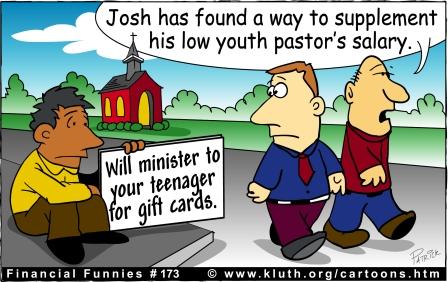
4. Finally, the most important reason why I hate associateships is that the ministries that are put under this heading “Pastoral Care” (translation: sick and old people), “Youth” (translation: those who we don’t get) and occaisionally “Mission (translation: those outsiders who need our help) are deemed LESS important than the “real” church (which apparently is made up of insiders who aren’t sick, over the age of twenty well off enough to not need help and not so old to be considered frail.

This

a. severely limits the church. We are essentially giving the more powerful pastor to those in power in the church. Basically rewarding those who we think can pull their own weight which is a broken theology, because no one has everything they need to be perfect, and we are putting our human limitations on who we think can serve the church

b. Severely limits the ministry itself, causing more red-tape, committees, paperwork and channels to get this “specialized” ministry done.

c. Finally, it severely limits the gifted associate pastors, all of whom have an important call to work, and may have specialized gifts in ministry that should be recognized. (Plus there’s that whole male/female discrepancy, I avoided Christian Ed and Associates like the plague figuring if I started there I’d never move out)

Image

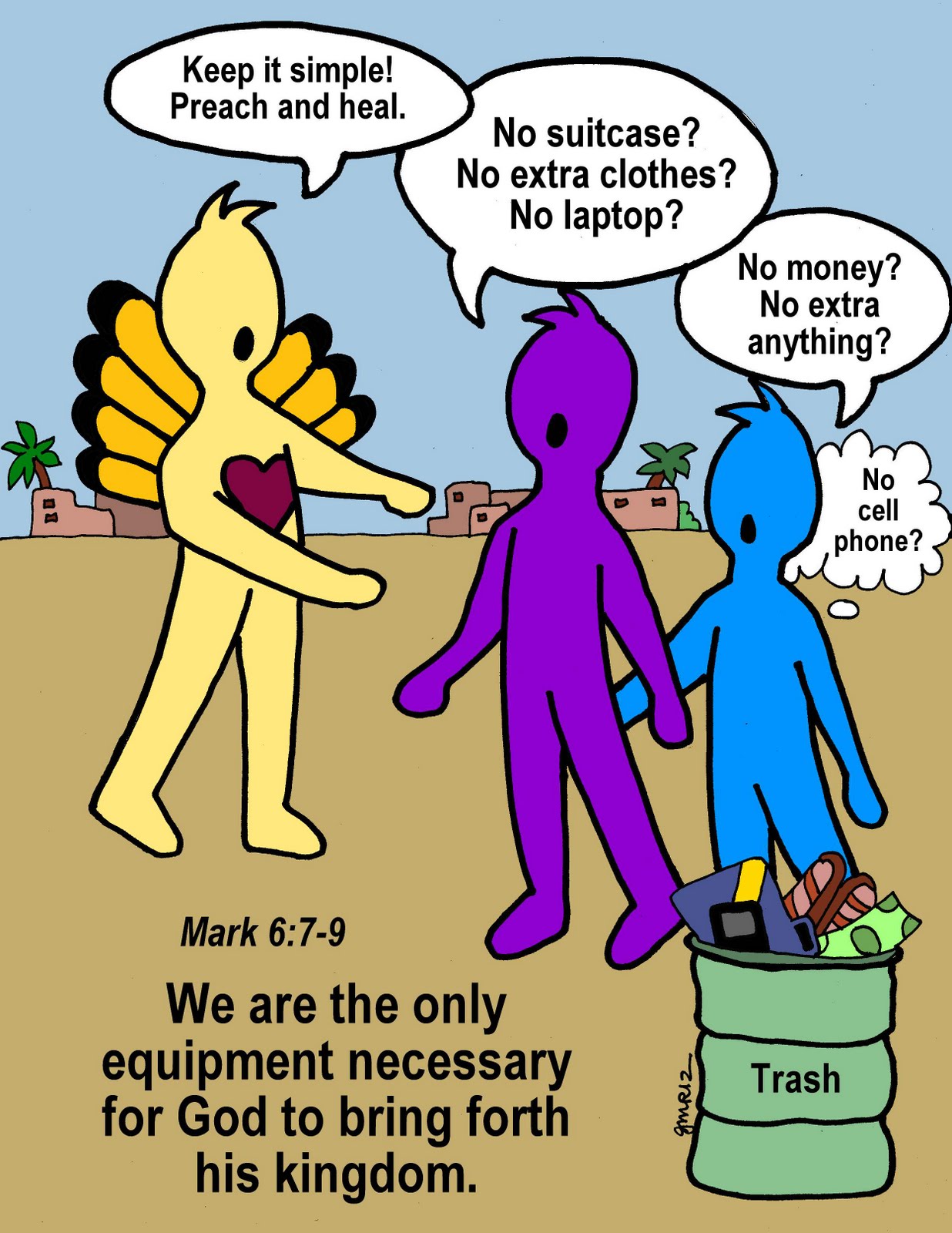
Finally, I am aware that most pastors are lonely and sad, and am aware that we have completely ignored the fact that Jesus sent everybody out in twos (Mark 6). What if we took this one step further and move more and more towards the copastorate being the regular form of ministry as opposed to the solo! This is especially true, since Christ says we don’t need anything but each other to do ministry!!!

Therefore, I propose we do away with all associate pastorships and move instead to co-pastorships. (This idea which I’ve been bouncing around forever dovetails well with Jack’s in  http://jackjenkins.wordpress.com/2012/04/30/hey-pcusa-i-have-an-idea/ to employ pastors. Could be the Holy Spirit is moving us one and one towards this new kind of employment).


Image

One co-pastor could be parttime and one could be fulltime or any combo thereof (how would two parttime pastors with full benefits work–wouldn’t that be AWESOME!!)

The way it tends to work is both pastors still get full vacation (particularly important if your a married couple). The pastors take turns moderating session, and probably a “pastor” would be available to answer pastoral needs (no guarentees which one, it would be worked out between the two pastors).

Down with Associateships! Up with Co-Pastorships

A Post about being Post…well Post-Everything

I am a graduate of Oberlin (yay Oberlin), and I loved (almost) every minute of it. But one of the things Obies love to do is take things apart. (Any other Obies feel free to chime in about this). In fact, sometimes we would move to “deconstructing” things so fast that I would feel like I didn’t even know how the thing was constructed in the first place (as an English Major my high school was highly lacking in Shakespeare, and I wanted to round my education out with him, however the only classes offered were about deconstructing what we supposedly had learned in high school).

Now as I get into ministry I hear a lot of talk about what this post-culture is going to do? Author Ross Douthat wrote an article about Can Liberal Christianity be saved? (http://www.nytimes.com/2012/07/15/opinion/sunday/douthat-can-liberal-christianity-be-saved.html) His conclusion was that” Today, by contrast, the leaders of the Episcopal Church and similar bodies often don’t seem to be offering anything you can’t already get from a purely secular liberalism. Which suggests that perhaps they should pause, amid their frantic renovations, and consider not just what they would change about historic Christianity, but what they would defend and offer uncompromisingly to the world.Absent such a reconsideration, their fate is nearly certain: they will change, and change, and die. (PS for a good response to this read http://www.patheos.com/blogs/livingaholyadventure/2012/07/can-liberal-christianity-be-saved-a-response-to-ross-douthat/)

However as I look at this world, I see that we are trying to construct a Post-Religious world (i.e. Spiritual not religious viewpoint that is so oft referenced). So the question comes, what does a post-church, post-christian, post-denominational (I am told by a good friend this is a move that the Bible belt is especially making) world. How do we post about our Post-world? (http://en.wikipedia.org/wiki/Postchristianity)

Going forward I have to say that to me a post-religious world would look like the following

1) Where individuals ultimately choose to uphold each other as people, even when beliefs differ (perhaps what our Moderator and Vice Moderator were trying to model at GA before our Vice had to step down). Allowing Spiritual Practices to bring people together–>at least I think this is what some of the Spiritual people are trying to get at…

2) Where church isn’t made up of the “shoulds” of religion: church should have pews, church should include hymns, church should have Sunday School, but is instead moved by Holy Spirit to BE a faith community whenever and however that comes together….

3) Where the Faith of a group of people is ultimately used to empower those individuals who are powerless. What happens when powerless people come together? that’s right they become empowered If the church functions as a community builder grounded in the love of God, then we cannot help but support and empower each other to do new and wonderful things….

Places where this is overlooked today=basically everyone who is assigned an associate pastor (that is a rant yet to come)

The Young

Image

Recently, these interactive boards have moved from the back of the broken pews to the corner of the sanctuary that we designated as a toddler area. (from a fellow pastor http://theresaecho.com/2011/04/18/interactive-toddler-boards/)

The Elderly

Image

The College Age

Image

The Young Adult (i.e. those in there 20s and 30s)

ImageImage

(you know those with young families who need babysitting or those who are still single and constantly on the move to find a job in the tough economy)

Image

The Minorities: Racial, Ethnic and of course the poor

Thats right if your not a white middle class, middle aged American in many denominations your power is significantly less not only in society but in the church itself. Plus if you are not well-educated and don’t love words (say you learn by practice or are a visual learner) you probably won’t fit in well to the traditional Presbyterian service. (Does anyone else see something wrong with this?)

What would a service look like if it was regularly handed to these groups? What would faith look like if we went to where these people were?

You know what I think? I think that Ministry, True Ministry is to make FAITH ACCESSIBLE (that’s right, I put it in caps, that’s how serious I am). ImageHow do we make, not only our building, our worship and our activities accessible, How do we make our Faith Accessible. What does it mean that people identify Spirituality over religion or faith? I think its because Spirituality feels accessible. You can use what is comfortable to you, you can learn about it at your own pace, and your can connect with different people over different aspects of it even if you don’t agree completely with them (for the record I have both liberal and conservative friends).

So how can we do that for Faith?

I don’t know,

But let me remind you friends, that there is no resurrection without death!
Whether you consider this time the denominational pregnancy http://vimeo.com/25360983

or even if you think we are dying….http://treymorgan.net/17-signs-your-church-might-be-dying/

Either way, there is a rebirth a coming, the question is how will we access it?

(P.S. Giving Access is not the same as watering down faith, just so I’m clear on that!)

LOL Pastor

I have been an LOL person before it was cool, before LOL was conceived (almost) I was living it out. If you have ever been to one of my services, be warned, LOL will happen. In fact I am very likely to LOL at myself (and if you don’t know what LOL please google it immediately)Image

Now here is the interesting thing, my willingness to laugh has gotten me into a lot of trouble. (For why I laugh please read https://katyandtheword.wordpress.com/2012/05/16/pastor-with-a-sense-of-humor/)

a. People think I’m an airhead (I think this has to do with me being female). People assume because I laugh, I don’t care, when actually its the opposite. I laugh because I do care. I tend to take life very seriously. And when I say seriously, I don’t mean in a holier-than-thou or everything-is-sacred kind of way I mean the, life-is-God’s-gift, We-only-get-one-shot-at-it, so I pay attention way! I pay attention, so I don’t miss the happy moments. I pay attention because I have found that laughter is rare, and humor is a hard commodity to find. I pay attention because it is SO important to find Joy in life, and I don’t want any ounces of it that I can catch to slip through my fingers. Image

b. People think I devalue God, ministry, etc. by laughing. Last I check the Book of Order (the Presbyterian Constitution) says W-1.1000 i.e. the very, very, very first thing said about worship is “Christian   worship   joyfully   ascribes   all   praise   and   honor,   glory  and  power  to  the  triune God.” We are supposed to have fun, I don’t know why we forget that (p.s. when is having fun not holy?)

Plus-we are currently striving under Openness to be more open to joy (bet you didn’t even know that). In F-1.0404, our first Openness statement is “a  new  openness  to  the  sovereign  activity  of  God  in  the  Church  and  in  the  world,   to  a  more  radical  obedience  to  Christ,  and  to  a  more  joyous  celebration  in  worship  and  work;”

What does this mean? It means the more obedience we find, the closer we are to God, the more joyous our celebration has become. My most recent example of this is the Farmer’s Market, which most of us find “fun.” This doesn’t mean we aren’t working, to the contrary, it means we are doing the right kind of work.

Which brings me to the third problem I often encounter.

3. People think I don’t work hard enough. I seriously think because I enjoy my job, people think I’m not “working.” I have tried to give more voice to the work I am doing, but I have found it difficult to do this without gogguzomen (grumbling, muttering, complaining in Greek–I love that word, doesn’t it sound just like what it means?). http://www.youtube.com/watch?v=jbhnRuJBHLs Anyway, so if I don’t complain like the rest of the world, I must not be doing my job properly, but in actuality I am obsessed with my job. I am, in truth a workaholic, and it takes a lot for me to put down the reins and take the days/hours/minutes off that I need. However, it is hard for people to see this, because I love my job. I truly love my job. I love that when I do well I can laugh, I love that when I make mistakes I can laugh at myself, and I love how God turns everything upsidedown on me, so what I thought I was doing completely changes (rather like a King in a manger, Salvation on the cross, Great Epistles written by a tax collector), when these surprises come I like to laugh. It doesn’t mean I am taking things lightly. It just means that I am game for God’s jokes. I am ready to be surprised, I am ready to be happy, and I’m ready to find happiness, even in what seems like mistakes at the time. It doesn’t mean that I don’t internalize those mistakes, it doesn’t mean I don’t feel guilty, or work on them. What it means is that I am able to find the humor in things. I am able to understand that I don’t understand. I see the mystery in God’s face, and I laugh.

So I admit it. In the face of a faltering denomination tearing apart on issues of acceptance no less (talk about the ultimate irony!!!), despite a disappointing GA where the Youth/Younger people were ignored (even as people wondered how to get young people into the church), in a place where Vice Moderators are threatened and feel the need to step down (http://www.pcusa.org/news/2012/7/4/mccabe-resigns-vice-moderator-220th-ga/). Times seem to be tough. However, I refuse to give in. It is easier to pick-a-little and talk-a-little than to find the good. It is easier to dwell on the bad, and it is human to try to rip things apart rather than to laugh and move on together. So in light of all this….I’m going to continue to be a LOL pastor.

By the Grace of God….

Very few scriptures talk about how “STRONG” Jesus is, have you ever noticed this? God is oft described as Almighty but that is not really a literal translation of the text:

it is really God of many mounds, because mounds were the places of little-g-gods, and the fact that God rules all the mounds means our God is almighty. Please there is this whole breasts/milk/nourishment implication which we tend to not translate in the slightest (get it, mounds?)

However, although Jesus is touted as powerful, I never see the superhero strength (Jesus is the man, because he is so strong) more often his kindness, care, wisdom and healing are the attributes named. So Christ is presented as powerful and mighty, but not through strength but instead through grace and kindness.

Because what is grace anyway?

     Grace is seeing imperfections and practicing love.

See the imperfections, acknowledge them, and then make a move of love (not anyway, not in spite of)  just because, because Christ made such a move towards us first.

What does this mean in day-to-day life? It means human dignity, it means seeing and acknowledging each other, and it means strength through love