More Memes/Notes resources

More things I’m finding along the way (Under Construction, I will add onto this as I find things that strike me)

If you appreciate my work, please support my D. Min in Creative Writing. I am in my final year and raising money here: https://gofund.me/391febb1
I am more than halfway funded! Any amount $10-$200 helps. Receipts available!

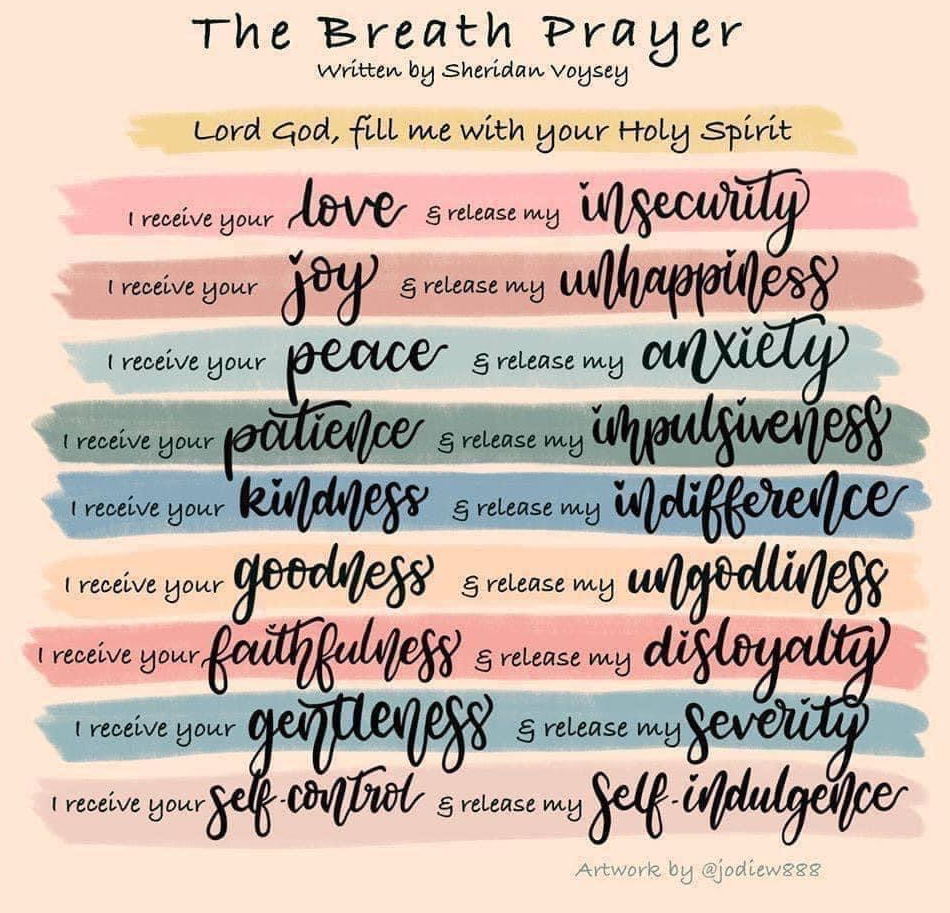
The Breath Prayer written by Sheridan Voysey Lord God, Fill me with your Holy Spirit. I receive your love & release my insecurity. I receive your joy& release my unhappiness. I receive your peace & release my anxiety. I receive your patience & release my impulsiveness. I receive your kindness & release my indifference. I receive your goodness & release my ungodliness. I receive your faithfulness & release my disloyalty. I receive you gentleness & receive my severity. I receive your self-control & release my self-control.*

*Some of these breath prayers are very Christian or too severe or ableist. I would be very careful before I gave these to an entire group. However they are good for ideas, and might be ok to be given as a choice with the gentle caveat that they are just ideas and do not fit everyone.

There is no end to what a living world will demand of you –Octavia Butler @BlackLiturgies author is Cole Arthur Riley who also wrote “This Here Flesh” Sermon Series (Which you may recall is a sister series to this one)

Inhale: The demand is too great Exhale: I deserve to stay whole @BlackLiturgies

Inhale: My “no” is sacred. Exhale: I can honor its Sound @BlackLiturgies

Meditate & Reflect: How does your body feel today?What practice brings you renewal? Who in your community is protective of your body and its needs? What dominant fear keeps you from saying “no'”? Explore its origins. What demands are you making of others that you can release?

@joynessthebrave This is your gentle reminder that one time in the Bible Elijah was like “god, I’m so mad! I want to die! so God said “Here’s some food. Why don’t you have a nap?” So Elijah slept, ate, & decided things weren’t so bad. Never understimate the spiritual power of a nap & a snack.
(This is one of my all time favorites)

“May we learn to honor the hammock, the siesta, the nap, and the pause in all its forms.” Alice Walker

Week 7 Notes

“Grind culture is a collaboration between white supremacy and capitalism. It views our divine bodies as machines. Our worth is not connected to how much we produce. We ignore our bodies’ need to rest and in doing so, we lose touch with Spirit. Our bodies are a tool agents for change. A site of liberation. The time to rest is now. Our collective rest will change the world because our rest resides in a Spirit of refusal and disruption. Resist is our protest. Resit is resistance. Rest is reparations.” p. 12

  1. Rest is a form of resistance because it disrupts and pushes back against capitalism and white supremacy. 
  2. Our bodies are a site of liberation
  3. Naps provide a portal to imagine, invent and heal
  4. Our DreamSpace has been stolen and we want it back. We will reclaim it via rest p. 13

Embrace knowing that you have been manipulated and scammed by a violent system as powerful evidence. Now with this knowledge you can grieve, repair, rest, and heal.” p. 17

Grind culture has traumatized us and then begin the lifelong process of healing from this trauma. This work is about more than simply naps and sleep, it is a full unraveling from the grips of our toxic understanding of our self-worth as divine human beings. Grieving in this culture is not done and is seen as a waste of time because grieving is a powerful place of reverence and liberation.” p. 28

“Once we know and remember we are divine, we will no participate and allow anything into our hearts and minds that is not loving and caring. We would treat ourselves and each other like the tender and powerful beings we are.” p. 29 Goodness and Mercy

“When I say sleep helps you wake up—it helps you wake up to the turret of who and what you are. And the system doesn’t want that. It would crumple und the weigh to this power.” p. 29 

“We can bend time when we rest and I’m grateful for the slowness and the embodied work of refusal. The way taking your time and disrupting the dominant culture’s need to rush is liberation. To just be, to just depend what already is and can never be taken from us is the praxis.” p. 32

“I want you to firmly plant yourself inside your imagination Take refuge in the beauty and power of community care and our daydreaming…Rest is a portal. Silence is a pillow. Sabbath our lifeline. Pausing our compass. Get your healing. Push back. Slow down. take a nap.” p. 32

“I want you to firmly plant yourself inside your imagination Take refuge in the beauty and power of community care and our daydreaming…Rest is a portal. Silence is a pillow. Sabbath our lifeline. Pausing our compass. Get your healing. Push back. Slow down. take a nap.” p. 32

“We are resting simply because it is our divine right to do so. That is it! Rest is this proclamation for a moment.” p. 62 Reclamation 

“As a person totally focused on our Spirits, souls, minds and bodies, I am worried about the road the Metaverse will play in an already sleep-deprived and disconnected world. There are too many ways to ignore the deep inner knowing, intuition, and divine wisdom that exists in us from birth already. To exists daily over time in a space of increased virtual experiences will have lasting effect on our ability to push back against capitalism and white supremacy.” p. 70

“My freedom from grind culture is intimately tied up in the healing and liberation of all those around me. Community care and full communal unraveling is the ultimate goal for any justice world, because without this we will be left vulnerable to the lie of toxic individualism.” p. 76

bell hooks all about love “‘mutual giving strengthens community’ Mutual and collective rest disrupts, interrupts, and heals. Our collective resting coordinated with traveling deep within our hearts begins the process of dismantling capitalism, white supremacy, racism, homophobia, ableism, and patriarchy.” p. 78 Rest Interrupts

“True liberation to me is to not be constantly attempting to prove our worth and ticking off to-do lists. To just be”. p. 80

 “You can begin to create a ‘Not-TO-Do List’ as you gain the energy to maintain healthy boundaries. Our opportunity test and re-imagine rest is endless. There is always time to rest when we reimagine.” p. 83

Emile Townes Womanist theologian “Liberation is a process. Freedom is a temporary state of being. Liberation is dynamic. It never ends.” p. 98

“Imagine a life outside of grind culture right now. You can create it because you are more powerful than you believe. We are more powerful than we belie. What liberations can you craft outside your grind culture.” p. 137

“The illusion of living within grind culture offers the myth of control. many of us are on automated, robot machine mode and there is not room here for the magic of mystery and Spirit to move in your life.” p. 140

Do not let your credit score, man-made poverty, and/or racism define your extreme power. Your body is a site of liberation.” p. 148

“You can rest. You can shift. You can heal. You can resist. You can lay down right now. If you are in a safe space that would allow for you to lay down, please do so as you read. If it’s not safe to recline. just slow down your breathing. Visualize your favorite place to slumber and relax. Go there in your mind. May these rest moments multiply as you integrate more into your daily practice.”  p. 148

Ideas to dream into p. 151-152: Safe surfaces to nap, silence as a sound, baths, stretching, detox from social media, experiment with naps, read poetry, meditate, journal

“You don’t have to be always be creating, doing, and contributing to the world. Your birth grants you rest and leisure as well.” p. 152

“Resting is not a state of inactivity or a waste of time. Rest is a generative space. When you are resting your body, it is in its most connected state. Your organs are regenerating. Your brain is processing new information. Your connecting with a spiritual practice. You are honoring your body. You are being present. All these thing are so foundational for liberation and healing to take root.” p. 153

“Your bodies don’t belong to capitalism, to white supremacy, or to the patriarchy. Your body is a divine temple and a place of generative imagination. A place of healing and freedom.” p. 153

“I believe any work that is rooted in wellness and justice and doesn’t include the collective, without a framework about dismantling and decolonizing, is incomplete work” p. 154

“I am forever inspired by bell hooks and Octavia Butler for believing in and teaching us about imagination as a tool of our greatest liberation.” p. 159

Meditation 159 to steal back time

“I believe specifically that my Ancestors, those enslaved on plantations, had their DreamSpace stolen. A theft. The space to just be replaced with racial terror and violent terror.” p. 160

“How would our justice work look different if all involved were not sleep-deprived?” 160

“What transmissions would we receive in our dreams that guide us to our liberation?” p. 160

“There is rest for the weary. For those working two or three jobs and still unable to pay rent consistently. For those parenting, working, and going to school, there is rest available to you. For the body that is unable to labor the long hours grind culture requires, rest is a refuge to you.” p. 161

“I am not overlooking the blatant reality of poverty, low wages, late-stage capitalism, corporations generation billions of dollars while the worker isn’t offered a living wage and all other trickery and abuse that make it feel impossible to thrive.” p. 161

“Rest is an imagination tool because it makes space to simply be. To be a human being is an ancient miracle that we overlook when we work so hard to prove our worth via exhaustion.” p. 161

Discernment Journal

  1. What do I feel called to do?
  2. How can I create space for me and my community to heal? What needs healing in me?
  3. Can the idea of unplugging and resting for a whole month be reimagined by creating smaller moment daily, weekly?
  4. What does intentional rest and care look like to you? Sketch a map out a visual.
  5. How is your heart?
  6. Who are you being?
  7. What are you Holding?
  8. What story are you telling yourself? What is a more liberating Story you can tell?
  9. How can you create rest in this moment?
  10. Are you ready to change?

p. 163

Go on Social Media rest to create space p. 163-168

“The Nap Ministry is a commitment to an ideal that may seem unattainable. This makes it revolutionary because it creates space to imagine and hope. Both are keys to our liberation. p. 174

“In Afrofuturism, there is a future where all current problems are solved. the future is now.” p. 177 We need to remember to imagine together

“Between growing up in the Black Church, watching what the Spirit can do for and to a person during embodied worship, paired with my obsession with Afrofuturism, it is easy for me to connect the dots to rest as a portal for healing.” p. 181

“I am very comfortable with embodiment and the idea of trusting deeply what is happening behind the scenes. Things essays and ears can’t see and hear.” p. 182

“Rest on a somatic level is a small resurrection. I have always been interested in the concept of community resurrection…A resurrection is a waking up into a new thing. It’s life, insight, breathing, refusing, think and a movement that is alive and made new. Rest is resurrection. A literal raising form the dead. Grind culture is a spiritual death.” p. 182-183

Meditations for rest

  1. I deserve to rest now
  2. I am worthy of rest
  3. I am not lazy. How could I be lazy? My Ancestors are too brilliant for that.
  4. Capitalism wants my body to be a machine. I am not a machine.
  5. I am a magical and divine human being.
  6. I have the right to resist grind culture. 
  7. I do not have to earn rest.
  8. Do less, watch how I thrive.
  9. Rest is my birthright.
  10. I will rest. 

p. 192-193

Week 6 Notes

Grief and Healing

“Capitalism was created on plantations. We as a culture class over this historical truth. We must grieve. Grieving is a sacred act and one of the ways we can begin to reconnect with out bodies, as we craft a rest practice.” p. 15

“A mind shift, a slow and constant practice filled with grace” p. 16

We should use every tool we have to constantly repair what grind culture has done to us” p. 16

Embrace knowing that you have been manipulated and scammed by a violent system as powerful evidence. Now with this knowledge you can grieve, repair, rest, and heal.” p. 17

“Resting is ancient, slow and connected work that will take hold of you in ways that may be surprising. Let deprogramming from grind culture surprise you. Let your entire being slowly begin to shift. Get lost in rest. Pull up the blankets, search for softness and be open to the ways rest will surprise and calm you.” p. 17

“We have been trained to believe that everything we accomplish is is because of our own pushing alone. This is false because there is a spiritual dimension that exists in all things and in everything we do. To understand that we are spiritual beings navigating life in a material world opens us to the possibility os rest as a spiritual practice. Our entire living is a spiritual practices. Much of our resistance to rest, sleep and slowing down is an ego problem….We can do nothing alone.” p. 18

“Grind culture has traumatized us and then begin the lifelong process of healing from this trauma. This work is about more than simply naps and sleep, it is a full unraveling from the grips of our toxic understanding of our self-worth as divine human beings. Grieving in this culture is not done and is seen as a waste of time because grieving is a powerful place of reverence and liberation.” p. 28

“A grieving person is a healed person. Can you guess why our culture does not want a healed person in it?” p. 28

“I believe the powers that be don’t want us rested because they know that if we rest enough, we are going to figure out what is really happening and overturn the entire system.” p. 29

Black Ancestors “They straddled the lines between exhaustion and always thriving. They moved mountains with their faith alone and created pathways for invention that I am still uncovering. They resisted every moment by exiting in a world that was not welcoming or caring.” p. 46

“Sunday was not a day of rest for my parents, especially my father. It was a day of working tirelessly for the Lord.” p. 49

“Sunday was not a day of rest for my parents, especially my father. It was a day of working tirelessly for the Lord.” p. 49 (Revenge Waking)

“His love of community and God fueled him endlessly, but the toxic side to this passion was his overworking, exhaustion, and lack of caring for his body.” p. 51

“Grind culture killed my father and is killing us physically and spiritually. Sleep deprivation is a public health issue and racial justice issue.” p. 54

“It is firm evidence that we as a culture don’t have clarity about what rest is and can be.” p. 55

“We are born knowing how to rest and listen to what our bodies need…This inner knowing is slowly stolen form us as we replace it with disconnection. We have been bamboozled and led astray by a culture without a pulse button.” p. 55

“Everything we believe we know about rest is false.” p. 55

World is groaning/birthing (grieving) and systematically trying to give birth to a new one, we need to rest and let it do its thing: Romans

“I know that saving my own life from the exhaustion of racism, poverty, and sexism made space for all, no matter their race, to also begin dismantling process from these systems.” 

“I know that my visualizations of what a world without capitalism and oppression looks like is based on something I have never experienced in this lifetime. IT is dreamworld and alchemy. p. 57

“In postmodern womanist theology, salvation is an activity… A postmodern womanist theory strives for tangible representations of good. The good includes justice, equality, discipleship, quality of life, acceptance and inclusion” Monica Coleman p. 58 

“Yes the system continues raging and destroying, but we will not be able to tap into spaces of freedom, joy , and rest by pushing our precious bodies and minds in abusive ways. To rest is to creatively respond to grind culture’s call to do more. It’s the possibility of rest, reparations, resurrection, and repair that holds us like a warm, soft blanket. “ p. 59

“How do we transform grief to power?” p. 59 grief article https://pres-outlook.org/2023/05/grief-as-innovation/?fbclid=IwAR0-hhwOI0DYgJoZq-PE5g1OMEten2iGyq5kyYwJii6ozZWqfQgNYHJAV_w

“There is space to just allow rest to settle and answer the questions for us.” p. 60

“We must remain committed to building community and go into the deepest cracks to gather and care for anyone left behind. Trading each other and ourselves and with care isn’t a luxury, but an absolute necessity if we’re going to thrive. Resting isn’t an afterthought, but a basic part of being human.” p. 61

We must make space for rest in small and large ways.” p. 61 Make room for the Holy Spirit–is this what that phrase means? Make room for hope, is this what this means?

CORRECTION “The concept of filling up your cup first so you can have enough in it to put to others feels off balance. It reeks of language that is part of our daily mantra. Language like ‘I will sleep when I am dead,’ “rise and grind,’” and is geared to women p.62 esp. marginalized!!! 

“I propose that the cups all be broken into little pieces” Something about communion here p. 63 

“I don’t want to pour anymore. p 63

Week 5 Notes

Worth and Blessedness

“We have been trained to believe that everything we accomplish is is because of our own pushing alone. This is false because there is a spiritual dimension that exists in all things and in everything we do. To understand that we are spiritual beings navigating life in a material world opens us to the possibility os rest as a spiritual practice. Our entire living is a spiritual practices. Much of our resistance to rest, sleep and slowing down is an ego problem….We can do nothing alone.” p. 18

“Fear is a function of grind culture..” p. 22

“We believe we are only meant to survive and not thrive. We see care as unnecessary and unimportant. We believe we don’t really have to rest. We falsely believe hard work guarantees success in a capitalist system. p. 24

The thought of not doing, even for a short time, is seen as lazy and unproductive. So an explanation for rest as a form of justice is layered and danced.” p. 27

most concise ways: “Rest makes us more human. It brings us back to our human-ness. To be more human. To be connected to who and what we truly are is at the heart of our rest movement.” p. 27

“Rest is not a privilege because our bodies are still our own, no matter what the current systems teach us….Our bodies and Spirits do not belong to capitalism, no matter how it is theorized and presented.” p. 28-29

“I Trust the Creator and my Ancestors to always make space for my gifts and talents without needing to work myself into exhaustion.” p. 29

“Our rest is centered on connecting and reclaiming our divinity, given to us by our birth.” p. 62

“Without examining ;the hold social media has over our lives, we will never be able to push any rest movement forward. IT’s simply not possible because social media is an extension of capitalism.” p. 71

“I see the brilliance and miracle of human beings. We are not machines.” p. 74

“Is the Nap Ministry just for Black people?’ The question itself stems from a white suprematist mindset that refuses to accept this truth: Black libration is a balm for all humanity and this message is from all those suffering from the ways of white supremacy and capitalism.” p. 75

“White people have had their humanity stripped from them via white supremacy. They are spiritually deficient and blinded by the idea that they are superior to other divine human beings. The lineage of terror, violence, enslavement resides in those bodies and hearts.” p. 76

“My freedom from grind culture is intimately tied up in the healing and liberation of all those around me. Community care and full communal unraveling is the ultimate goal for any justice world, because without this we will be left vulnerable to the lie of toxic individualism.” p. 76

“Rest is a meticulous love practice.” p. 147

“Do not let your lack of money and possessions make you feel negative about your worth as a human being.” p. 148

Do not let your credit score, man-made poverty, and/or racism define your extreme power. Your body is a site of liberation.” p. 148

“Your birth was not a coincidence.” p. 148

“You can rest. You can shift. You can heal. You can resist. You can lay down right now. If you are in a safe space that would allow for you to lay down, please do so as you read. If it’s not safe to recline. just slow down your breathing. Visualize your favorite place to slumber and relax. Go there in your mind. May these rest moments multiply as you integrate more into your daily practice.”  p. 148

“You don’t have to be always be creating, doing, and contributing to the world. Your birth grants you rest and leisure as well.” p. 152

Week 4 Notes

Do you remember daydreaming as a child?

“To hear the simple and bold proclamation ‘You are doing too much. You can rest. You can just be. You can be’ is revolutionary.” p. 96

“Who taught you the capacity to dream?…When ddi your desire to daydream fade away?” p. 98 (some people think that ritual is the capacity to dream together

Twitter Post:

I’m reading a fascinating little book by Byung-Chul Han called *The Disappearance of Rituals.* In it, Han makes the provocative implication that ritual is actually a kind of “play.” With the disappearance of rituals (communal performances that cultivate recognition and stability), “The holy seriousness of play gives way to the profane seriousness of work.” Thus we become an atomized, isolated, and narcissistic society oriented toward industry instead of community. Han writes, “Rituals and ceremonies are the genuinely human acts which allow life to appear to be an enchanting, celebratory affair. Their disappearance desecrates and profanes, transforming life into mere survival. we might thus expect a re-enchantment of the world to create a healing power that could counteract collective narcissism.”

“Daydreaming is a form of rest and feels like the opening of your great doing what it’s supposed to do… A blanket of care swaddling you tightly. A comforting now. We are socialized into systems that cause us to conform and believe our worth is connected to how much we can produce…we forget how to dream. This is how grind culture continues. We internalize the lies and in turn become agents..” p 99 ex: Holy Imagination, Anne of Green Gables

Audre Lorde Poetry is not a Luxury “Poetry is not only a dream and vision: it is the skeleton architecture of our lives. It lays the foundation for a future of change a bridge across our fears of what has never been before.” p. 100 humans need art, Hogfather: Humans need to imagine justice

“All right,” said Susan. “I’m not stupid. You’re saying humans need… fantasiesto make life bearable.”

REALLY? AS IF IT WAS SOME KIND OF PINK PILL? NO. HUMANS NEED FANTASY TO BE HUMAN. TO BE THE PLACE WHERE THE FALLING ANGEL MEETS THE RISING APE.

“Tooth fairies? Hogfathers? Little—”

YES. AS PRACTICE. YOU HAVE TO START OUT LEARNING TO BELIEVE THE LITTLE LIES.

“So we can believe the big ones?”

YES. JUSTICE. MERCY. DUTY. THAT SORT OF THING.

“They’re not the same at all!”

YOU THINK SO? THEN TAKE THE UNIVERSE AND GRIND IT DOWN TO THE FINEST POWDER AND SIEVE IT THROUGH THE FINEST SIEVE AND THEN SHOW ME ONE ATOM OF JUSTICE, ONE MOLECULE OF MERCY. AND YET—

Death waved a hand.

AND YET YOU ACT AS IF THERE IS SOME IDEAL ORDER IN THE WORLD, AS IF THERE IS SOME…SOME RIGHTNESS IN THE UNIVERSE BY WHICH IT MAY BE JUDGED.

“Yes, but people have got to believe that, or what’s the point—”

MY POINT EXACTLY.”

– Terry Pratchett, Hogfather

Rest Poem p. 101 (read to congregation)

Cultivate DreamSpace p. 106-107

p. 124
More Care.
More Therapy.
More Dreams
More Daydreaming
More DreamSpace
More Meditation.
More Love.
More Calls to Say, “How Are You Feeling?”
More Love Letters.
More Bedtime Stories.
More Strength to Love.
More Naps.
More Rest.
More Sleep.
More Care.
Place Us in a Dream Trance.

“This is not a book offering a step-by-step rigid list for you to find rest in a capitalist system. As a culture, we have already given ourselves over to a rigid binary that is neither expansive nor imaginative.” p. 125

Rest As Resistance Week 1 Notes

“We have been trained to believe that everything we accomplish is is because of our own pushing alone. This is false because there is a spiritual dimension that exists in all things and in everything we do. To understand that we are spiritual beings navigating life in a material world opens us to the possibility os rest as a spiritual practice. Our entire living is a spiritual practices. Much of our resistance to rest, sleep and slowing down is an ego problem….We can do nothing alone.” p. 18

“All of culture is in collaboration for us not to rest. This includes: K-12 public education, higher education, faith and religious denominations, medical industry and not-for-profits, activist organizations, corporations.” p. 24

“We are divine. Our bodies are divine and a site of liberation. Wherever our bodies are, we can find, snatch, and center rest.” p. 26

“When we honor our bodies via rest, we are connecting to the deepest parts of ourselves. We are freedom-making.” p. 26 

“You are worthy of rest. We don’t have to earn rest. Rest is not a luxury, a privilege, or a bonus we must wait for once we are burned out.” p. 28

“I want you to firmly plant yourself inside your imagination Take refuge in the beauty and power of community care and our daydreaming…Rest is a portal. Silence is a pillow. Sabbath our lifeline. Pausing our compass. Get your healing. Push back. Slow down. take a nap.” p. 32

P. 34 Body Scan breathing exercise

This Here Flesh Notes Ch 14 Memory

Ch 14 Memory Notes

“I hope when God brings heaven down, they bring with them the storytelling circles of old-that we would all gather around the fire listening to the ancestors, singing familiar songs. I don’t want to make it to the promised land if it means I forget the wilderness” p. 172

“Memory is frail. It requires a dictate touch, a tenderness…Sometimes it is only in the hands of another a memory of another that a memory can be fully encountered…This is the beauty of collective memory.” p. 174

“I think the whole Bible is predicated on collective remembrance. You have feast and fast days, storytelling’s and most conspicuously, the Eucharist. Z shared table and shared loaf. Take, eat, drink. The Christian story hinges on ceremony of communal remembrance.” p. 174

Road to Emmaus 

“The truest memory is rarely the one that survives” p. 175

“Why do we need to remember truthfully? Because every untruthful memory is unjust memory, especially when it concerns relationships, fraught relationships of violence’ Miorslav Volf said, In this way, communal storytelling can be an act of justice.” p. 176

“When a person or group has no artifacts to reconstruct their stories, things slip away across generations. People slip away.” p. 178

“we must learn to create our own artifacts.” p. 178 White people have a lot of these, perhaps over and above storytelling

“Bible says Samuel erected a large stone so everyone would remember God had protected them.” p. 178

Hagar Genesis 16:13 The God who sees 

“Traditionally, Western Christianity has replaced Christian habits of storytelling with singular and all-encompassing testimonies of a person’s conversion to faith. This is sad to me. We must recover a habit of very specific story exchange and shared memory if we are to have robust liberation.” p. 181 

This Here Flesh Notes Week 9 Justice and Liberation

Ch 10 Justice

“Justice is different from violence and retributions; it requires complex accounting” p. 122

“Justice doesn’t choose choses dignity is superior. It upholds the dignity of all those involved, no matter whom it offers or what it costs.—there is no liberation without justice.” p. 123

“The freedom of God’s people did not occur in a vacuum. There were consequences. There was truth-telling. And there was a disturbingly costly justice.” p. 124

“Activism is the body of justice” p. 125

Habakkuk” In weariness and frustration, demanded God do something..the Christian story is the tensions between the promise of justice and liberation and the unjust and oppressive patterns in our daily lived experiences. “ p. 128-129

“Assata Shakur ‘Nobody in the world, nobody in history, has ever gotten their freedom by appealing to the moral sense of the people who were oppressing them’…They are parched and delirious, their memory of themselves tainted. Their only hope is the hear the voices of the marginalized hiding them back to the water—a mercy they will not immediately understand. It is not until they drink from the streams that the prophet Amos calls on to roll down like justice and righteousness that their withering sons regenerate, and they recognize that all this time, the problem was not that they were thirsty; it was that they were were cursed.” p. 129

Land and Justice are the same p. 132, 133 bc we all live here 

Ch. 15 Liberation: Summation You deserve more than the despair that stalks your days. You don’t have to make a sound; just let the peace pass through your belly and be what you need it to be. p. 169

No notes, plan to reread

Full Liturgy Here

This Here Flesh Notes Week 7 Repair and Joy

Ch 11 Repair

“I think confession is liberation” p. 137

“dismantle their delusion of heroism or victimhood and begin to tell the truth of their offense, a sacred rest becomes available to them. You are no longer fighting suspend the delusion of self. You can just lie down and be in your own sling. And as you rest, the conscience you were born with solely begins to regenerate. “ p. 137

“confession alone…serves the confessor more than the oppressed.” p. 137

“Reparations are required…what has been stolen must be returned.” p. 138

even God themself is not too bold to undo the way things were meant to be, to show the most tragic and noble reparation” p. 138

“Sincere remorse” “apologize with grave specificity…look at me…describe what in you made you do it…I want your soul to write lie it was the back of God that was cut” AND “ask to be forged” p. 140 

Forgiveness can grow slowly and unity/reconciliation can be slow and painful p. 141  (Black woman’s answer)
“I don’t know if liberation depends on our reconciliation with others, but I am certain it at least depends on our reconciliation with ourselves” peace with her body, protected her inflamed legs instead of enemies  p. 144 

Touch Christ’s Wounds?

Father’s recovery did not feel like triumph “you feel ashamed. It’s once you’re clean that you remember.” p. 145

“As we heal, the need for more healing becomes apparent to us. It is painful, but healing makes us better perceivers of what is still hurting.” pp. 145

Father has 1,000 scars that “welded his selfhood back down and delivered back to me. I am indebted to every mark.” p. 146

Ch. 13 Joy

“When your child chooses you…” p. 159

I think we were made to e delighted in. And I think it takes just as much strength to believe someone’s joy about you as it does to muster it all on your own.” p. 159 

“I think when we give ourselves to play, the scope of ours lives expands.” p. 160

“After all, it is only in anticipation of sorrow that joy seems frivolous.” p. 161

“We become so used to bracing for the next devastation we don’t have time or emotional energy to rejoice. “ p. 161 “Some of us even begin to believe we are not worthy of pleasure or play.” 

“You know it’s joy when you feel it in your entire body” p. 163 Great Grandma Hedges “built for fun”

“My gramma’s deepest experiences of joy come in moments when if feels as if something has been restored or renews. When repair happens, we must bear witness to it. Joy does that. IT trains us toward a spirituality that isn’t rife with toxic positivity but is capable of telling the truth and celebrations when restoration has indeed happened.” p. 165

Depressed, “it was not that my family wanted me happy; it was that they wanted me close. They didn’t wan for me the kind of sadness that alienates you.” p. 168

“Mine is a joy born not of laughter but of peace. That is okay. p. 169

Ezra 3:13 

Full Liturgy Link

Week 6 Rage Notes

“fig tree was the private preface to the very public force of anger in the temple the face of injustice and exclusion, we meet a God of holy, premeditated, bodily, unapologetic rage.”  p. 109

“What does it mean that Christ doesn’t just scream but also physically overturns tables? What does it mean that Christ doesn’t just lament the bare fig tree but damns it, leaving his followers with gaping mouth and no immediate resolution?” p. 109

“I like that GOd doesn’t play or talk nice to the hands of injustice.” “I can name very few instances (none, arguable) of a niceness in God, and yet this is the demand of the oppressor will always make of us. p. 110

“I’ve determined I will no longer settle for mere articulation of anger. I want to feel my voice shake and the warmth cree up up my spine.” p. 111

“I remember when I first read the psalmist begin God to break the teeth of his enemies…Anger expressed in the interior life is permitted to exist in its rawest and most honest form.” p. 113

“If you read the psalms, you’ll find no small number of them committed to rage. Calling for a creditor to seize money from the oppressors, begging for bones to broken, enemies to be wiped out, their descendants punished. These imprecatory psalms were a liberation to me because they finally told me the truth—that is, I belong to a God capable of holding the ugliest parts of my anger.” p. 113

Private anger doesn’t have to be public, but our wounds can be seen, and some anger, on behalf of the dignity of others can be justified p. 114 

Justifiable Anger is amazing, but you have to have a care that it doesn’t turn to hate. Hatred should only be directed towards evil and not creation, very fragile and difficult to contain towards where its meant to be p. 114

Scream when you need to