A nice shout out to the blogs of workings moms, especially those in ministry!

320 × 320 – myraloves.com
http://christianitypaused.blogspot.com/2013/03/mims-word.html

A nice shout out to the blogs of workings moms, especially those in ministry!
http://christianitypaused.blogspot.com/2013/03/mims-word.html
I know a lot of pastors who are trying to redo their committees, but the truth is I just don’t have any at my church.
Well I have two the deacons (our hospitality and care ministry) and facilities (the same four guys who have been taking care of the church for decades)……and that is about all we can support.
So when I want to have an Easter Program, do Christian Ed, Run a Farmer’s Market (which we did last summer and will again this summer), or do a play of Charlie Brown Christmas, run a breakfast/dinner, etc. The buck stops with me not a committee.
The session (my governing board) is 6 people, usually I have about 5 devoted people and 1 person who is too busy with “life” to be able to put a lot of time in. The session makes lots of decisions, but they also end up leading (almost) everything that isn’t already designated to the other two committees.
We only have 30-40 adults participating in church so about 6 who are too elderly (too being a relative term our facilities committee as a 70-something year old on it) and unable to do things. 6 people on session, 4 on facilities, 6 on deacons, plus 5 or 6 people who attend but aren’t really members (for whatever reason, probably so they don’t have to be on session, although technically these people could do committee work, but you don’t want to overwork the newcomer right)
((Too often we focus more on the structure of the church than the welcome for our new membership……))

Somehow the buck always stops with me. The session makes a decision, and often it reads as “we will support you as you do that” instead of “how can we build a team to do that”
I am not casting blame here. The church is only 30-40 people, some of whom are too infirm to take up the mantel of leadership, some of whom lead in spite of their age, some of whom attend but aren’t members, and the rest serve, and serve and serve…
So the question is, is there a way to do this without committees? How do we do all the “work” of the church that needs to get done? How do we streamline? How do we garner support? How do we get the community on board?
Committees are out, I’m ready for a new way to plan!

If you are a hard case theologian you know about the deep debate between emergent Christians (McLaren, Rob Bell, Brian Berghoef, etc) and the more (what is a non-insulting term for traditional, because I totally do not want to discredit these scholars) academic Christians such as James K. A. Smith
If your not, then this post will hopefully help. Here are some of the important conversations going on about whether emergent Christianity is a pick and choose/fluffy type of theology or alternatively, whether the tried-and-true-Christian scholars are providing too many answers on behalf of God instead of letting God give the answers….(that’s it in a nutshell, you can skip to the bottom if you don’t want the in-depth version)
One back and forth is about “God doesn’t need our help” and a more emergent understanding/refutation here.
One of the things hot under debate is giving up God for Lent, which tries to take seriously the critiques of Christianity. An article about Giving up God for Lent is here. This is something I am trying and a critique that it is a movement for intellectual (eggheaded) theologically trained (clergy) young (millenials)…which he definitely has the audience right, I am all of that–oh and I really appreciate the respectful tone of this critique…
RESTART HERE IF YOU’VE SKIPPED DOWN!!!!
As us young folks try to struggle with what church means to us–ie the emergent church, and what it could mean to the nones….I find all of this debate and forethought invigorating. Sure we don’t have the answers, but I think that looking at THEOLOGY as the source of our institutional woes (as opposed to programming, attendance or money) is a grand start.
To me the answers are to start doing the things we know the church is good at, and then build from there (strength based training anyone? anyone? ). How can we be community centers (we used to be good at that) how can we form relationships with our neighbors (we could be good at that) how do we work for social justice (I always say that human rights issues should be the ones all Christians can agree on)….

And yes we have gone through such questions before, What if God was one of us? Jesus Christ Superstar, Godspell, The Quest for the Historical Jesus come to mind. But remember, whenever people are thinking and talking about God, they are, in essence, working out their faith–and isn’t that what we at the church want to encourage? Questions, speculations, riddles and wonders about God? It’s certainly Biblical…

My church is taking its slow, we are starting farmer’s market with no ulterior motive for members or money (or at least attending to when we think about these ulterior motives) and simply getting to know the neighborhood. We are thinking theologically about our church space (we are blessed with a “great location” it would be great if we could prayerfully use it), we are consciously trying to accept people whereever and whoever they are through the strength and guidance of the Holy Spirit (Won’t You Be Our Neighbor?)…
I don’t know where this is leading, but hey, at least we are talking about it–I’d be even more excited to see these “opposing” viewpoints working and praying together, after all doesn’t the body have different parts for different reasons? (1 Cor 13:1-13)
The farmer & the pastor walked thru a field where the fence was down. The pastor said, “Guess you have some work to do here.” The farmer says, “My work is to decide what doesn’t absolutely have to be done right away.” The pastor says, “mine too.”
Sören Kierkegaard, 19th century
“Christ turned water into wine, but the church has succeeded in doing something even more difficult: it has turned wine into water.”
Only the church can do that! Take Jesus’s Wine and turn it back into water–how do we do this, by constricting God
Item 1: Grace
Do you know what grace is? Its abundance. Grace is giving room for someone else in your life, so that they can be themselves. Its giving space to someone else. God’s grace is abundant–God moved Godself aside to make room to create us, so that we can be something other than God.
Christians job is practice that hospitality, to make room for EVERYONE in the church, and to make certain that we aren’t trapping God in our structures, limiting who God is and when God is relevant.
Consider if we said music can only be delivered thru a tape deck, music would be dead.

Item 2: Church is Boring
When we say God can only exist in a formal church, when we say our understa nding is the “correct”
(this is the opposite of open-sourcing church which is the way all information is going see Open Source)
If we make God ordinary, everyday; unexceptional and predictable.
We constrain God to what we understand her to be (see what I did there?)

We would rather tame Jesus than trust him (hence the above)
In fact, as I explained my job to a Japanese man who I am tutoring in ESL–he said that he found it amazing that we were applying a 2,000 (whereabouts) document to everyday life, and he asked how that worked, and I said that was basically my job, to talk about why its still relevant today and give the big message of God’s Grace and Love through the little stories and messages in the Bible…
“ah” he said “so your a translator” smart man that 🙂
Item 3: the Story (wedding at Cana) John 2:1-11
Name: Jesus
Location: Wedding
Mission: to Party people into the kingdom (through hospitality, wine and grace)
Jesus makes space for us, and gives us abundant love–making space for us, and we as the church should be doing the same
Item 4: the Translation (otherwise known as timing is everything for God, and we need to see God acting beyond the here and now to make the here and now better!–this is a deep thought for a parenthetical, oh well)
1. I’ve been praying about some kind of immigrant service due to a congregant’s problems getting a santioned-job-and-also-visa…plus I’ve been tutoring ESL on the side (again, this is what I do because the kids gotta eat). An offer came in last week for an immigration center to rent space for an office from us (rent, can you believe it) how perfect is that?
2. My church enjoys the “perfect” location, being high in demand for functions–we have been leveraging that into money…instead we are going to make the move to try to be theological & intentional in how we use the space (I’d like to have a ceremony dedicating the spaces of the church)
3. A congregant once suggested that we get snuggies for everyone in the church–our church is cold and hard to heat (ah the beauty of the 70s A-frame building). We could be known as the snuggie church–some people might feel that isn’t “proper” but lets face it I think being warm and comfortable is a more realistic presentation of God than shivering in nicer clothes….
The point is that God gives to us abundantly, and she does so by giving us new ways to understand, by giving us new people to enjoy relationships with and by full-on giving us permission to party people into the kingdom (who doesn’t love a wedding?)
Item 4: Happiness and Holiness
Plus! Jesus consecrates happiness
Sometimes, the church has forgotten that our Lord once attended a wedding feast and said yes to gladness and joy,” Robert Brearley writes. “God does not want our religion to be too holy to be happy in”(Feasting on the Word Year C, Vol. 1)….suppose we took every time we are happy as a holy time (note I did not say that we are only holy when we are happy). What if we celebrated, promoted happiness and in that way opened the way for God’s glory in the world?
Jesus is calling us to abundance, to happiness and to grace–and we need to be certain the church is concentrating on those instead of on the programs, the pews, the property, and the payments. These things do not make a church. People and Prayer do!!!
PS Here is today’s Coffee with Jesus, Apropos much?

http://www.faithandleadership.com/blog/01-10-2013/david-lose-its-time-think-differently
“What’s the problem? someone might ask. “People don’t go to church in the numbers they used to,” we answer. No, that’s not the problem. “People don’t give money to programs like they once did.” Nope, not that either. These are just symptoms.
And as long as you think the problem is lower attendance or giving, then the only possible response is to do what we’ve always done, except do it better. We preach the same as we always did, except now we use screens and PowerPoint. Worship hasn’t really changed, but now we’ve thrown in a drum set. What we are doing is fundamentally the same, yet we somehow expect different results….(excerpted from above blog)”
hmmm….maybe the problem is THEOLOGICAL
Ie changing the time of church or the order of worship and adding more programs (the most common solutions I’ve seen to “change” the church) do not an exciting/relevant church make.
Recently my friends and I had a discussion on facebook about what church is…here is a microcosm (kind of the adverse of NPR’s study on why people don’t go to church, we discussed what church could/should be)
Tim said “A lot of theological terms confuse and get misconstrued…and I think you’re right – finding the people locally rather than them finding you. How? is the big question. Through all the misconceptions and stigma “church” gets, it’s a real challenge. There has to be some risk-taking…”
Shellie said…”Yes!!! It’s life together, authentic relationships, passionate worship, interactive study of scripture, no agenda or programs to distract or divide us, communion as a meal gathered at the table. Intimate yet informal, depth yet accessibility. A truly beautiful expression of the Church”
Tim said “Distractions being key there. We are easily distracted into thinking the programs/building/structure is “church” even when we agree that the “church” is relationships between God and people.”
Shellie said “Yes. Exactly. I’ve worked in several churches where – even with the best of intentions – the emphasis shifts to the curriculum, programs, worship service performance – and relationships slide further down the priority list. And it’s not just a pastoral problem or leadership problem – the “church” has grand expectations for its pastors.” and “es!!! How often does “do authentic relationships” or “serve the widowed, poor, oppressed” or “spend face-to-face time with the unlovely or persons outside the faith” show on our job descriptions of the church’s expectations?”
Oh and I said some stuff too…
“i think that’s what confuses people, they think church is just for belief, but I maintain its for unbelievers and faith (belief is something else!)”
“Awesome, its so hard, I think that we “do” church differently and a lot of people who are friends of mine would come, but now I need to find those people locally, I think that the idea of “church” gets in our way”
“I always say that when the church bought its first building everyone was probably like “what? That’s crazy, that won’t be real church, real church happens in peoples houses” etc, etc. all the objections people have to churches without pews or in different locations (coffeeshops, etc)”
“lol which is hilarious because the pastor’s job is to put themselves out of a job (teach others to pray, teach others to preach, teach others to lead–but church’s do focus on the programs”
The convergence continues
(Young Spiritual (and maybe not religious) people are converging! See the following article for more about the awesome convergence!!!)

There has been an unspoken understanding that the church parking lot is fair game in the neighborhood. Recently people have been throwing trash in our dumpster to move and advertising free parking with the house that was on the market, re: our parking lot.
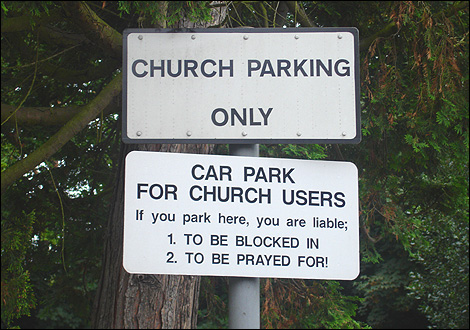
Maybe we should have a sign like this——>>>>>>>>>>>>>>>>>>>

We have left notes and had conversations (Mostly in which the drivers were angry with us) about the fact that as the church increases our activity it is harder for us to let them park, especially since we have signs all over saying its illegal anyway (and I really don’t want to tow anyone to get my point across) I’ve been struggling about what to do with this, on the one hand it feels like we have been taken advantage of, on the other hand I want to practice Grace.
Grace is not safe. It is not an easy or even “nice” course. Grace is dangerous, its opening up your vulnerabilities and allowing others to be vulnerable too. How? Grace is giving space to another. Space for them to live into themselves, and there is a cost.
God is the God of grace because she created a space within herself in order to create us (Moltmann does a good job of describing this). God created space separate from Godself in order to create us, her children.
Grace is giving space to people who you don’t want to give space so and forming relationships AS you give them that space. Its acknowledging that everyone is human and broken
Sidenote: My church going to see Les Mis and discuss grace, but here is (I think) the point “Grace making bad guys into Good Guys and Good Guys into heroes since the beginning of time”–Katy Stenta
So what am I going to do about the people who are taking up space in our parking lot? I think maybe I’ll go over, tell them that I’ve noticed that they have parked in our lot and invite them to church…

How can a pastor save a dying church??? read here to find out!
 Whenever a congregation goes looking for a new pastor, the first question on their minds when the committee interviews a new candidate is: Will this pastor grow our church?
I’m going to go ahead and answer that question right now: No, she will not.
No amount of pastoral eloquence, organization, insightfulness, amicability, or charisma will take your congregation back to back to its glory days.
What then can your pastor do? She can make your board meetings longer with prayer and Bible study. She can mess with your sense of familiarity by changing the order of worship and the arrangement of the sanctuary. She can play those strange new songs and forget about your favorite old hymns. She can keep on playing those crusty old hymns instead of that hot new contemporary praise music. She can bug you incessantly about more frequent celebration of Communion. She can ignore your phone…
View original post 562 more words
We say we want young people at church, but how do we make worship accessible for young families (that means the adults and the children) Here is one way
In the first issue of PLGRM, Rev. LeAnn Watkins, rector at St. Mary’s Episcopal Church in St. Paul, MN, shares how after numerous attempts of increasing attendance of bible studies and other church-related programs, her staff decided to cancel it all – everything during the weekdays except seasonal services. You can hear her tell her story on the Episcopal Story Project. She says, “You can’t chase after folks and expect them to hear you. You have to be in front of them when they are coming toward you. So we’ve tried to ask the question, ‘How do we stop chasing people, and get in front of people?'” I have to say that I ask myself the same question.
Not unlike many churches, I can no longer assume that those sitting in the pews are familiar with Bible stories such as Noah and the Ark, Jonah and the Whale…
View original post 841 more words


 katyandtheword