Convergences, Nones and the church is dying (do you believe in resurrection?)

http://www.faithandleadership.com/blog/01-10-2013/david-lose-its-time-think-differently

“What’s the problem? someone might ask. “People don’t go to church in the numbers they used to,” we answer. No, that’s not the problem. “People don’t give money to programs like they once did.” Nope, not that either. These are just symptoms.

And as long as you think the problem is lower attendance or giving, then the only possible response is to do what we’ve always done, except do it better. We preach the same as we always did, except now we use screens and PowerPoint. Worship hasn’t really changed, but now we’ve thrown in a drum set. What we are doing is fundamentally the same, yet we somehow expect different results….(excerpted from above blog)”

hmmm….maybe the problem is THEOLOGICAL

Ie changing the time of church or the order of worship and adding more programs (the most common solutions I’ve seen to “change” the church) do not an exciting/relevant church make.

Recently my friends and I had a discussion on facebook about what church is…here is a microcosm (kind of the adverse of NPR’s study on why people don’t go to church, we discussed what church could/should be)

Tim said “A lot of theological terms confuse and get misconstrued…and I think you’re right – finding the people locally rather than them finding you. How? is the big question. Through all the misconceptions and stigma “church” gets, it’s a real challenge. There has to be some risk-taking…”

Shellie said…”Yes!!! It’s life together, authentic relationships, passionate worship, interactive study of scripture, no agenda or programs to distract or divide us, communion as a meal gathered at the table. Intimate yet informal, depth yet accessibility. A truly beautiful expression of the Church”

Tim said “Distractions being key there. We are easily distracted into thinking the programs/building/structure is “church” even when we agree that the “church” is relationships between God and people.”

Shellie said “Yes. Exactly. I’ve worked in several churches where – even with the best of intentions – the emphasis shifts to the curriculum, programs, worship service performance – and relationships slide further down the priority list. And it’s not just a pastoral problem or leadership problem – the “church” has grand expectations for its pastors.” and “es!!! How often does “do authentic relationships” or “serve the widowed, poor, oppressed” or “spend face-to-face time with the unlovely or persons outside the faith” show on our job descriptions of the church’s expectations?”

Oh and I said some stuff too…

“i think that’s what confuses people, they think church is just for belief, but I maintain its for unbelievers and faith (belief is something else!)”

“Awesome, its so hard, I think that we “do” church differently and a lot of people who are friends of mine would come, but now I need to find those people locally, I think that the idea of “church” gets in our way”

“I always say that when the church bought its first building everyone was probably like “what? That’s crazy, that won’t be real church, real church happens in peoples houses” etc, etc. all the objections people have to churches without pews or in different locations (coffeeshops, etc)”

“lol which is hilarious because the pastor’s job is to put themselves out of a job (teach others to pray, teach others to preach, teach others to lead–but church’s do focus on the programs”

The convergence continues

(Young Spiritual (and maybe not religious) people are converging! See the following article for more about the awesome convergence!!!)

Shasta and Aslan -Horse and His Boy

Thoughts about where the church is heading and how God ties us all together…

Bryan Berghoef's avatarpub theologian

old_church_door

A few writers, thinkers, pastors, and theologians (Brian McLaren and Eric Elnes, among others) note that a new convergence is happening within Christianity.  McLaren notes:

“A new coalition is already happening, as existing organizations and emerging networks discover one another and realize they have independently reached common conclusions.”

Hence, convergence.

While more conservative churches may well become even more strict with the changes afoot in the culture and in the church, McLaren notes that others are expanding outward, and this convergence will be comprised of people from four general streams:

That new coalition, I believe, will emerge from four main sources:

  1. Progressive Evangelicals who are squeezed out of constricting evangelical settings.
  2. Progressive Roman Catholics (and Eastern Orthodox) who are squeezed out of their constricting settings.
  3. Missional mainliners who are rediscovering their Christian faith more as a missional spiritual movement, and less as a revered and favored religious institution.
  4. Social justice-oriented…

View original post 699 more words

Its not safe…

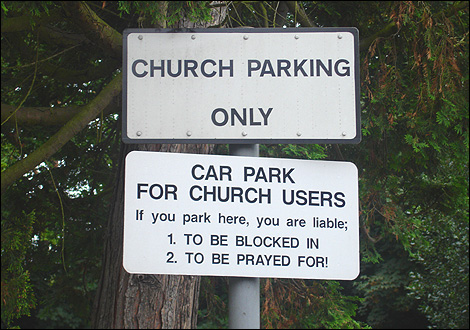
There has been an unspoken understanding that the church parking lot is fair game in the neighborhood. Recently people have been throwing trash in our dumpster to move and advertising free parking with the house that was on the market, re: our parking lot.

Maybe we should have a sign like this——>>>>>>>>>>>>>>>>>>>

We have left notes and had conversations (Mostly in which the drivers were angry with us) about the fact that as the church increases our activity it is harder for us to let them park, especially since we have signs all over saying its illegal anyway (and I really don’t want to tow anyone to get my point across) I’ve been struggling about what to do with this, on the one hand it feels like we have been taken advantage of, on the other hand I want to practice Grace.

Grace is not safe. It is not an easy or even “nice” course. Grace is dangerous, its opening up your vulnerabilities and allowing others to be vulnerable too. How? Grace is giving space to another. Space for them to live into themselves, and there is a cost.

God is the God of grace because she created a space within herself in order to create us (Moltmann does a good job of describing this). God created space separate from Godself in order to create us, her children.

Grace is giving space to people who you don’t want to give space so and forming relationships AS you give them that space. Its acknowledging that everyone is human and broken
Sidenote: My church going to see Les Mis and discuss grace, but here is (I think) the point “Grace making bad guys into Good Guys and Good Guys into heroes since the beginning of time”–Katy Stenta

So what am I going to do about the people who are taking up space in our parking lot? I think maybe I’ll go over, tell them that I’ve noticed that they have parked in our lot and invite them to church…

“While Nevin’s …

“While Nevin’s elevation of the church to the status of being Christ’s mystical body resulted in a condemnation of his views by his contemporary, Charles Hodge (1797-1878), president of Princeton Seminary, who particularly objected to the place of the church in Nevin’s work, stating that the whole spirit of The Mystical Presence “is churchy,”presenting “all our access to Christ [as] through a mediating church,” ascribing “to the outward church, the attributes and prerogatives of the mystical body of Christ.”-

-Barb Hedges-Goettl,

how about that, the whole church used to be considered Spiritual and not Religious

http://www.huffingtonpost.com/2013/01/08/call-time-congressional-fundraising_n_2427291.html

call time2

http://theblueroomblog.org/2013/01/08/clergy-burnout-clergy-health/

and Clergy are burning out…..hmm……..

pastors cannot (or should not) be friends with parishioners. The second article is about a pastor of a large church in Charlotte who’s on a leave of absence at a treatment center after struggling with depression and alcohol abuse.

What if pastors put our schedule more like senators.

4hrs reaching out

1-2hrs church visits

2hrs church business

1hr community outreach

1hr recharge time….


Amazing how different professions view work differently huh?

Quick note Maryann in http://theblueroomblog.org/2013/01/08/clergy-burnout-clergy-health/ says

But generally speaking, both of these comments (and perhaps the articles in general) reveal a model of ministry that is, frankly, passing away as the guild becomes younger and less male-dominated. Younger people want a leader they can relate to more than one who holds up a lofty ideal; they seek identification more than inspiration. And women, well, we have a different way of negotiating boundaries than do men. Again, I’m speaking generally.

Also, as churches get smaller and more and more pastors become part-time, the dynamics will change even more.

And I agree people are ALWAYS surprised that I am a pastor because I am a. relatable b. young c. female (I say what I’m not a stiff, old, white, male?) Of course I am white but people get the gist. These people, though, are looking for church to be a new and different, they are looking for a spirituality that is relatable and frankly the pastors need to be a part of the community…..


I don’t know what I believe….

In light of atheism, etc! Here’s what I don’t know……

katyandtheword's avatarkatyandtheword

When I worked at the Psychiatric Hospital as a chaplain, one of the things I would do as often as possible was a Spiritual Assessment: Basically to get a feel of someone, their faith, and how it may or may not support them.


One of the questions was “Do you feel hope?”


And more than once the answer I got was, “no, not really, maybe someday I will.”


i.e. I’m hoping for hope


To me, this is the essence of the Christian question….


When a father brings his son in Mark 9 to be healed, Jesus says he can only be healed by belief, and the father says “I believe, help my unbelief”


In PCUSA we have a great deal of rules and order. We have systemized theology so that we have a complete (well complete as humans get get) picture–we…

View original post 437 more words

Books that are not as well known(ish) but loved by me

Like Tamora Pierce, Kristen Cashore, Robin McKinley, Patricia C. Wrede, J. K. Rowling, Neil Gaiman, Peter S. Beagle, George McDonald, The Ordinary Princess, The Princess Bride, The Hobbit, Neverending Story, Serephina, Eona, etc. (for my traditional list see my ultimate fairy tale list)

Susan B. Dexter: Warhorse of Esdragon and Winter King’s Wars
Warhorse of Esdragon: heroes who find a magic horse that empowers them to be better! Winter King’s Wars: Reluctant Hero, falls in love, saves the world

Of Two Minds (Point Fantasy)Of Two Minds & More Minds by Carol Matas and Perry Nodelman: Prince who only lives in his mind, Princess who can make her imagination real, an arranged marriage, what’s not to love!

The Great Good Thing by Roderick Townley: Sylvia is stuck in her story, and wants it to change. (SuperWhy for adults??)

Nobody’s Son by Sean Stewart: Young Man follows a fairy tale to marry a princess and discover how love defines you

Dave Duncan: A Tale of King’s Blades (The Gilded Chain, Lord of the Fire Lands, Sky of Swords, Paragon Lost, Impossible Odds, The Jaguar Knights): Parallel Worlds, Alternative Endings, all in a world of Three Musketeer + Magic…

The Seer and the SwordThe Seer & the Sword & The Healer’s Keep by Victoria Hanley: Landen is defeated by his enemy and vows revenge, but the princess is nice + secretly she’s a seer….

Claidi Journals (quartet) by Tanith Lee: Claidi finds a journal and starts an adventure outside her protected world

Wren (quartet): Sherwood Smith: Her best character, this magic girl saves the entire kingdom with her magic

To read about how I read fantasy theologically look at my post on the popular fantasy or my analysis of the best fairy tale ever Beauty and the Beast

Someday I want our worship to look like this one

Theresa Cho's avatarStill Waters

In a previous post, I shared the journey my church has gone through to move into a more intergenerational way of worshiping. I also shared some lessons learned in an intense 2-month experiment of trying some different things in worship. One thing that became clear during the experiment is a need to have some type of worship guide for parents and kids, explaining the different components of worship. I got the idea from A Children’s Guide to Worship, which does a great job explaining worship through illustration. However, there are parts and words used that we don’t implement in worship at my church so I found myself making a version of my own. While I followed a similar structure to the book, I added a message to parents about the importance of children in worship and why we believe worshiping intergenerationally is important. I also added our community…

View original post 43 more words