
…..Mary Poppins says that until your baby curls are cut, babies can understand the languages of nature–birds and bees and breezes and other babies all sing together to tell the story of creation.
When I was little I listened hard to the story, attending to the spirits alit on the wind, looking for the chatter that filled up the clouds, attending to the adults as they told more and more stories of how the world worked.
You know how every single relationship is a story in action? How every time you relate to someone in your life sister, love, fairy godmother, you are storytelling. I want to know the big story, I want to participate in writing the world, co-creating reality, understanding the endings. I want to know who plotted this world, and how, and where all the people fitted together in the cloth of time.
You know why names are magical? Because they are first gift we are given, because to name something is to claim it through perception. Stories grow with us, they change as we change. The more complex we are, the more complex the story becomes. To name something is to grow it into creation. Which is why we are able to become old enough to read Fairy Tales again (as C. S. Lewis says). I’m working on being mature enough to hear the bird, breeze, bee, and baby breathe their true names into my ear once again.
Category: Uncategorized
#Professional #Human
“I’m basically a professionalized human” I tell my non-religious friends as I try to explain the hows and whys of life and the wherefores of my deep thoughts upon it.
Much like philosophers and theorists, theologians are about the practicum of life
Both how it works and how it could work
and so when I caught a speaker on NPR, a snippet of one of their TED talks or some other type lecture (nope don’t know any more I was driving to my run and that’s all I caught) that purported that no one was telling the “current story” of humanity, I found myself yelling at the radio.
NB: I don’t really do this often.
I’m like, “That’s what religion does” and the lecturer says “religion tells the established story”
“It shouldn’t” I muttered
“It shouldn’t!” I found myself yelling “that is when religion doesn’t work”
“The story” the lecturer went on “should be open to telling about what it should be now.
“Well what do you think we are doing” I said. I thought about how an alive God is more interactive than the safe God that so many people would prefer. I thought about the “checklist Christianity” that so many people would rather deal with than the struggling, wrestling, ongoing dynamics that living actually involves.
If we had the right way to live, we would do it.
Or we would all be the same, copies of each other doing the exact same perfect thing.
Of course that isn’t right. Its more dynamic, that’s why we need people “in the trenches” so to speak.
A colleague and I discussed that there are few jobs more “in the trenches” than parish (i.e. regular old small church) ministry. There you are thrown all the problems of life and are doing small, little teachings to help people get through the day. There you deal with the mundanity, the normalcy, the muggle-ness of life and the practice of God’s presence and miracles in the ordinary.
Its there you practice being human.
#Christianity, you keep saying that word, I don’t think it means what you think it means
So what with the kerfuffle with Kim Davis (the clerk who won’t issue same sex marriage licenses) and the Syrian Crises, I feel like I need to say how Christianity informs my life, and how that might be
different than what you think it means
Christianity
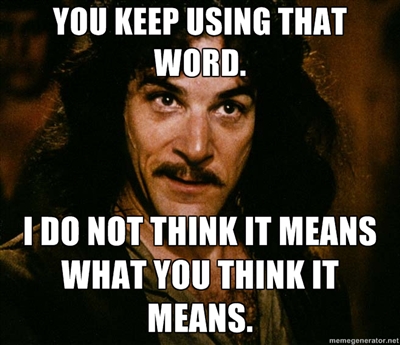 Source: #Christianity, you keep saying that word, I don’t think it means what you think it means
#Christianity means (#syria #kimdavis #lbqt #justice #blacklivesmatter #starvation)
Practical Christianity (otherwise known as theology):
I don’t want us to “all get along”
I want people to thrive
I want people to ask hard questions
I want people to respect each other
I want people to stand up for each others’ rights
Christianity is that hard and that easy
#pifs #mifs #Pnc how #PCUSA calls pastors
PCUSA call process resource
With Fall comes a new influx of search committees (in the PCUSA) ready to find a new pastor after their summer.
The search process for Presbyterian Church is based on building a mutual relationship seeded and fostered by God’s Call. It takes a long time, a lot of work and much prayer and discernment for everyone involved (basically the opposite of a corporate job)
Today I came across 2 blogs addressing this, so I will list them along with my own here as a resource
Tips for the Pastor
http://revontheedge.com/2015/08/28/one-year-later-the-search-process-revealed-fbf/
Tips for the Pastor Nominating Committee
Lord Lead Us Not into Temptation: Things to Avoid
Good, Better, Best Reflections on #expectations
Good Better Best: Some great thoughts on expectations here from two bloggers: parental and personal reflections included, Go!
http://miheekimkort.com/2015/09/01/deeper-story-great-and-no-so-great-expectations/
#empty #churches and the meaning of #community
Just thinking about this (again) today
What is the symbolic meaning of churches closing? Communities who never go, still find it sad….is it the loss of the open community that is the issue…you never went, but you could have, any time. Can we build this in other ways?
(This article is QUOTED below, follow the link for the original)
http://jimfriedrich.com/2015/07/30/owl-among-the-ruins-what-shall-we-do-with-empty-churches/
“Entering into a church is a metaphor for entering into a shared world of symbolic narratives and meanings, somewhat like entering into a story and discovering the richness and internal coherence of its structure. – Richard Kieckhefer[i]
A space’s or a building’s ‘sacredness’ is, with rare exception, neither a permanent nor an absolute black-or-white condition. The sacrality of even the most natural or ‘found’ sanctuary is vulnerable to defilement, and thus desacralization.[ii] – Lindsay Jones
Where once the spire of the cathedral or the steeple of the church gave the first glimpse of city or village, today it is the Sears and Hancock buildings.[iii] – Nicholas Wolterstorff
Fifty years ago on Thanksgiving Day, a group of friends shared a festive meal in a former Episcopal church in Great Barrington, Massachusetts. First constructed in 1829 as St. James Chapel, then enlarged and renamed as Trinity Church in 1866, the white wooden structure, with pointed Gothic windows, steeply pitched roof and tall attached tower displays the Platonic ideal of a New England church, the transcendent anchor of so many Northeastern towns. But its congregation had dwindled over the years. In 1964 it was deconsecrated and sold to Alice and Ray Brock, who put a bedroom in the tower and made it their home.
As Arlo Guthrie tells it in his song, “Alice’s Restaurant,” the new owners had “a lot of room downstairs where the pews used to be. Havin’ all that room, seein’ as how they took out all the pews, they decided that they didn’t have to take out their garbage for a long time.” So after dinner, Arlo and friends offered to take all that garbage to the dump in their VW bus. But when they found the dump closed for Thanksgiving, they improvised, emptying their load onto an unofficial garbage pile spotted on a side road. Guthrie was arrested for littering, an offense which would eventually make him “unfit” for the draft. Absurd but true, and Guthrie’s 18-minute song about it became a uniquely comic anthem of the antiwar movement. Many of us would sing its joyful chorus as we marched on the Pentagon in November, 1967.
I thought about Alice and Arlo and old Trinity Church when I read an article by Inga Saffron about the fate of struggling churches in Philadelphia: “In the rush to build houses, churches are being discarded.” Her subject was St. Laurentius, an historic Gothic Revival church built in 1882 with the nickels and dimes of Polish immigrants. A prominent symbol of the city’s Polish heritage, but no longer a viable parish, it was slated for demolition by the Roman Catholic Archdiocese. The property would be sold to housing developers.
It’s a familiar problem. When neighborhoods change or religious affiliation declines, church buildings often lose their sustainability. In addition, significant changes in liturgical understanding and practice make many inherited structures unsatisfactory venues for the renewal of worship. Since historical preservation is not the primary mission of Christianity, religious institutions cannot be expected to hold onto every property in perpetuity.
But the decision to abandon a church building is not without impact on the surrounding community. What happens when a church’s physical and symbolic presence is erased from the landscape? As Saffron writes, “Certainly, Philadelphia’s archdiocese is stuck with far more buildings than it can use. But it’s dispiriting that it has taken to treating their disposition as purely a business problem, compounding the community trauma brought on by the closings of so many churches and schools . . . {T]he city can’t be just houses. It needs the punctuation of civic monuments – churches, schools, libraries, and even old factories. Without those larger structures to break up the relentless grid, our blocks would be run-on sentences, without meaning.”[iv]
It’s hard to imagine a Europe without its cathedrals, England without its country parishes, or a New England village green without its white church. And many residents of Philadelphia’s Fishtown neighborhood have protested the potential disappearance of St. Laurentius. “Can you imagine Fishtown being Fishtown without it?” Saffron asks.
At a city hearing on St. Laurentius, architect Susan Feenan argued for the preservation of historic structures. “I have no delusions about this building being a Catholic church again,” she said, “but a neighborhood without old buildings is like a child without grandparents.”[v]
However, if a building is no longer functions as shelter for a living congregation, or is no longer suitable as an enlivening worship space, is there an alternative to demolition, so that it may continue at least as an aesthetic presence and a repository of historical and cultural memory, without draining the Christian resources needed for mission and service?
One solution has been repurposing – the conversion of churches to primarily secular uses. In the last decade, 52 Philadelphia churches have found a new life without religion. Some of these conversions retain a community function, such as art gallery, bookstore, school, brew pub or restaurant. Some become offices or private residences. There are many examples of converted churches on the web. Their creative adaptation of challenging interiors is impressive, and they are all alluring. Who would not want to spend time in these lovely spaces?
I confess to some uneasiness here. I feel a certain melancholy in deconsecration. A sense of loss. Loss of community, loss of shared symbols, loss of faith, loss of God. Generations of prayers and hymns have thinned to fading echoes. Spatial or visual symbols, detached from their roots like cut flowers, seems sadly bereft and disregarded. The meaning of the space has been disconnected from the intentions of its builders. One couple who has taken up residence in an old Serbian Orthodox church “couldn’t live with all the wall paintings,” and they covered most of them up. The starry ceiling, happily free of explicit religious narratives, did please them, so it survived.
I’m not saying the Church should hold on to specific buildings when their day is done, no matter how many beloved memories they contain. Death and resurrection is the pattern we live by. Death is not the opposite of resurrection, but its necessary component. Sometimes we just need to let go so that the new may happen.
But the continuing physical presence of religious buildings provides a vital sign of a reality beyond our human projects and mirrored desires. Their importance is not only aesthetic and emotional. It is also spiritual, imploring all who pass by: Don’t forget!
Even a repurposed church retains a memory, a trace of the faith that built it. And that trace puts a question mark to the depthless horizontality of materialist culture. Can you dwell within or among such places without pausing to wonder?
Of all the options for church conversion, the residential privatization of sacred communal spaces seems the most troubling. Places once devoted to public welcome and communal prayer seem substantially trivialized when their function is reduced to the personal pleasure of the lucky few. But make old churches into places of public conviviality and conversation, of art and music, teaching and learning, or feeding and sheltering the poor, and Jesus will be there as surely as he was in the midst of the old worship community.
And whatever happened to the former church of “Alice’s Restaurant”? After being a private residence under several owners, it was bought by Arlo Guthrie in 1991, who turned it into the Guthrie Center at the Old Trinity Church. Reconsecrated as a home for all religions by his guru, Ma Jaya Sati Bhagavati, it provides social assistance, communal hospitality, educational events, concerts and lectures, and interfaith services. Sometimes a building just knows what it wants to be.
[i] Richard Kieckhefer, Theology in Stone: Church Architecture from Byzantium to Berkeley (Oxford: Oxford University Press, 2004), 135
[ii] Lindsay Jones, The Hermeneutics of Sacred Architecture: Experience, Integration, Comparison – Vol. Two, Hermeneutical Calisthentics: A Morphology of Ritual-Architectural Priorities (Cambridge, MA: Harvard University Press, 2000), 291
[iii] Nicholas Wolterstorff, Art in Action p. 23, quoted in T.J. Gorringe, A Theology of the Built Environment: Justice, Empowerment, Redemption (Cambridge: Cambridge University Press, 2002), 199
[iv] Inga Saffron, “In the rush to build houses, churches are being discarded”: http://articles.philly.com/2015-06-06/entertainment/63090297_1_historic-register-fishtown-based-st
[v] http://articles.philly.com/2015-07-11/news/64310933_1_fishtown-preservation-law-church-architect“
Prayer for Special Needs Parents
Prayer for Kindergarten

Inspired by Prayer for Special Needs Moms
I wrote my own to be a little more inclusive and reflect what I feel more…
Please, oh please let this be a good year for my child.
Please let our teachers’ classroom be structured, but not rigidly so.
Please let all the teachers have patience and humor, but be firm enough to set boundaries.
That we communicate clearly when things go wrong and when things go right!
Help me to hear when my child tells me what is going on, to listen when others offer opinions and options and to remember that no decision is final and that we are all learning who my child is and what that means together.
That the best of my child that I get to see all the time is witnessed by other students, peers and friends.
Heavenly God you welcome the least of these, let…
View original post 46 more words
Episode 9: Food Tripping and Vocation
Podcast with Mihee Kim-Kort on This Everyday Holy towards my sermon on Sunday–with the help of some joyful noises


My guest this week was the Rev. Katy Stenta and we talked about John 6 and a little bit of Ephesians 6. We talked about everything from eating food too loud to understanding the need for fulfillment and satisfaction to Korean culture to vocation. And the kids are really present throughout this episode – mine and the snippets from Katy’s home life. Mine are really obnoxious – sorry – and I think that Anna is drinking her sippy cup insanely loud. It sounds weird.
Links to some of the content on this blog:
Take This Bread: A Radical Conversion
Let Your Life Speak: Listening for the Voice of Vocation

Katy’s blog: Katy and the Word

Yay! People
Thanks for following me! As I prep for vacation I notice that my followers have slowly risen to over 500, I hope to continue my #failedsermontitles series which are thoughts towards my sermon for the week, upon my return. And perhaps even review some of the books I read over vacation 😉

