O come, O Branch of Jesse’s stem,
unto your own and rescue them!
From depths of hell your people save,
and give them victory o’er the grave.
Rejoice! Rejoice! Immanuel
shall come to you, O Israel)
Fear not, for one shall conceive and bear son, and they shall name him Emmanuel, God with us.
God so loved the world he sent his only begotten son, Jesus, who came not to condemn the world, but to save us, Jesus will save his people from his sins.
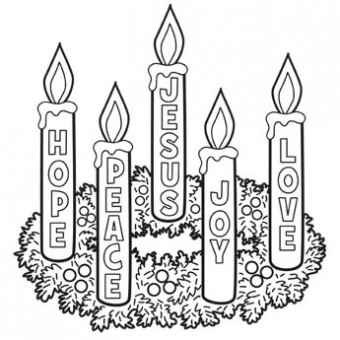
Christmas Candle
How long shall I cry for help?
Christ is on the way. O Come Emmanuel
Can Christ be here?
(Optional Hymns: Taize Christe Luxe Mundi or O Come O Come Emmanuel or God Rest Ye Merry Gentlemen
O come, O come, Immanuel,
and ransom captive Israel
that mourns in lonely exile here
until the Son of God appear.
Rejoice! Rejoice! Immanuel
shall come to you, O Israel)
Go, and know this will be a sign to you, for you will find a child lying in a manger.
And we will know good news of great joy for all people, for unto us is born to us is the Messiah, the Immanuel, the Wonderful Counselor, the Strength of God, The Eternal Protector, the Champion of Peace.
(Translation of Text from Illustrated Children’s Ministry)
Look at the nations, be astonished and see!
A work is being woven That you’d not believe
The Son of Salvation is promised to come
And stay with us present, and lead us all home
(Isaiah 42:1-9)
God send us your servant, in whom you delight
Let justice be woven An’ covenants of light
God who stretched heavens & birthed us with love Give light to the nations being taught from above.
(Psalm 139 and Matthew 1:21-22)
Come God and be with us, through babe ‘mmanuel
Let your child be woven a child in the womb, Hold fast with your left hand and lead with your right So we can know your Son and name him aright
Optional Additional Text: Hebrews 11 https://www.workingpreacher.org/preaching.aspx?commentary_id=3837 http://www.aplainaccount.org/copy-of-proper-26c-gospel-1/
with particular attention to the historical setting of Habakkuk 2: https://www.patheos.com/progressive-christian/righteous-faithfulness-john-holbert-10-28-2013.aspx?p=2
the current time and the appointed time: http://www.workingpreacher.org/preaching.aspx?commentary_id=1875
having faith for survival in this life v. Paul’s “have faith” for life eternal’http://homebynow.blogspot.com/2013/10/contemporary-and-awful-and-faithful.html
Further commentary on Habakkuk 1-2, some of which also include mention of chapter 3 http://www.textweek.com/prophets/hab1_2.htm
Themes include
Resisting/protesting/lamenting oppression
Waiting on/believing in God
God promising (eventual) victory
2:3-it will not delay=אָחַר ʼâchar, aw-khar’; a primitive root; to loiter (i.e. be behind); by implication to procrastinate:—continue, defer, delay, hinder, be late (slack), stay (there), tarry (longer).
As my psychologist husband says, “Waiting is hard, but It’s part of growing up”—maybe for the church as well as for individuals! Two part statement: waiting is hard, and that waiting matures us (despite the immediacy encouraged by commercialism, esp in the context of Christmas…)
These readings also remind me of the story of a child telling his mother he was late home because his friend’s dog died. When his mother asked what he did, he said he sat with his friend to cry with him. So often we are either impatient with others when they are dealing with the tough stuff of life or we hear their pain too loudly and respond by wanting them to just stop crying instead of helping them cry/pray/protest/lament.
Materials below are related to the need to lament.
My worship prof at Emory, Don Saliers, was deeply committed to the need to lament as well as praise. See https://www.youtube.com/watch?v=zApUM3cry9o Don E. Saliers as the 2018 Rodney and Lorna Sawatsky Visiting Scholar. Don offered a public lecture titled, “Psalms in a Difficult Time: the Rhythms of Doxology and Lament,” on Thursday, February 15, 2018. http://www.praytellblog.com/index.php/2018/01/15/amen-corner-psalms-in-a-time-of-violence/ From the journal Worship, also Don Saliers, about denying lament
Abstract
Where are worshipers in Christian communities to go with their experiences and observations of violence, injustice, and other forms of suffering? Historically, a central source of realistic faith-based responses to tragedy has been the Psalter, broadly defined as a set of biblical psalms arranged by date to be individually and collectively read, sung, and prayed. Recent scholarship on psalms has focused on lament and complaint, and questions regarding the presence of trauma and violence in religious traditions have shown such psalms to be particularly relevant to contemporary culture.
This article (also by Saliers) examines three “psalms of lament,” Psalms 13, 42/43, and 88, discussing their implications for communal acts of worship, the development of critical theological skills in worshipers, and neglected dimensions of liturgical theological work. It argues that psalms of lament and protest, used liturgically, can enhance a congregation’s practices of truth telling, integrating life events with expressions of faith, and situating individual and communal experiences of suffering within the context of church history. Issues affecting the “performance practice” of liturgical psalms are also addressed, such as problematic content in imprecatory psalms (i.e., Psalm 137), discrepancies in the musical settings of lament and praise psalms, and styles of prayer and scripture engagement with or without the influence of lament psalms.
Another set of Lament materials is the online Material for lament from Lyrics of Lament: From Tragedy to Transformation by Nancy C. Lee, Ph.D. at http://store.fortresspress.com/media/downloads/9780800663018WebLinksLyricsofLamentnew.pdf
It includes Lamentation poetry https://www.poetryinternationalweb.net/pi/site/search/index
And recent contexts of lament: http://observers.france24.com/content/20110606-graffiti-artists-show-support-tunisian-revolution article: Graffiti artists in the Tunisian revolution
It gives website links for performances and texts of lament poems, songs and related information (most works referenced in Lyrics of Lament, according to chapters): Book Introduction; Chapter 1 From Dust to Dust—Common Ground: Suffering Is Universal; Chapter 2 Features of “Traditional” Lament across Cultures; Chapter 3 The Grounding of Lament in the Hebrew Bible; Chapter 4 Lament as Prayerful Plea in the Abrahamic Sacred Texts; Chapter 5 Lament, the Prophetic Vision, and Social Justice; Chapter 6 Laments of the People; Chapter 7 Developing Constructive Lament: Mourning and Nonviolent Justice; and Chapter 8 From Tragedy to Transformation.
The book itself can be previewed at https://books.google.com/books?id=9SKQLKbDbZIC&printsec=frontcover&dq=lyrics+of+lament&hl=en&sa=X&ved=0ahUKEwij8LT-jfHeAhWIjFkKHfFlDK4Q6AEIKjAA#v=onepage&q=lyrics%20of%20lament&f=false
Psalms of Lament original psalms by Ann Weems is also available to preview at https://books.google.com/books?id=9qB1BwAAQBAJ&printsec=frontcover&dq=psalms+of+lament&hl=en&sa=X&ved=0ahUKEwiM39erivHeAhWLwFkKHb2IDrwQ6AEIKjAA#v=onepage&q=psalms%20of%20lament&f=false
Suggested related readings:
Psalm 119:137-144 provides an immediate response. The readings and gather will slowly grow until the story of Zacchaeus from Luke 19:1-10. The Habakkuk reading prepares the congregation to hear, “The Son of man came to seek and to save what was lost” – itself a wonderful introduction to the Invitation to the Great Thanksgiving, the Holy Eucharist.
The key words here (one word in Hebrew, moed) are “appointed time.” This word in Hebrew is used to designate festival times in Israel’s worship (Leviticus 23:2), a time of birth (Genesis 17:21; 18:14; 21:2), seasonal migration (Jeremiah 8:7), and, yes, the end time (Daniel 8:19).
2 Thessalonians 1:1-4,11-12 “Trouble and anguish” also pervade 2 Thessalonians, but here it is the “persecutions and afflictions” that thefaithful suffer through while waiting for the imminent return of Jesus. But here, the suffering has a direct purpose: “to make you worthy of the kingdom of God, for which you are also suffering.”
The first section “how long, O Lord” stands in a tradition of other complaint passages in the Hebrew Scriptures. Here are some examples:
Pss. 13:1-2
1 How long, O Lord? Will you forget me forever?
How long will you hide your face from me?
2 How long must I bear pain in my soul,
and have sorrow in my heart all day long?
How long shall my enemy be exalted over me?
Psalm 62:3
3 How long will you assail a person,
will you batter your victim, all of you,
as you would a leaning wall, a tottering fence?
Job 19:2
2 “How long will you torment me,
and break me in pieces with words?
Communal psalms of lament may also be helpful in finding hymns; try these in your hymnal index:
Psalm 44
Psalm 60
Psalm 74
Psalm 79
Psalm 80
Psalm 85
Psalm 90
Saliers’ work (cited above) adds Psalm 13, 88 and 137; Psalm 18 talks about hinds’ feet in high places.
While the lectionary adds in verses from Chapter 2 about beating swords into ploughshares, I find myself wondering if this provides too ready a solution to the situation, moving from a threat to morale and from the military to a time when might will not dictate right, but without necessarily addressing the time now/between now and then.
I have to admit to not being too fond of taking chapters out of order in this way, either.
In chapters 36 and 37, the king of Assyria, rather than defeating Israel in battle, seeks to conquer them by making them disbelieve God’s power and support. Take away the people’s hope/vision and it won’t matter what you do to them after that.
Why does the Assyrian king talk instead of fighting, especially when he apparently has the military advantage? Maybe he figures he can defeat the Israelites for all time at less cost if they give up hope. Without hopes/dreams, we are lost.
While in the lectionary the text is paired with Matthew 5:14 about being the light of the world/city on a hill, I find myself thinking of other passages.
In John, Jesus praises those who believe without seeing. In a sense, the king of Assyria is contrasting his own visible, physical rule with that of the (unseen) god of Hezekiah that must be believed without being as visible. https://www.biblegateway.com/passage/?search=john+20%3A26-29&version=NRSV
Below are angles on the king of Assyria’s attempt to kill the Israelites’ hope
Collect/invocation:
O God of Israel, Hezekiah, and Isaiah,
who sustained the hope of your people Israel,
threatened by Assyria’s words and weapons
embolden us to face all threats to our faith and hope,
that we can serve and praise you with our whole selves for our whole lives.
Amen.
Confession of Sin (the refrain is from Isaiah 37: 31, Isaiah’s prophecy to Hezekiah)
O God, you shatter the powers of this world.
You conquer all that separates us from you and from one another.
Yet we remain captive to doubt and fear.
When the problems of the world and our own problems overwhelm us, forgive us.
As your faithful remnant, root us below that we may bear fruit above.
When we look at our challenges as though we must meet them ourselves, forgive us.
As your faithful remnant, root us below that we may bear fruit above.
When our lack of seeing threatens to result in a lack of believing, forgive us.
As your faithful remnant, root us below that we may bear fruit above.
When hopelessness is contagious and cynicism reigns, forgive us.
As your faithful remnant, root us below that we may bear fruit above.
When we give in to meeting hate with hate, forgetting to listen, forgive us.
As your faithful remnant, root us below that we may bear fruit above.
When our lack of seeing threatens our believing, forgive us.
As your faithful remnant, root us below that we may bear fruit above.
God promises that we will sow and reap;
taking root below and bearing fruit above.
Out of Jerusalem will come a remnant,
and out of Zion a band of survivors.
The zeal of the Lord will accomplish this.
Thanks be to God!
Prayers of the People
The leader part could also be prayer concerns/petitions/prayers of the people, with the refrain as a call to action: As your faithful remnant, root us below that we may bear fruit above.
This might open with the closing from above:
God promises that we will sow and reap;
taking root below and bearing fruit above.
Out of Jerusalem will come a remnant,
and out of Zion a band of survivors.
The zeal of the Lord will accomplish this.
Thanks be to God!
For newly elected leaders, that they may serve the people and thus serve you, we pray and take action. As your faithful remnant, root us below that we may bear fruit above.
For victims of wildfires, hurricanes and other disasters, we pray and take action.
As your faithful remnant, root us below that we may bear fruit above. Etc.
(Closing) God, make us part of your zeal, praying and working as members of your kingdom, the faithful remnant.
Prayer of Great Thanksgiving (Note that aspects of this prayer may also be used when the Lord’s Supper is not celebrated)
The Lord be with you.
And also with you.
Lift up your hearts.
We lift them to the Lord.
Let us give thanks to the Lord our God.
It is right to give our thanks and praise.
God make us truly thankful to you.
For all that you have made, for the world and the people in it, we give thanks.
For the witness of your people and your prophets, we give thanks.
For your providence and your promises, we give thanks.
For sowing and reaping; for harvest and feasts, we give thanks.
For the planting of vineyards and the reaping of their fruit, we give thanks.
For your presence as Creator, Redeemer, and Spirit, we give thanks.
For the sustaining gift of this Supper, we give thanks.
As Hezekiah came to Isaiah
when external and internal threats seek overwhelm,
when forces that destroy hope are gaining power,
when those who do not believe in you belittle you—and us,
we come to you.
In this meal, we come to you,
to partake what you offer:
your constant presence and power,
your everlasting hope,
nourishment and strength for the journey of faith.
Send your Spirit upon these gifts of bread and cup,
that they may be for us the body of your Son, Christ Jesus,
so that we may be the body of your Son in the world.
Hymns relating to various themes of the passage
From Glory to God: Presbyterian Hymnal
#53: O God, Who Gives Us Life
#168: Within Your Shelter, Loving God (Psalm 91)
#177: I Will Come to You, You are Mine
#339: Lift Every Voice and Sing
#356: Praise to God, Whose Mighty Acts
#357: The Days Are Surely Coming
#373: O Day of Peace (swords into plowshares)
#463: How Firm a Foundation
#706: Commit Your Way to God the Lord (Psalm 37)
#758 Why Do Nations Rage Together (Psalm 2; swords into plowshares)
#776 O God, Be Gracious (Psalm 4)
#781 Hear My Cry, O God, and Save Me! (Psalm 77)
#782 Hear My Prayer, O God (Psalm 43)
#790 In Silence My Soul Thirsts (Psalm 62)
#812 O Save Me, God, and Hear My Cry (Psalm 54)
#817 We Walk by Faith and Not By Sight (John 20)
#818 By Gracious Powers
#831 I Depend upon Your Faithfulness
#841 God Is My Strong Salvation (Psalm 27)
#842 The Lord is My Light (Psalm 27)
#843 My Soul Is at Rest (Psalm 62)
Note that if you have access to ATLA, you should try articles there, which are peer-reviewed.
Other open access materials are mainly of the conservative persuasion.
This commentary notes the text of Isaiah 36-37 is nearly identical to that of 2 Kings 18-19 and that the events are also provided in a more summary fashion in 2 Chronicles 32:1-19.
For a side-by-side comparison of the three from the KJV with summary and commentary
Collect/Call to Worship
O Lord, you continually cast out our fear,
calling us to trust in you rather than we can see—and cannot see—
in the world around us.
Visit us this day with your courage and strength,
that we may know that our hope is in you alone,
and share that hope with one another and the world.
In the new creation of the Father,
the victorious action of the Son,
and the ongoing action of the Spirit,
hear our prayer. Amen.
Note that if you have access to ATLA, you should try articles there, which are peer-reviewed.
It is election time in the United States, and I have been thinking about this text–Mark 12:38-44 all week, before even I was conscious that it was the lectionary.
I will start by admitting that I didn’t remember that those in political & religious power are devouring widows. I remembered thew widow giving her all, but I didn’t remember that it was in such sharp contrast to those in power.
My gaff makes sense, however, because too often we forget that Christianity is not about power. Or rather, that Jesus Christ is all about empowering those who have none. Thus being in power and being Christian is tricky at best.
As a Presbyterian in the United States this is a hard pill for my particular denomination to swallow. We used to be the power brokers in the US, we are the Catholics in Rome, we have our Reverend Witherspoons and our Aaron Burrs.
I think about this often because, in my context, my denomination has the least amount of money it has ever had. And its panicking all levels from the local church to the national governance. We are spending down our reserves as less and less money is coming in and membership is “declining.”
I think Jesus Christ is telling this story not only to point out the differences in power, and to remind us who it is we should be standing by. But I also firmly believe that Jesus tells this story because its true. Those who are the closest to being poor given the most to those in need. Those who are in the most precarious place, tend to practice their faith closer to the church and in a quieter manner than those with money and power and prestige.
And I’m convinced that those who have experienced poverty give the most because they understand what it means to have nothing, and that they, we, appreciate what they have more. I say we because I have experienced the grief of poverty and debt, and as I rise in prestige, power and money I hope that I never forget what its like to pick which bill you aren’t going to pay this month, to scrape together all the change in the house to send your child the money for a school activity, to carefully put all the baby food and milk back in the fridge to be used later.
But our God is a God of abundance, as is evident of 1 Kings 17:8-16. I have seen God make something out of nothing multiple times. I have had it so that the thing that was going to break my bank was miraculously paid for by someone else. I have received timely gifts of items we have desperately needed, that the person didn’t know we needed, but somehow the winter coat came just after the zipper from the old one broke, that a free day of play at a kids entertainment center appeared right when we couldn’t afford to do anything but the kids desperately needed to get out. I’ve seen politics and power at its worse and but I have also seen how Medicaid and Therapy Care provided by the state of New York has saved our sanity and provided the structure our son with autism, and really our entire family desperately needed. And though the structure that comes through is the government, I cannot help but believe that these gifts came through my trust in God. Because the reason are in New York in the first place, in an epicenter for autistic care, is because I came here to serve a church. We thought we were just coming here to serve God, but of course, God called us here to help us.
I give to God not because God needs my money and my goods, but because God can increase them tenfold. I give to God because God can do way more with my stuff and talents than I could ever imagine.
Both widows have little
Both widows give
Both widows experience miracles.
Psalm 146 puts it well, I do not trust in the power and principalities of the world–as Nadia Bolz-Weber notes they are but footnotes in the story of Jesus, because God is the true power. So when I pray, when I trust, it’s God.
Because I want my God to be the one who executes justice. That’s who I want to worship and that’s who I want my God to be. I want a God who wants me to feed the hungry and set prisoners free, the one who opens the eyes of the blind and lifts up the burdened.
I want the God who teaches be me love the righteous, watch over the strangers/immigrants, and to uphold the orphan and the widow.
I want to know this God, and in knowing this God I want to be able to do this work.
Because I want to love God with all my heart
all my soul
and all my mites.
Thanks be to God
Katy Stenta is a solo pastor at a tiny church that is bigger on the inside in Albany, NY for over eight years and blogs at katyandtheword@wordpress.com When she is not dreaming up projects and ideas, some of which creep into the church, she plays with her three boys-boys or goes and visits her husband at the library, while he works, to read.
RevGalBlogPals encourages you to share our blog posts via email or social media. We do not grant permission to cut-and-paste prayers and articles without a link back. For permission to use material in paper publications, please email revgalblogpals at gmail dot com.
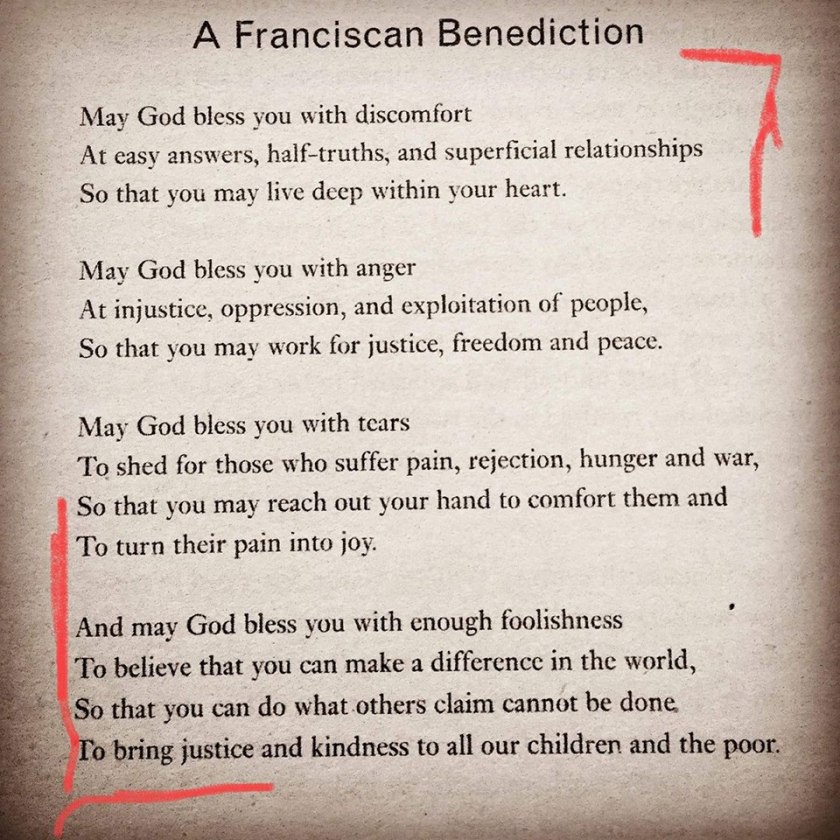
Meditative Thought: Does infinity look like justice, mercy and kindness?
Call to worship:
Let me hear what God the Lord will speak
For he will speak peace to his people
Surely his salvation is at hand for all God’s people, the Lord will give what is good, and our land will yield its increase.
Let us worship the God of Righteousness.
How shall we approach the Lord, with great sacrifice?
The Lord has told you what is good
What does the Lord require?
Do justice, love kindness and walk humbly with God
Prayer of Confession:Lord we admit that we have trouble with the words justice, mercy and kindness. We confess that it would be easier to just give over some goods or money than to do things. Guide us on the path of righteousness, show us justice, mercy and kindness so that we can do that same, we pray. Amen.
Assurance of Forgiveness: Fear Not, God promises that Steadfast love and faithfulness will meet; righteousness and peace will kiss. So we know the truth: In Jesus Christ we are forgiven.
Eucharist Prayer: Lord we give thanks that you have given us many ways to experience your love. And when you sent your only son to die on the cross, we were able to witness your mercy. Whenever we taste your bread and cup we can experience your kindness and abundance. When we gather into communion with one another and you we can practice your justice. Creator of all good things, add your spirit to this meal, make it a meal of righteous and holiness, so that we might be nourished to continue your kingdom work today and everyday we pray.
Prayer of Dedication/Closing Prayer: God, you are love, you are mercy, you are justice. Send us into the world with hope for all these things. In Christ’s name we pray. Amen
When I worked at the psych hospital and asked the patients (for their spiritual assessment) if they had hope, some would say, no but I’m hoping for it–hoping for hope.
Hymns:
Live into Hope
I’ve Got Peace Like a River
Lift Every Voice and Sing
Amazing Grace
Sunday School Ideas: Footprints to follow & talk about walking humbly, trace shadows and talk about being made in God’s image, Take pictures of everyone and fill them in as the body of Christ to do God’s work





 katyandtheword