Re-reading Harry Potter


In Chapter 24 of Harry Potter and the Deathly Hallows, when Harry makes his cataclysmic decision to go after the horcruxes, he begins to sound like Dumbledore.


He speaks simply, directly and with authority


He thanks people, retains information, and still acts in empathy and sympathy with Griphook and Ollivander.


He becomes quite …dare I say… pastoral in his demeanor….

Interesting….


“Conversion doesn’t hap…

“Conversion doesn’t happen by forcing people to believe things the same way you do. I figure if Jesus meets us wherever we are (whether it be at a well, in the tree or on a cross), then we should do the same. Do you know what happens when you force someone to run when they can’t keep up? They fall. You don’t want to cause someone to fall by forcing them into a belief they don’t have. If someone has doubts or is an aetheist/agnostic you have to meet them there and let them reach the next step through loving them wherever they are. That’s what Jesus did.”–Pastor Katy Stenta

 A good ministry moment today. 

“Conversion doesn’t happen by forcing people to believe things the same way you do. I figure if Jesus meets us wherever we are (whether it be at a well, in the tree or on a cross), then we should do the same. Do you know what happens when you force someone to run when they can’t keep up? They fall. You don’t want to cause someone to fall by forcing them into a belief they don’t have. If someone has doubts or is an aetheist/agnostic you have to meet them there and let them reach the next step through loving them wherever they are. That’s what Jesus did.”–Pastor Katy Stenta

 A good ministry moment today. 

Soul Beauty

Embracing God and self identity, that’s what is about folks!

suchkindways's avatarthe beautiful changes...

In a world where too much ugliness happens every day–much of it on the internet for millions of eyes to see–let’s take a moment and celebrate how one young woman has transformed a moment of ugliness into one of beauty.

It all started when this photo, taken without the subject’s knowledge, was posted on a website that invited mocking and cruel comments.

Then this happened:

“Hey, guys. This is Balpreet Kaur, the girl from the picture. I actually didn’t know about this until one of my friends told on facebook. If the OP wanted a picture, they could have just asked and I could have smiled 🙂 However, I’m not embarrased or even humiliated by the attention [negative and positve] that this picture is getting because, it’s who I am. Yes, I’m a baptized Sikh woman with facial hair. Yes, I realize that my gender is often confused and I…

View original post 394 more words

Peter Pan and the Economy

“We will never grow up” Sometimes I think that this is the theme song for my generation. Playing the day away–putting off being settled, trying to find a foothold on which to grasp. Here we are living at home, putting off marriage and  renting. .Image

“Today, some 29 percent of 25- to 34-year olds either never moved out of their parents’ home or say they returned home in recent years because of the economy, according to the Pew report. Among 18- to 24-year olds, that figure is even higher – 53 percent of young adults in that age group live at home”. That’s right half of the youngest adults have to live at home.

(for more read http://www.csmonitor.com/USA/Society/2012/0315/Three-in-10-young-adults-live-with-parents-highest-level-since-1950s)

Image

Personally, I know this to be true. My siblings and I have all been supported by my parents since college. Every person I know has had to live off/with their parents Luckily my family had my grandmother’s house so I was one of the few of my friends who didn’t have to move back in with the family after grad school–that’s right grad school with two kids and two cats in tow.

The Young Adult age keeps getting longer and longer. Young Adults are those who have the responsibilities of an adult but don’t yet feel settled (thanks Kenda Dean for that definition).  Young Adults used to be the generation that belongs in the YA section of the library–you know those between the ages of 15 and 18 or maybe even 20. Today “young” adults are all those under age 35.

Image

Because of the economy, us Boomerangs, or Millenials have put off marriage, housing and Children. “Nearly half say that in recent years they’ve taken a job they didn’t really want, to pay the bills. More than a third have gone back to school because of the poor economy. About a third have postponed either their plans to get married or have a child, and one in four say they have moved back in with their parents after living independently. And fewer than half of young people who are now employed say they have the education and training necessary to get ahead in their jobs”.

Maybe it isn’t “We won’t grow up” but we can’t grow up. Personnally I know that we will not be owning a house for a long time, the used bookstore we want to open has to wait, and we are lucky that we were able to have kids so soon.

So what does religion have to do with us? Can religion help those struggling with debt and self-worth as is described in http://articles.latimes.com/2012/feb/09/local/la-me-young-recession-20120209

Here a summary of the current situation. Most people consider themselves “Spiritual” but “not religious” “Katie Douglass a Phd student at Princeton, researched young adults “While they typical attendance/praying/Bible study questions continue to be dismal when it comes to young adult responses – when asked Have you become more or less religious in the last year? – and Are you interested in growing in your faith? -produces emphatic yeses.”

for the hr long interview about young spirituality see http://churchnext.tv/2012/09/12/katherine-douglass-young-adults-are-more-spiritually-aware-than-you-think/

So young people are looking for meaning, they are looking for purpose, but the connection has not been happening. Apparently most young people find anything relevant to them in the sermon. There is nothing. According to research done by Stephen Cady, young people do not find anything spiritual or connectional about a sermon (http://churchnext.tv/2012/08/20/stephen-cady-why-100-of-young-people-dread-the-sermon/)

If young people who are in high school find little meaning in worship, I expect the same is true of this generation of boomerang/millenial/Peter Pans. Plus, if we are feeling rootless and unfulfilled a rooted congregation might feel overwhelming, or apathetic about a generation that can’t be around for the long haul, can’t attend church every Sunday, and can’t commit the way other generations might have.

Here is a generation that was told “work hard and go to school and you will succeed” and here we are: Not Succeeding. Understanding that this must be somehow our fault. How might faith and Christ address this? How might the love of God and the purpose of our lives to build relationships and communities based on that love give purpose to these people’s lives. If Jesus met a college student, what would he have to say to them????

Would he had said “Peter Pan why won’t you grow up and get your butt to church, so that you can understand God (the way we do)”

or Would he have met him where he was “Peter Pan, Can I play with you?”

PS remember the Harry Potter/Fantasy generation is graduating next, what is their fascination with fantasy about? how does that fit into spirituality? How does that work in this economy? *”For young adults, bad times don’t trump optimism. Among those ages 18 to 34, nearly nine-in-ten (88%) say they either have or earn enough money now or expect they will in the future” see for full survey http://www.pewsocialtrends.org/2012/02/09/young-underemployed-and-optimistic/

(Just some light philosophical questions 🙂

Children in Worship: It’s More than Having Coloring Sheets

We say we want young people at church, but how do we make worship accessible for young families (that means the adults and the children) Here is one way

Theresa Cho's avatarStill Waters

In the first issue of PLGRM, Rev. LeAnn Watkins, rector at St. Mary’s Episcopal Church in St. Paul, MN, shares how after numerous attempts of increasing attendance of bible studies and other church-related programs, her staff decided to cancel it all – everything during the weekdays except seasonal services. You can hear her tell her story on the Episcopal Story Project. She says, “You can’t chase after folks and expect them to hear you. You have to be in front of them when they are coming toward you. So we’ve tried to ask the question, ‘How do we stop chasing people, and get in front of people?'” I have to say that I ask myself the same question.

Not unlike many churches, I can no longer assume that those sitting in the pews are familiar with Bible stories such as Noah and the Ark, Jonah and the Whale…

View original post 841 more words

Katy’s Rant Against Associate Pastors, and a proposed solution


II think Associate Pastors are totally stupid for the following reasons 1. Didn’t Protestants break away from Catholicism to avoid a hierarchical governance of the church, yet here we are reinstituting it.

2. Most associates are women and most head pastors are men

3. Associate Pastors have to work for too many bosses. Regular pastors already have two (sort of) between the congregation and God. The associate has the congregation, God and the Head Pastor

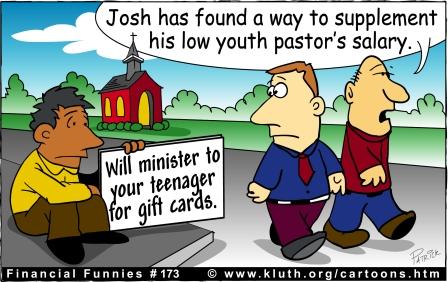
4. Finally, the most important reason why I hate associateships is that the ministries that are put under this heading “Pastoral Care” (translation: sick and old people), “Youth” (translation: those who we don’t get) and occaisionally “Mission (translation: those outsiders who need our help) are deemed LESS important than the “real” church (which apparently is made up of insiders who aren’t sick, over the age of twenty well off enough to not need help and not so old to be considered frail.

This

a. severely limits the church. We are essentially giving the more powerful pastor to those in power in the church. Basically rewarding those who we think can pull their own weight which is a broken theology, because no one has everything they need to be perfect, and we are putting our human limitations on who we think can serve the church

b. Severely limits the ministry itself, causing more red-tape, committees, paperwork and channels to get this “specialized” ministry done.

c. Finally, it severely limits the gifted associate pastors, all of whom have an important call to work, and may have specialized gifts in ministry that should be recognized. (Plus there’s that whole male/female discrepancy, I avoided Christian Ed and Associates like the plague figuring if I started there I’d never move out)

Image

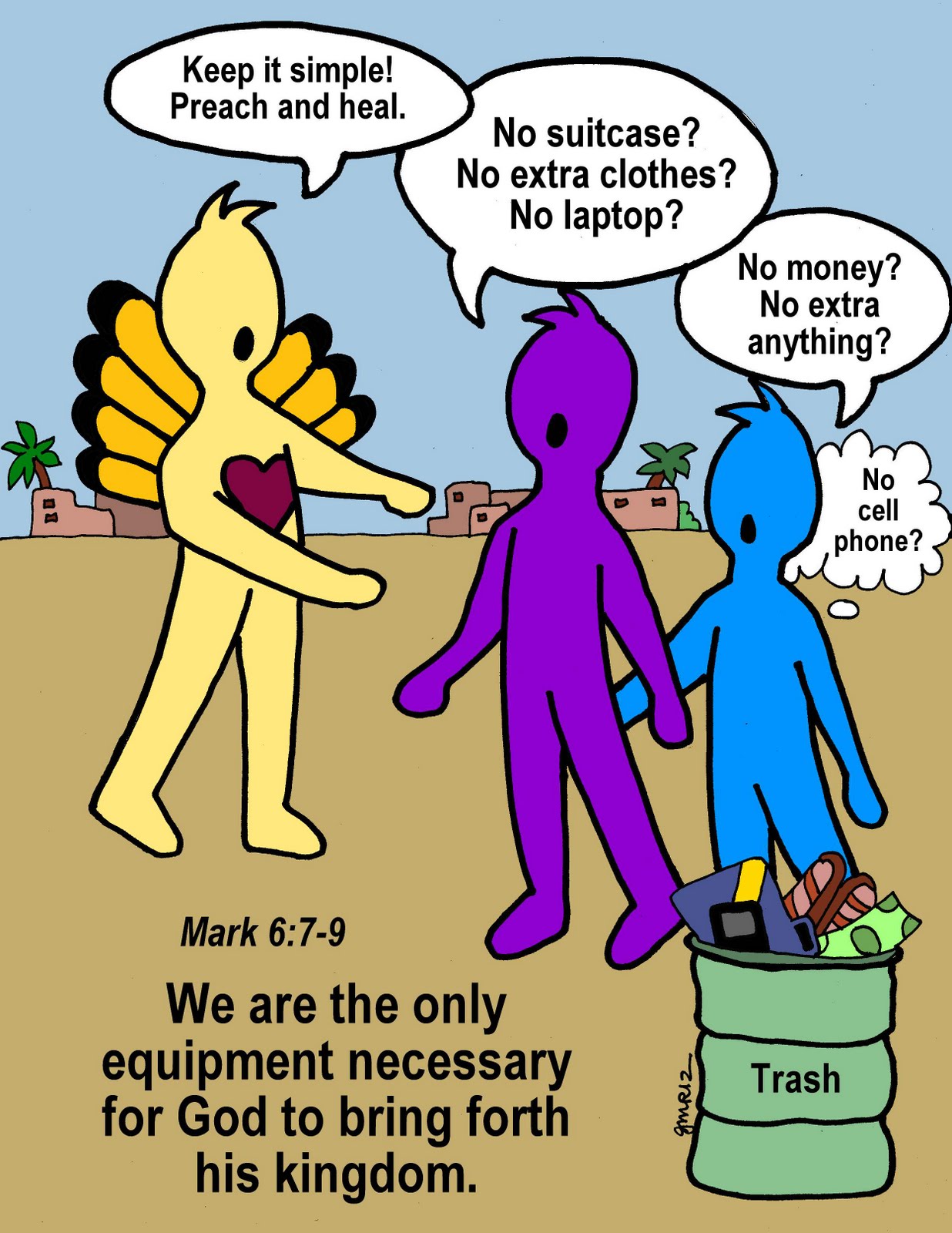
Finally, I am aware that most pastors are lonely and sad, and am aware that we have completely ignored the fact that Jesus sent everybody out in twos (Mark 6). What if we took this one step further and move more and more towards the copastorate being the regular form of ministry as opposed to the solo! This is especially true, since Christ says we don’t need anything but each other to do ministry!!!

Therefore, I propose we do away with all associate pastorships and move instead to co-pastorships. (This idea which I’ve been bouncing around forever dovetails well with Jack’s in  http://jackjenkins.wordpress.com/2012/04/30/hey-pcusa-i-have-an-idea/ to employ pastors. Could be the Holy Spirit is moving us one and one towards this new kind of employment).


Image

One co-pastor could be parttime and one could be fulltime or any combo thereof (how would two parttime pastors with full benefits work–wouldn’t that be AWESOME!!)

The way it tends to work is both pastors still get full vacation (particularly important if your a married couple). The pastors take turns moderating session, and probably a “pastor” would be available to answer pastoral needs (no guarentees which one, it would be worked out between the two pastors).

Down with Associateships! Up with Co-Pastorships

Laughing Opportunities

– Lesson 1: Laugh at Self

When I make silly mistakes (particularly good ones are calling people I know and love by the wrong name, am clumsy or keep doing the same thing over and over) I like to think of these mistakes as the funny hiccups of being human, rather than the great faults that weigh me down.

-Lesson 2 Laugh at Life

When things are ironic: Ironic situations are great because the opposite of what you would expect actually gets to happen. What is the opposite of expectations than a surprise (Jesus saving us all by dying might be the greatest irony ever)

-Lesson 3 Laughing at Other’s Briliance

When things are so true, that its funny–you know when someone states something so well that it illuminates the entire situation

-Lesson 4: Every single time you get to see, talk to or otherwise interact with Childrn

Children have a gift for laughter, appreciate it!

-Lesson 5: When scripture calls for it

–you know when the Disciples seemed drunk in Luke? Last week we read Ephesians 5 and Paul basically comes out and says whatever you wear on your feet better be comfortable because the Gospel needs “real” shoes….there are a million places where the Bible is funny, find them!

Read http://katyandtheword.wordpress.com/2012/07/15/lol-pastor/ to find out more about my theology of laughter

Young People and Church

Young People and Church

Take seriously youth Ministry?

Worried about why young people don’t go to church?

Teens want to know why does worship matter in their lives…

Teens want help understanding “What it means to be a person”


more reflections to follow

Young People and Church

Take seriously youth Ministry?

Worried about why young people don’t go to church?

Teens want to know why does worship matter in their lives…

Teens want help understanding “What it means to be a person”


more reflections to follow