
I still remember when the stock market was falling. I had just decided (luckily) to stay another year in school, and the market was doing horribly, and everyone was running around like chickens with their heads cut off saying “the sky is falling, the sky is falling” no wait…that’s chicken little.  They were actually saying “The market is falling, the market is falling” which of course just made the panic and therefore the downturn of the market worse…
2 things get me about this
1. If someone with authority had just said, Stop, calm down, let’s take the time to think about this–instead of throwing money at the situation as quickly as possible things might have gone better (and I am totally bipartisan in my blame here)
2. Money is not what we think it is…
Anyone remember when gas was under a dollar a gallon? When I was 10 (that would be 19yrs ago–yes you may do the math of how old I am 🙂 ) I remember gas sometimes being as cheap as $.89
And when I asked my congregation if they can remember one cent candy, most of them could (alas that was before my time)  The point being that a dollar is not really a dollar, and that money is just a symbol.
To us it means status (yes)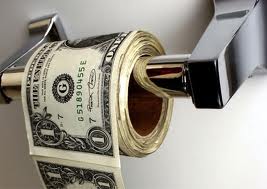 but its more than that, we trust the value of the dollar, to us it means security something we can depend on. But you know what? Money is not security. People like to think about money in the bank, or land ownership as guarentees. People like to talk about job security (is there such a thing). Heck, we even have a system of money that is named Social Security.
Do you know that our dollars aren’t backed by silver anymore? It used to be money was the symbol of the silver that backed it up in the treasury–now its backed up by nothing.
So what I have a question, what makes money an effective symbol? Probably its quantifiable and tangible nature. We have put a piece of paper out to symbolize commerce, and so we are able to better conceptualize it.
This is why tithing is so important, it isn’t just about giving money to the church–its about your relationship with God. If you give money to God regularly, then you are going think about God whenever you deal with money, hence changing the very way we deal with money in the day to day–it changes the symbol. (Maybe this is why research shows the only way money makes you happy is if you give it away see amazing TED Talk http://www.ted.com/talks/michael_norton_how_to_buy_happiness.html for more)
Now…what if God was our security? What if we depended not on pieces of paper but on God to bring us through. What if we, in essence bank of God.
How much God do you have on you?
Do you have enough to get you through the week?
Can you share some God with me today?
Need more God, better go back to the bank (Church) where theres enough God to go around..
As the church, are we “generating interest” in God? Are we growing our funds? Are we accruing more God through our actions?

Because after all, God doesn’t grow on trees…
PS Scripture Matthew 19, note 2 things 1. When the man is foolish, Jesus loves him first before he responds in ANY other way, Jesus loves him & 2. Jesus promises to increase everything a hundredfold–which is great because it clues us in to the fact that this love isn’t really quantifiable…hundredfold is a better interpretation than a hundred, because it isn’t exact, it is more a SYMBOL of what is going happen (besides who can handle a hundred spouses, speaking as a married woman who finds polygamy BIblical yet crazy, I couldn’t even handle two 😉
Anyway, the point being, Possessions are just symbols
17As he was setting out on a journey, a man ran up and knelt before him, and asked him, “Good Teacher, what must I do to inherit eternal life?” 18Jesus said to him, “Why do you call me good? No one is good but God alone. 19You know the commandments: ‘You shall not murder; You shall not commit adultery; You shall not steal; You shall not bear false witness; You shall not defraud; Honor your father and mother.’” 20He said to him, “Teacher, I have kept all these since my youth.” 21Jesus, looking at him, loved him and said, “You lack one thing; go, sell what you own, and give the money to the poor, and you will have treasure in heaven; then come, follow me.” 22When he heard this, he was shocked and went away grieving, for he had many possessions.
23Then Jesus looked around and said to his disciples, “How hard it will be for those who have wealth to enter the kingdom of God!” 24And the disciples were perplexed at these words. But Jesus said to them again, “Children, how hard it is to enter the kingdom of God! 25It is easier for a camel to go through the eye of a needle than for someone who is rich to enter the kingdom of God.” 26They were greatly astounded and said to one another, “Then who can be saved?” 27Jesus looked at them and said, “For mortals it is impossible, but not for God; for God all things are possible.”
28Peter began to say to him, “Look, we have left everything and followed you.” 29Jesus said, “Truly I tell you, there is no one who has left house or brothers or sisters or mother or father or children or fields, for my sake and for the sake of the good news, 30who will not receive a hundredfold now in this age—houses, brothers and sisters, mothers and children, and fields with persecutions—and in the age to come eternal life. 31But many who are first will be last, and the last will be first.”



 katyandtheword